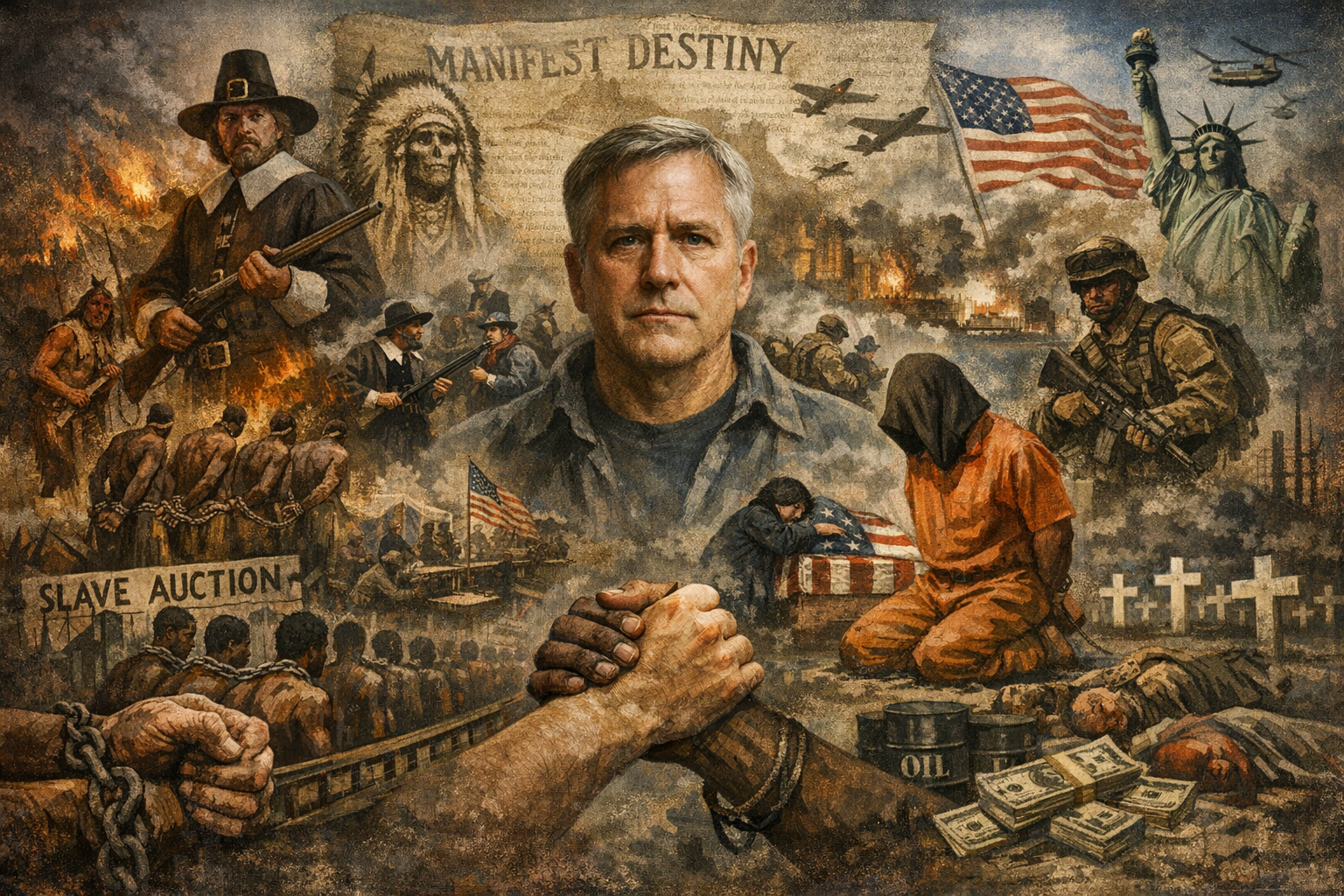
I often hear this comment from well-meaning US colleagues: “This is not who we are.” Perhaps it’s a manifestation of wishful thinking rooted in the mistaken belief that MAGA 2.0 is an aberration. My interior monologue always quickly responds, “This is exactly who we are.”
If you’d studied US history, the good, the bad, and the ugly, and are familiar with the impact of US foreign policy, US nationalism, and the fact the US has been at war for most of its history, you know this is true. As a white male of settler colonial heritage, my connection to this history is intensely personal. I know exactly what my ancestors from England, Scotland, and elsewhere did to their fellow human beings in the name of religion, profit, and ideology, including murder, torture, displacement, and slavery. I’m also well aware that I’m the beneficiary of these crimes against humanity, which forms the basis of allyship as one form of penance.
Dear Leader is a symptom and a catastrophic culmination of the latter two categories of US history. I sincerely hope this is a teachable moment for most US Americans. Tick-tock. Time waits for no one, not even “the peculiar, chosen people – the Israel of our time…,” as Herman Melville wrote in White-Jacket; or, the World in a Man-of-War, published in 1850 in London. (Melville is a paternal 7th cousin four times removed.)
For the past 20+ years, I’ve lived in a country that is intimately familiar with the concept of asymmetric warfare, having defeated two superpowers consecutively, France in 1954 and the US in 1975. Speaking of asymmetric warfare, a recent trip to Điện Biên Phủ reminded me that Vietnam and Iran could compare notes in spite of their markedly different historical and cultural contexts.
In June 2018, Bill Blum, who wrote Rogue State: A Guide to the World’s Only Superpower, among other books, gave a talk in which he said, The American people are very much like the children of a Mafia boss who do not know what their father does for a living, and don’t want to know, but then they wonder why someone just threw a firebomb through the living room window. “This is exactly who we are,” from a foreign policy perspective.
One thing is abundantly clear. Trump 2.0 has accelerated the decline of the US empire, which is good news for most of the world. The masks are off and truth shall set us free.
Here’s a link to the article behind a New York Times paywall.
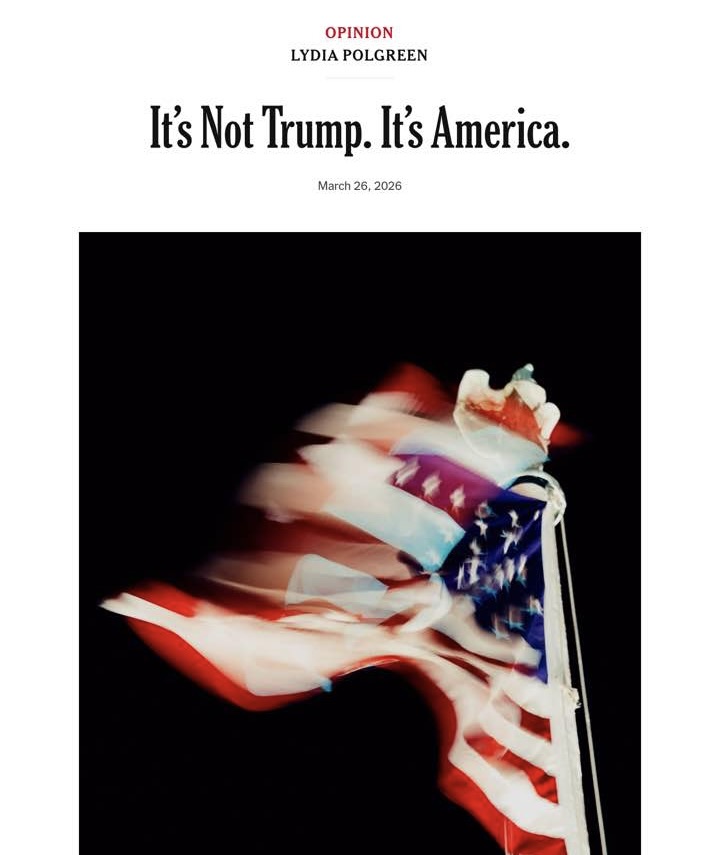
Is Trump a freak of history or its fulfillment, an aberration or a culmination? The answer, surely, is both. But in the course of his presidency, Trump has revealed a much older malady: America’s unshakable faith in its ability to shape the world to its liking, indifferent to what others might want and supremely confident that its plan is the right one. Beyond Trump, it’s this disfiguring mentality we Americans must face.- Lydia Polgreen
– – – – – – – – – – – – – – – – – – – –
“Like a lot of other Americans, I’ve oscillated in these dark times between two emotional poles. At points, I tell myself that Donald Trump is a uniquely malevolent figure who has seized levers of power that no previous president had ever dared to grasp. The story doesn’t stop state violence in the streets or illegal military operations abroad. Yet it has its comforts. Once Trump passes from the scene — as the laws of nature, if not politics, require — some kind of restoration of the American democratic and constitutional project can take place.
On darker days, I find myself turning to a more thoroughgoing narrative: that Trump is the fulfillment of what America has always been — a self-satisfied nation, granted license by its myths about providence and exceptionalism to do whatever it wants. Trump didn’t come from nowhere, after all. His two victories were forged by choices made by Americans and the leaders they elected. If he had not existed, history would have invented someone like him. This explanation offers its own consolation. At least it is something a rational mind can grasp.
This oscillation can feel a bit like whiplash. Trump’s loss in 2020, interventions by the courts to block some of his most brazen moves and the prospect of a Democratic romp in the midterm elections sustain the aberration theory. But other developments — Trump’s popular-vote triumph in 2024, the near total submission of the Republican Party to his will and the Supreme Court’s grant of sweeping immunity to Trump for potentially criminal acts committed as president — suggest the opposite.
The war in Iran has shattered this binary. It is, to be sure, the product of Trump’s unique recklessness, as he plunges heedlessly into a conflict his predecessors had been wise to avoid. Yet it is also the logical terminus of decades of American history — the country’s addiction to technological wizardry to wage war at a distance, the blinkered belief that it could shape events in faraway places by force, the steady whittling away of constitutional limits on the presidency.
Is Trump a freak of history or its fulfillment, an aberration or a culmination? The answer, surely, is both. But in the course of his presidency, Trump has revealed a much older malady: America’s unshakable faith in its ability to shape the world to its liking, indifferent to what others might want and supremely confident that its plan is the right one. Beyond Trump, it’s this disfiguring mentality we Americans must face.
In December 1952, a Scottish scholar named Denis Brogan published a remarkable essay titled “The Illusion of American Omnipotence.” Writing as the United States was emerging as the world’s pre-eminent power, Brogan diagnosed a peculiar feature of the American mind. The United States, fueled by its myths and unswervingly certain of its vision for the world, could not see difficulty, much less defeat, as a reason to question its aims. Failure was never brought about through the strength or power of rivals. It came, instead, through blunder and betrayal.
“Very many Americans, it seems to me, find it inconceivable that an American policy, announced and carried out by the American government, acting with the support of the American people, does not immediately succeed,” Brogan wrote. “If it does not, this, they feel, must be because of stupidity or treason.” An admiring but canny observer of the country, Brogan captured something essential. America, in its own imagination, could never fail; it could only be failed.
In its struggle against global communism through the Cold War, the country had ample opportunity to show off the reflex. When China’s insurgent communists triumphed, Brogan wrote, it was widely understood as a result of American bungling or treachery. China, a vast and ancient civilization, was seen as something for America to win or lose. That failure helped give rise to the paranoia of McCarthyism. Korea, Vietnam and more covert disasters were further tinder to recrimination, long after the senator had gone. Failure could come only from internal betrayal, an idea that paradoxically bolstered the illusion of omnipotence.
When the Soviet Union collapsed in 1991, America had the chance to experience the full weight of its might. It had defeated the evil empire and stood alone as the most powerful nation the world had ever known, its former failings folded into a story of success. America’s swift and decisive victory in the gulf war that year was a showcase of the superpower’s military prowess. The United States would become the world’s policeman, putting its soldiers on the line to protect a rules-based order it led.
Yet it didn’t take long for the old pattern of failure followed by recrimination to re-emerge. America persuaded a rapidly growing China to further liberalize its economy, confident that it would become something more like America — an open and free society. When this gambit produced the China shock, hollowing out American manufacturing as China grew richer, more powerful and more autocratic, Americans would cry betrayal by their political leaders. China and its leaders hardly featured in the narrative.
Then came Sept. 11, 2001, shattering the fiction of American invulnerability to attack. There was plenty of blame to go around. Yet George W. Bush transformed the grievous wound into extraordinary power. He took America to war in Afghanistan and Iraq with an absurd plan to turn them into liberal democracies. His administration argued that in Iraq, a country with no role in the attack on America, the crisis was so urgent that the constitutionally mandated role of Congress in declaring war could be abandoned. After Sept. 11, constraints on presidential power themselves were identified as potential betrayers and stripped away.
It didn’t work, of course. The wars dragged on, killing thousands of American service members and hundreds of thousands of Afghans and Iraqis. Afghanistan today is ruled by the same movement that sheltered Osama bin Laden, the Taliban. Iraq is an exceedingly fragile and divided nation. The war gravely destabilized the Middle East, giving rise to fearsome new terrorist groups like the Islamic State and setting off a bloody civil war in Syria.
The election in 2008 of Barack Obama, a critic of the post-9/11 wars, seemed to be a moment of reckoning with American illusions. But Obama was soon bogged down by the conflicts and a global financial crisis to boot. Notwithstanding his feints toward American humility in the world, he embraced many of the outsize powers he inherited to make high-tech war in distant places with little oversight. America continued to act unbounded.
Striding onto the national stage in the aftermath of these disasters, Trump tapped into an old American story. America’s elites had betrayed the American people, he declared. Trump’s whole life was a dress rehearsal for this moment: constantly imposing his will, wriggling out of scrapes, never held accountable, born on third base and thinking he’d hit a triple. He was the American illusion of omnipotence incarnate.
Trump collapsed the distance between his personal will and American will, declaring as he accepted the Republican nomination in 2016 that “I alone can fix it.” Like America, Trump cannot fail; he can only be failed. Everything is always someone else’s fault. Handed the tools of the imperial presidency, he clearly regards America as identical with his person. He jettisons all pretense of constitutional order. He will know in his gut when wars are won, he’s said, and the only limits are his own sense of morality.
In the Persian Gulf, that illusion has come face to face with material reality. Trump’s hope of a rapid collapse of the Iranian regime was always fantastical. Geography is having its revenge: The oil and gas that power so much of the global economy pass through a narrow strait that Iran effectively controls. A ground invasion on its vast and forbidding terrain could far exceed the Vietnam quagmire. The Iranian regime, ruthless to its neighbors and its own people alike, appears unshaken by Israel and America’s relentless assaults. It seems dug in for a long war.
Yet Trump seems unable to conceive of a force immune to America’s omnipotent might. And he cannot imagine that a distant war could possibly harm America, blessed with bountiful land and natural resources, separated from the troubled world by two oceans. But soaring gas prices, rising interest rates and the prospect of a stock market collapse have put paid to any delusions of splendid isolation from the global economy. If this war grinds on, Americans will suffer greatly.
There has been plenty of suffering already: More than 58,000 names are etched onto the black granite of the Vietnam War memorial in Washington. As yet, there is no national memorial for the so-called forever wars, but over 7,000 Americans died serving in them. In those wars, there was at least a veneer of American idealism, as thin and self-deceiving as it may have been. Trump has dragged America into a war completely unmoored from any pretense to virtue. It is a naked exercise of power with no cloak of providence or moral superiority. In its brazenness, it is almost bracing.
Writing at the same time as Brogan, the theologian Reinhold Niebuhr published a short book called “The Irony of American History.” A favorite of Obama’s, it is a call to Christian humility in world affairs, addressed to Americans who misunderstand their virtue. “Man is an ironic creature because he forgets that he is not simply a creator but also a creature,” Niebuhr writes.
That line made me realize the folly of my own oscillation: Both views — Trump as aberration or Trump as history’s fulfillment — had America as the protagonist of its own story, with the world as a stage. I needed a wider frame, an honest engagement with history and a willingness to admit that America is, like any other nation, just one place in the world.
America does not know how to exist in a world it does not control. Since its inception, America has assured itself it was simply too big, too far away and too richly endowed to suffer any serious consequences for its actions. But there will be no escaping the cataclysm in Iran. In its wake, there is a chance to recognize our place in an interconnected world and see ourselves clearly. The way out of the cycle of failure and betrayal is to shed our illusions, once and for all.” – Lydia Polgree is an Opinions columnist with the New York Times.
 An International Educator in Vietnam
March 28, 2026
Heather Cox Richardson
3-29-26
Almost exactly a year ago, on March 27, 2025, President Donald J. Trump issued an executive order titled “Restoring Truth and Sanity to American History.” The order asserted that “[o]ver the past decade, Americans have witnessed a concerted and widespread effort to rewrite our Nation’s history, replacing objective facts with a distorted narrative driven by ideology rather than truth.”
The order claimed, as Trump did in his first term, that “historical revision” was reconstructing “our Nation’s unparalleled legacy of advancing liberty, individual rights, and human happiness…as inherently racist, sexist, oppressive, or otherwise irredeemably flawed.” Trump has claimed since his first term that a “left-wing mob is trying to demolish our heritage, so they can replace it with a new oppressive regime that they alone control.” He told his followers that they are in “a battle to save the Heritage, History, and Greatness of our Country.”
Embracing the idea that there is a perfect past currently being destroyed, Trump echoes twentieth-century fascists who promised to return their country to divinely inspired rules that, if ignored, would create disaster.
Trump’s order called for putting his ideology in place, turning federal historic sites, parks, and museums into “solemn and uplifting public monuments that remind Americans of our extraordinary heritage, consistent progress toward becoming a more perfect Union, and unmatched record of advancing liberty, prosperity, and human flourishing.”
The order directed the Secretary of the Interior to “determine whether, since January 1, 2020, public monuments, memorials, statues, markers, or similar properties within the Department of the Interior’s jurisdiction have been removed or changed to perpetuate a false reconstruction of American history, inappropriately minimize the value of certain historical events or figures, or include any other improper partisan ideology,” to restore their previous content, and to make sure that they “do not contain descriptions, depictions, or other content that inappropriately disparage Americans past or living (including persons living in colonial times), and instead focus on the greatness of the achievements and progress of the American people or, with respect to natural features, the beauty, abundance, and grandeur of the American landscape.”
Setting administration officials’ eyes on the Smithsonian Institution, it said: “Museums in our Nation’s capital should be places where individuals go to learn—not to be subjected to ideological indoctrination or divisive narratives that distort our shared history.” Trump’s order named a three-person team to review the Smithsonian’s museums, including his Florida criminal defense attorney Lindsey Halligan, who joined his team from the field of property law and who, as legal analyst Anna Bower observed, “didn’t like some of the museum’s exhibits when she visited after the inauguration so she convinced Trump to sign an executive order putting her in charge.” Also on the team is Russell Vought, director of the Office of Management and Budget and a key author of Project 2025.
Since then, Trump’s people have tried to rewrite American history according to their ideology. Revealingly, one of the first things the administration did to alter the past was to remove from a U.S. military cemetery in the Netherlands two displays that recognized Black soldiers who helped liberate Europe from the Nazis.
Interior Secretary Doug Burgum issued his own order on May 20, 2025, also titled “Restoring Truth and Sanity to American History.” He told officials at all National Park Service sites to make sure information in the park adhered to Trump’s demands and to ask the public to let them know if they had “any signs or other information that are negative about either past or living Americans or that fail to emphasize the beauty, grandeur, and abundance of landscapes and other natural features.”
By July 2025, National Park Service teams were trying to figure out what the vague order not to “inappropriately disparage Americans” meant, flagging exhibits on sea level rise due to climate change at Cape Hatteras National Seashore in North Carolina, human enslavement at Independence National Historical Park in Philadelphia, and the imprisonment of Seminoles, Cheyennes, Araphaos, Kiowas, Comanches, Caddos, and Apaches at the Castillo de San Marcos National Monument in Florida.
On August 12, 2025, Trump’s Smithsonian team wrote to Dr. Lonnie Bunch, the historian who serves as the secretary of the Smithsonian Institution, informing him they intend to review museum exhibitions, curatorial processes, planning, the use of collections, and artists’ grants in order to make sure they align “with the president’s directive to celebrate American exceptionalism, remove divisive or partisan narratives, and restore confidence in our shared cultural institutions.”
They said they were focusing on the National Museum of American History, the National Museum of Natural History, the National Museum of African American History and Culture, the National Museum of the American Indian, the National Air and Space Museum, the Smithsonian American Art Museum, the National Portrait Gallery, and the Hirshhorn Museum and Sculpture Garden.
On December 18, 2025, they wrote to Bunch again to complain he had not provided as much information as they had requested. They expressed concern “that the museums of the Smithsonian Institution be well positioned to play an important role during the historic yearlong celebration of our Nation’s 250th birthday that is fast approaching. We wish to be assured that none of the leadership of the Smithsonian museums is confused about the fact that the United States has been among the greatest forces for good in the history of the world,” they wrote. “The American people will have no patience for any museum that is diffident about America’s founding or otherwise uncomfortable conveying a positive view of American history, one which is justifiably proud of our country’s accomplishments and record.”
At about the same time, Trump unveiled that the history he intended to see shared was one that remade the U.S. by destroying its complicated history of struggle toward multicultural democracy and rewriting it as a dictatorship.
In mid-December the White House revealed that Trump had attached partisan descriptions of previous presidents on the “Presidential Walk of Fame” at the White House, calling Democratic president Barack Obama “one of the most divisive figures in American History,” and Joe Biden “by far, the worst President in American History.” “Taking office as a result of the most corrupt Election ever seen in the United States,” it continued, “Biden oversaw a series of unprecedented disasters that brought our Nation to the brink of destruction.” Trump described himself, though, as the architect of “the Greatest Economy in the History of the World.”
Then, on the fifth anniversary of the January 6 attack on the U.S. Capitol, the White House unveiled a new website blaming the Democrats for the attack and saying Trump had “corrected a historic wrong” by pardoning the rioters. Under pressure from the White House, the Smithsonian Institution’s National Portrait Gallery removed text by Trump’s portrait that referred to Trump’s two impeachments, as well as his loss to Democrat Joe Biden in the 2020 presidential election.
In January the National Park Service took down displays about the enslavement of nine Black Americans at the home of President George Washington and First Lady Martha Washington in Philadelphia, and the city sued. In February, U.S. District Judge Cynthia Rufe, who was appointed by President George W. Bush, ruled that the materials must be put back as the case works its way through the courts. She began her order with a quotation from George Orwell’s 1984, a novel based on the premise that an authoritarian regime constantly rewrote history for its own ends.
But a funny thing happened on the way to the erasure of American history in favor of a whitewashed authoritarianism. The American people began to preserve the truth of who we have been.
Volunteers worried at the potential loss of National Park Service information created the Save Our Signs project, a crowd-sourced archive of photographs from National Parks. Historians appalled by changes to the Smithsonian created Citizen Historians for the Smithsonian, similarly documenting changes to the Smithsonian. One of its leaders, James Millward, is a scholar of Chinese history and is concerned that “history being snipped and clipped and disappeared” looks a great deal like the methods of the Chinese Communist Party. Sitting next to Trump’s portrait in the Portrait Gallery, he handed visitors copies of the old text until guards closed the exhibit.
At the Organization of American Historians, the History, Archives, and Records Preservation Project (HARPP) is made up of historians, archivists, librarians, and their allies, who are recording “changes since January 2025 that threaten the historical record.”
Even more dramatically, though, today’s Americans are demanding the preservation not just of who we have been, but of who we are. Far from accepting the administration’s whitewashed assertion that the nation has an “unparalleled legacy of advancing liberty, individual rights, and human happiness,” we are remembering our complicated history of community struggle and mobilizing to protect our right to govern ourselves against those who would take that right from us.
Millions of Americans and their allies turned out today for more than 3,100 “No Kings” events in all 50 states, U.S. territories, Washington, D.C., and towns and cities around the world in what appears to be the largest one-day protest in American history.
Instead of accepting the destruction of the true lessons of our past, we are bringing them back to life.
[Image I took at a No Kings rally today.]
—
Notes:
https://www.whitehouse.gov/presidential-actions/2025/03/restoring-truth-and-sanity-to-american-history/
https://thehill.com/homenews/administration/5675182-trump-launches-jan6-website/
https://www.washingtonpost.com/entertainment/art/2026/01/10/national-portrait-gallery-trump-photo/
Brad Poole, “Trump Rally Fills Megachurch With Young Conservatives,” Courthouse News Service, June 23, 2020.
https://apnews.com/article/trump-plaques-presidential-walk-fame-e6b496f68862f4b678bbe608a0efde95
https://abcnews.com/US/trump-admin-removes-pride-flag-stonewall-national-monument/story?id=130023944
https://www.nbcnews.com/world/europe/us-removal-panels-honoring-black-soldiers-wwii-cemetery-netherlands-rcna251475
https://www.nytimes.com/2025/07/22/climate/trump-national-park-service-history-changes.html
https://www.whitehouse.gov/briefings-statements/2025/08/letter-to-the-smithsonian-internal-review-of-smithsonian-exhibitions-and-materials/
https://www.whitehouse.gov/briefings-statements/2025/12/letter-to-the-smithsonian-review-of-smithsonian-exhibitions-and-materials/
Lena Bohman, Molly Blake, Jenny McBurney, Amelia Palacios, and Henrik Schönemann, “Save Our Signs: A Crowdsourced Project to Combat Censorship at US National Park Sites,” Panorama: Journal of the Association of Historians of American Art 11, no. 2 (Fall 2025), https://doi.org/10.24926/24716839.20459.
https://segd.org/member-news/save-our-signs-archive-launch/
https://www.cbsnews.com/philadelphia/news/presidents-house-independence-mall-slavery-trump/
https://storage.courtlistener.com/recap/gov.uscourts.paed.648842/gov.uscourts.paed.648842.53.0.pdf’
https://www.pbs.org/newshour/nation/citing-orwells-1984-judge-orders-trump-administration-to-restore-slavery-exhibit-it-removed-in-philadelphia
https://www.washingtonpost.com/entertainment/art/2026/02/25/smithsonian-volunteer-historians/
https://www.oah.org/resources/advocacy-partners/harpp/
https://www.doi.gov/document-library/secretary-order/so-3431-restoring-truth-and-sanity-american-history
https://www.newsfromthestates.com/live-feed/no-kings-march-2026
https://www.nytimes.com/2026/03/28/us/no-kings-protest-photos-videos.html?smid=nytcore-ios-share
https://www.theguardian.com/us-news/gallery/2026/mar/28/no-kings-protests-across-the-world-in-pictures
Bluesky:
annabower.bsky.social/post/3lw7wddgsqs2o
indivisible.org/post/3mi5rnx72qs2a
thatseankeenan.bsky.social/post/3mi5oasvkh22c