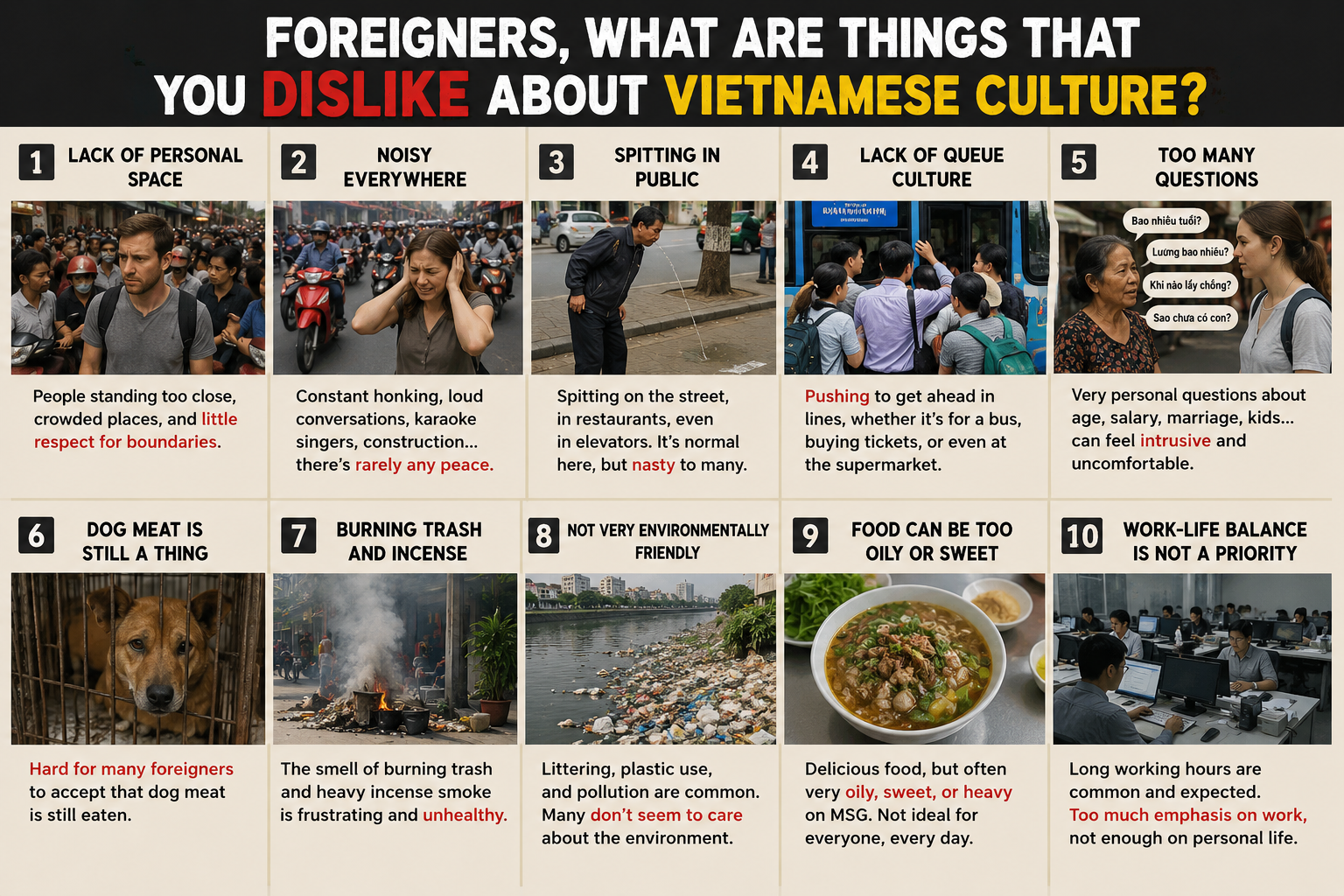
Someone kicked off a discussion in the r/Vietnam Subreddit with this question. Most of the comments revolved around these themes: consideration for others, responsibility for shared space, accountability, hierarchy, money/status, and weak enforcement of rules. The discussion also includes Vietnamese and Việt Kiều voices, not just foreigners, and several commenters explicitly say they love Vietnam despite their criticisms. Note: After every MAA (my initials) is my “two cents.”
As I mention in the concluding paragraph, the key question is which of these items represent genuine cultural differences that outsiders need to understand and adapt to and which are problems that Vietnamese themselves, especially members of Generation Z, recognize and want to solve?
Full disclosure: I asked one of my digital assistants to sort through the comments and place them into logical categories. It performed this formidable task in a cool 11 seconds saving me an hour or more of precious time.
Bonus I also asked ChatGPT to generate a couple of images based on this post. Here are the results.
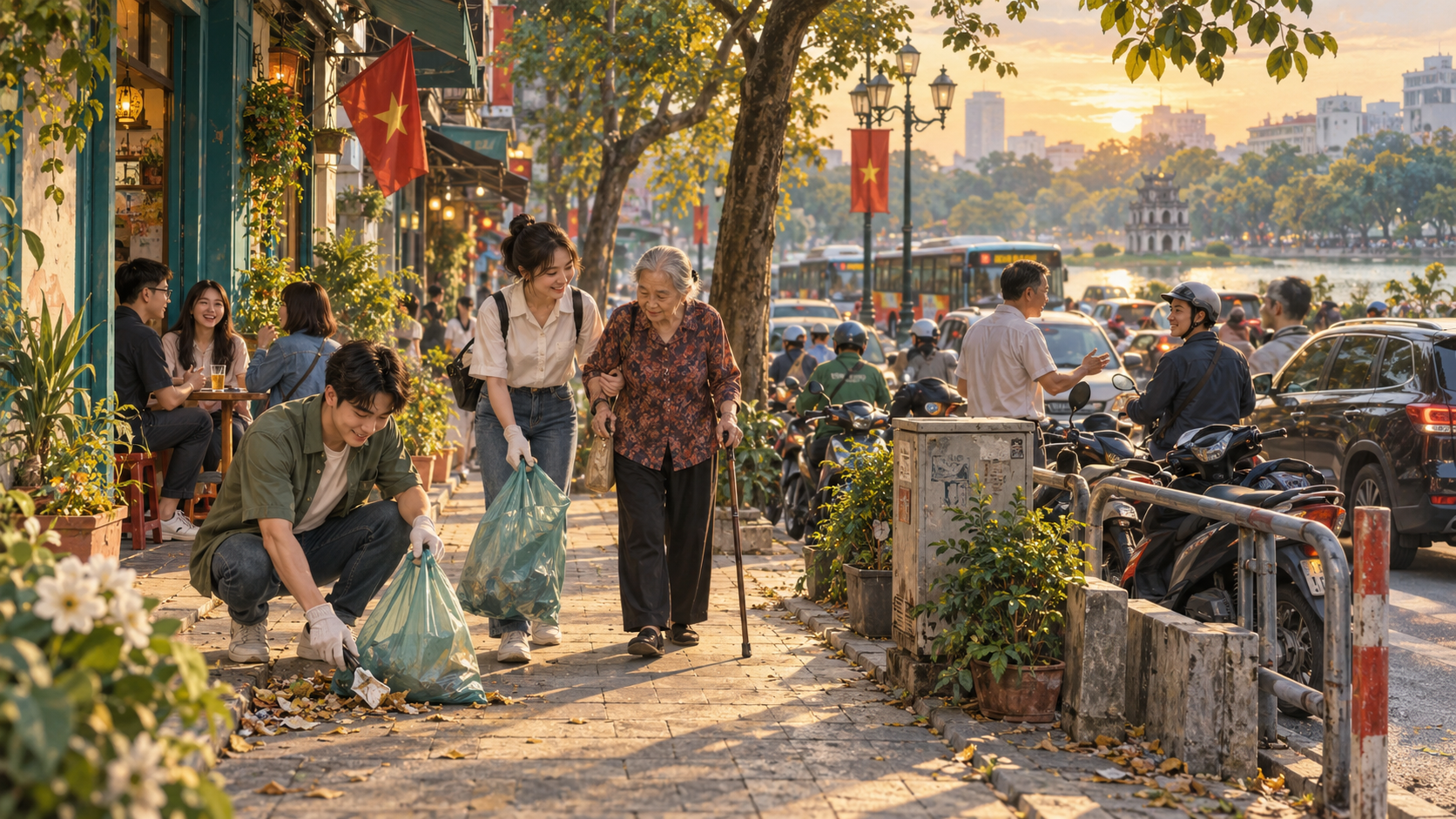
Caring Neighbors on a Hanoi Sidewalk
A Hanoi street scene where young people care for a shared sidewalk and help an older pedestrian. It reflects the essay’s view that people can love Vietnam and still work to improve it.
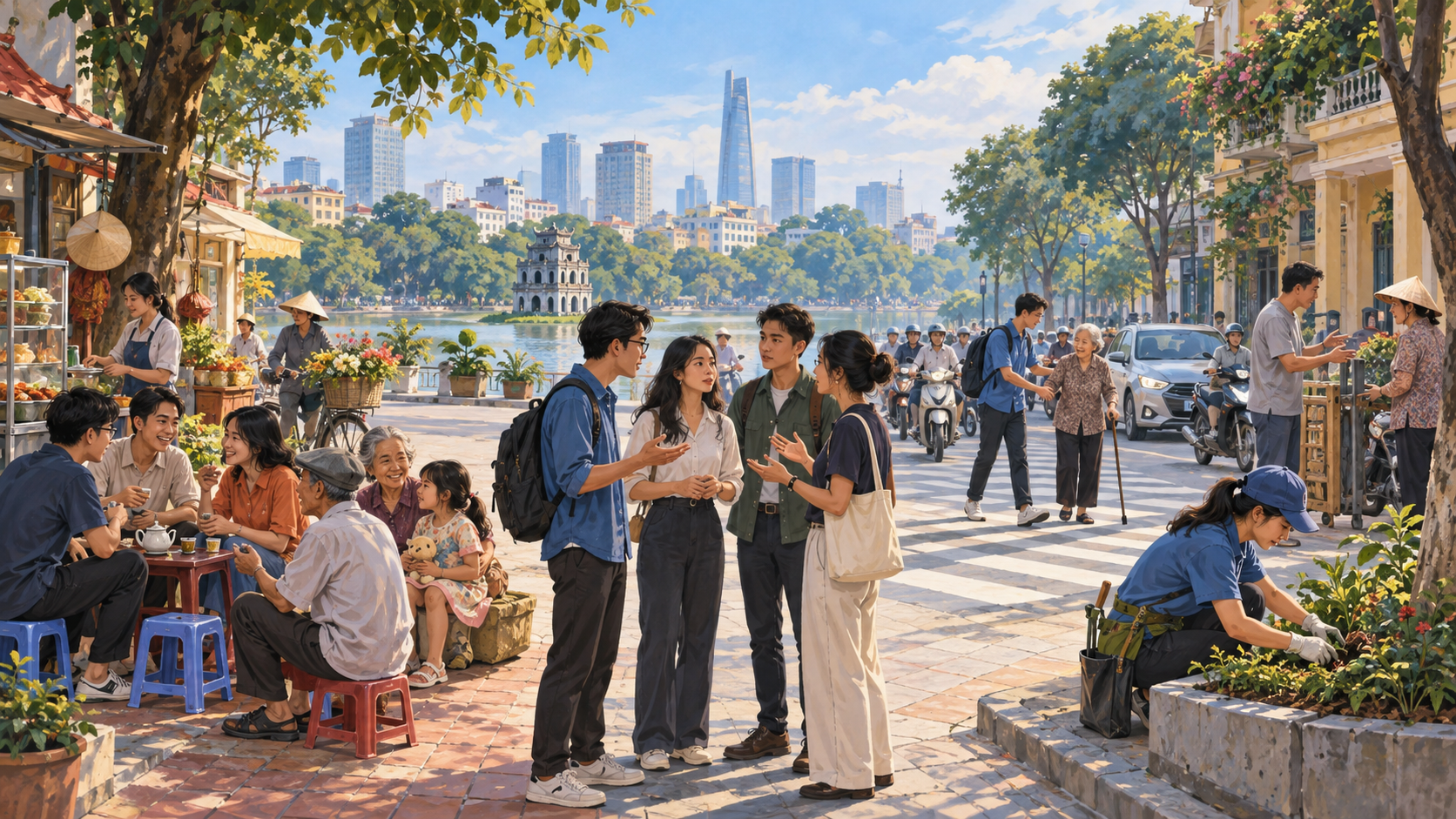
Vietnam: Everyday Life, Shared Responsibility
By placing the warmth of everyday life alongside young Vietnamese people discussing and addressing shared public problems it focuses on my closing question.
Introduction: Culture, Bad Habits, or Systemic Problems?
Their answers ranged from minor cultural irritations to complaints about problems that affect public health, safety, equality, governance, and quality of life.
That distinction is important. Cutting in line is not in the same category as corruption. On a scale of 1-10, loud karaoke is not in the same league as dangerous driving or contaminated food or drink. Some behaviors routinely described as “Vietnamese culture” may be better understood as habits, inadequate enforcement, rapid development, generational differences, or shortcomings in civic education.
Several commenters themselves made this distinction, including one who argued that people sometimes confuse “uncivilized attitude” with culture and another who cautioned against turning discussions like this into expat complaint echo chambers.
We can divide the comments into these categories:
1. Corruption, Governance & the Rule of Law
This includes:
- Bribery and the ubiquitous “red envelope”
- Corruption involving police, government officials, schools, and employment
- Bureaucracy and paperwork
- Rules that appear rigid until money changes hands
- Selective or inconsistent enforcement
- Nepotism and jobs obtained through connections rather than competence
- Perceptions that wealthy or powerful people can avoid accountability
- Authorities ignoring obvious violations until occasional enforcement campaigns
- Complaints about government generally
- The perception that people who insist on following the law can be regarded as troublesome
- Reactive rather than preventive governance
- Police allegedly attempting to extract money from foreigners
One commenter summarized the problem as: “Everywhere you go, an envelope goes first,” arguing that the system rewards people with money and disadvantages those without it. Vietnam is referred to as an “envelope culture (Văn hóa phong bì).
MAA: Corruption is a structural rather than uniquely cultural problem and can be divided into subcategories ranging from petty corruption, traffic police pocketing a fine, to high-level corruption involving much larger amounts of money.
2. Accountability, Saving Face & Admitting Fault
This is one of the strongest recurring themes in the entire discussion. It includes:
- Difficulty admitting mistakes
- Avoidance of personal responsibility
- “Saving face”
- Blaming others
- Asking forgiveness rather than permission
- Being unwilling to acknowledge wrongdoing even when evidence is obvious
- Passive-aggressive behavior
- Gossiping behind someone’s back rather than confronting an issue openly
- Truth sometimes being treated as negotiable
- Resistance to criticism
The original comments repeatedly connect saving face with a perceived lack of accountability.
MAA: The notion of saving face is hardly unique to Vietnam and is widespread throughout Asia. Maintaining face can also serve positive functions—preserving harmony, avoiding public humiliation, and preventing unnecessary confrontation. It’s also a way to avoid taking responsibility.
3. Civic Responsibility & Consideration for Others
Many complaints fall into this category.
- “Me first” behavior
- Lack of awareness of how one’s actions affect strangers
- Failure to maintain shared spaces
- Leaving problems for somebody else to solve
- Blocking entrances and doorways
- Sitting on or touching other people’s property
- Speakerphone use
- Playing videos without headphones
- Shoving instead of saying “excuse me”
- Standing too close to strangers
- Lack of spatial awareness
- People not moving aside in narrow spaces
- General discourtesy toward strangers
The Vietnamese expression cha chung không ai khóc (everybody’s business is nobody’s business) appeared in the discussion as an explanation for neglect of common property. In other words, when something belongs to everyone, nobody feels personally responsible for it. One commenter connected this mentality to littering, food safety, and broader civic responsibility.
This category connects many seemingly unrelated complaints.
4. Queuing, Elevators & Public-Space Etiquette
This appeared so often that it deserves its own section even though it overlaps with civic responsibility. It includes:
- Cutting in line
- Not recognizing an existing queue
- Crowding checkout counters
- Entering elevators before others exit
- Standing directly in front of elevator doors
- Blocking exits, stairs, escalators, and entrances
- Refusing to step aside
- Pushing or nudging instead of saying “excuse me”
- Rushing to leave airplanes even when everyone is going to the same shuttle
- Personal-space differences
The elevator examples are especially useful because commenters repeatedly use them as a miniature illustration of a larger complaint about collective efficiency.
MAA: It’s important to distinguish the cultural concepts of personal space and behavior from behavior that simply makes public movement less efficient. Like other Asian societies, you will rarely hear Vietnamese apologize for a mistake they make.
5. Littering, Waste & Environmental Responsibility
This is probably the single most frequently mentioned visible problem. It includes:
- Littering
- Throwing rubbish on restaurant floors
- Cigarette butts
- Garbage in rivers, canals, beaches, and the sea
- Vacant lots filled with plastic
- Roadside waste washing into drainage systems
- Burning garbage
- Lack of recycling
- Failure to clean around homes or businesses
- Treating public spaces as somebody else’s responsibility
- Environmental neglect generally
- Burning votive paper and its contribution to urban air pollution
Several commenters expressed the contradiction especially forcefully: Vietnam is extraordinarily beautiful, yet rubbish damages precisely the landscapes people are proud of.
MAA: More important than aesthetics are flooding, drainage problems, marine plastics, tourism, public health, and economic development.
6. Noise Pollution
Another overwhelmingly consistent theme.
Subdivide it:
Karaoke
- Late-night karaoke
- Early-morning karaoke
- Extremely amplified home karaoke
Phones and electronics
- Speakerphone calls
- TikTok/videos without headphones
- Loud televisions or music
Traffic
- Constant honking
Construction
- Construction starting extremely early, including weekends
Everyday speaking
- Loud conversations
- “Outdoor voices indoors”
Commercial noise
- Street vendors and amplified advertising, including bánh bao loudspeakers
Commenters repeatedly described quiet as surprisingly difficult to find in Vietnamese cities.
MAA: I take ear plugs to some events. (My hearing is more important that people’s stares.) I recently spoke with a Singaporean audiologist who said that many of her Vietnamese patients are young adults, i.e., in their 20s and 30s.
7. Traffic, Motorbike Culture & Pedestrian Safety
This is separate from ordinary etiquette because it involves physical danger. It includes:
- Dangerous motorbike riding
- Wrong-way driving
- Driving on sidewalks
- Poor lane discipline
- Dangerous buses
- Lack of consideration for pedestrians
- Vehicles ignoring crosswalks
- Motorbike parking blocking sidewalks
- Sidewalks becoming unusable for pedestrians
- Particular problems for elderly people, children, wheelchair users, and people with disabilities
- Infants and children riding without adequate helmets
- Constant horn use
- Cars and motorbikes making unpredictable U-turns
One commenter noted the paradox that motorbikes make urban transportation cheap and remarkably efficient while simultaneously degrading sidewalk accessibility, safety, and air quality.
MAA: Motorbikes as a source of air pollution, especially in Hanoi and HCMC at certain times of the year, is an impetus behind the shift to electric motorbikes. In case you’re counting, Hanoi has about 7 million registered motorbikes, and Ho Chi Minh City has over 7.3 million registered motorbikes. There are regional differences, e.g., drivers in Hanoi are more aggressive than elsewhere.
8. Hygiene, Sanitation & Food Safety
There are two issues here.
Personal/public hygiene
- Public urination
- Occasionally public defecation
- Nose picking
- Coughing and sneezing without covering one’s mouth
- Inadequate handwashing
- Bare feet on furniture or seats
- Touching feet and then other surfaces
- Open-mouth chewing and noisy eating
- Smoking in inappropriate places
Food hygiene and consumer safety
- Questionable food handling
- Improper storage
- Ingredients of uncertain origin
- Alleged use of unsafe additives or chemicals
- Cutting corners to reduce costs
The discussion explicitly links some food-safety concerns to the larger issue of consumer safety.
MAA: There are many horror stories of businesses cutting corners at the expense of their customers to maximize profit. My personal favorite is the use of battery chemicals to dye waste coffee beans. Another more recent story is digging up dead, diseased pigs and selling their meat. A recent story unrelated to food and drink but still related to profit at any cost was about a Vietnamese company making counterfeit Nike shoes for export to the US. All of these stories illustrate one of my favorite unattributed says, Success without integrity is failure. Another issue related to personal hygiene is the dismal state of dental health. Finally, there are cultural differences that one eventually accepts such as slurping one’s soup, talking with your mouth full of food, and the floss picks that often magically appear after a meal.
9. Smoking, Drinking & Public Health
These are qualitatively different from hygiene and include:
- High smoking prevalence, particularly among men (between 41.1% and 43% of adult Vietnamese men smoke, one of the highest rates in the world)
- Smoking in restaurants, cafés, buses, and other shared environments
- Cigarette litter
- Social pressure to consume alcohol, e.g., forced drinking at family or business gatherings
- Drunkenness
MAA: The percentage of Vietnamese adult women who smoke is less than 2%, something the tobacco industry would like to change. Vietnam’s drinking culture is changing because of the zero-tolerance DUI laws. According to the Vietnam Beer Alcohol Beverage Association, YOY sales fell by 23% in 2023. The strict DUI laws took effect on 1 January 2020. I stopped playing the drinking game a long time ago for health and other reasons. Note: Vinataba is a 100% state-owned company that has a partnership with Philip Morris. Put that in your pipe and smoke it, pun intended.
10. Hierarchy, Age & Family Authority
Another major recurring thread that includes:
- Elders “can’t be wrong”
- Younger adults being treated as children
- Difficulty challenging parents
- Age trumping expertise
- Older people cutting queues and expecting deference
- Controlling parents
- Family interference in adult decisions
- Negative or highly critical parenting styles
- Limited autonomy
- Family expectations
MAA: Here’s a relevant comment: Old people can’t be wrong. Me and my wife (Vietnamese) both in mid 40s, her parents still call us ‘kids’. My father in-law last year lost half a billion ($19,177 today) on an investment scam, his daughter works in finance. When we asked why he never at least asked her opinion on the “miracle investment opportunity” his angry answer was something like “why would I ask a children about businesses????” Old people can be stubborn anywhere in the world, but in Vietnam culturally younger people not allowed to call them out on their shit.
11. Parenting, Children & Discipline
This includes:
- Young children running, screaming, or disrupting public spaces
- Parents apparently not intervening
- Children littering
- Children using public spaces as toilets
- Concerns about physical punishment or public displays of abuse
- Children on motorbikes without adequate protection
One commenter noted that Vietnamese teenagers appeared far better behaved than teenagers in his home country, even though he found younger children unusually uncontrolled.
MAA: Based on my 21 years of living in Vietnam, it’s clear that many parents either refuse or don’t know how to discipline their children. As in other Asian countries, boys are treated differently than girls with the latter often getting the short end of the stick.
12. Gender Roles & Patriarchy
This includes:
- Traditional expectations of wives and mothers (between 71-79% of “working-age women,” i.e., between 15 and 64, are employed)
- Men socializing while women remain responsible for childcare
- “The Viet mom archetype” described by one commenter
- Gendered drinking culture (17-23% of adult women drink alcohol over a longer annual or recurring timeframe)
- Gender differences in smoking
- Comments about men generally
One respondent summarized the traditional gender-role complaint as men being free to socialize while wives remain home caring for children.
MAA: The double-standard is still very real in Vietnam though it is slowly but surely changing among some members of the younger generation.
Not only are men “free to socialize” but there’s also a lot of cheating going on. Having girlfriends and using prostitutes is still part and parcel of being masculine. As with other issues, this is changing with the younger generation.
I’m not a big fan of “gendered drinking” and avoid it whenever possible, which almost always. Sitting around and getting shit-faced drunk with the guys is not my idea of fun. It’s also bad for one’s health. A few toasts, yes, bottoms-up of multiple glasses of hard liquor, no.
13. Appearance, Body Image & Beauty Standards
This combines several different types of comments:
- Obsession with light/white skin
- Body shaming
- Commenting openly on people’s weight or bodies
- Plastic surgery
- Appearance-consciousness
- Judging people based on clothing or possessions
- Beauty standards
MAA: People even have nicknames for Vietnamese with darker skin. For example, if I had dark skin, I could be called “Black Mark” (“Mark Đen”) or if I were Vietnamese but had foreign features, people, including friends, might call me “Mark Tây,” which means “Mark Foreigner/Westerner.” When it comes to weight, there’s no beating around the bush. There are no euphemisms. She or he is FAT or THIN. For example: “Hi, Mark, You look fatter since I last saw you.” MAA: “Yeah, I’ve gained some weight. Too much good food to eat and not enough exercise.” There are restaurants that use the owner’s name and “fat.” For example, if I had a restaurant, I could call it “Fat Mark’s” (“Mark Béo”).
14. Money, Materialism, Status & Social Comparison
This includes:
- Bragging about wealth
- Designer brands
- Latest iPhones
- Judging someone’s economic status by possessions
- Going into debt to maintain appearances
- Constant comparisons between families
- Jealousy and status competition
- Belief that wealth implies intelligence, worth, or correctness
- Sharp rich-poor divisions
- Unequal access to healthcare and education
One commenter specifically criticized people who struggle financially yet feel compelled to own the latest luxury-branded products or technology to appear successful.
MAA: As I’m fond of telling people who are interested and maybe some who aren’t, Vietnam is still very much in the nouveau riche phase of development. “If you’ve got it, flaunt it!” You see a lot of “flexing” on social media channels. Look at me, what I own, the international trips I’ve taken, the car I drive, the jewelry I’m wearing, etc.!
15. Classism, Racism, Colorism & Treatment of Minorities
This includes:
- Preference for white/light skin
- Racism
- Prejudice against ethnic minorities
- Prejudice against poorer Southeast Asian nationalities
- Staring at people who look different
- Touching Black or mixed-race people’s hair
- Treating visibly foreign children as permanently foreign
- Stereotyping people by hometown or region
- Labeling people who hold different views
A particularly disturbing example came from a commenter whose spouse belonged to an ethnic minority and who reported openly derogatory remarks about her group.
MAA: Vietnam is a homogeneous society. Some of the above is curiosity. (During my time in Germany, I remember a story about a little German girl who pulled up the pants at the ankles a Black US soldier to see if he was the same color below his knees. He took it in stride.) Most people have little contact with people of color. The preference for white/light skin stems from the association of dark skin with working in the fields under the tropical sun, for example. And, yes, many ethnic (Kinh) Vietnamese have a prejudice towards towards ethnic minorities.
16. Foreigners, Tourists & the “Foreigner Price”
This includes:
- Double pricing
- Tourist pricing
- Scams
- Nickel-and-diming
- Aggressive solicitation in tourist areas
- Shopkeepers looking into customers’ wallets
- Being followed around shops
- Taking cards out of customers’ hands
- The perception that foreigners who allow themselves to be cheated somehow “deserve” it
Think of some of this as a “foreigner tax.
There are much more serious business anecdotes involving allegedly uncompensated design work, intellectual-property misuse, nepotistic hiring, and construction shortcuts.
MAA: One colleague told me about a taxi driver who picked him up at the airport. Said colleague agreed to go with him (and one other person sitting in the backseat) because the driver told him Grab and the other car were a kilometer away from the airport. Fortunately, the fare to my colleague’s hotel was reasonable. One red flag was that the driver suggested my colleague join him and “two female friends” for drinks and music. That was probably where the real scam would have begun.
Bottom line: There are plenty of opportunities, on- and offline, to prepare oneself for a trip to Vietnam and know how to react in these situations. Ignorance is no longer an excuse.
17. Workplace & Business Culture
This includes:
- Nepotism
- Connections over competence
- Lack of systems and processes
- Last-minute changes
- Poor advance planning
- Reactive management
- Service employees lacking training
- Workplace dishonesty alleged by commenters
- Intellectual-property concerns
- Construction shortcuts
- Poor customer service
- Some complaints about young/inexperienced workers
- Korean corporate culture in Vietnam—as an important reminder that not every workplace complaint is actually about Vietnamese culture
One Korean commenter explicitly said the workplace culture he disliked came from Korean manufacturing companies operating in Vietnam, rather than Vietnam itself. (This Deutsche Welle documentary comes to mind: The hidden cost of foreign factories in Vietnam.)
18. Gossip, Conformity & Social Pressure
This includes a combination of:
- Gossip
- Comparing families
- Conformity
- Fear of standing out
- Separate friend groups that supposedly cannot mix
- Social anxiety
- Passive aggression
- Concern about “what people will say”
- Judging people based on hometown or background
- Reluctance to challenge group norms
MAA: Some of this has to do with the concept of saving face. As in other countries, there is an urban/rural divide and stereotypes about cities and regions.
19. Nationalism, Patriotism & Sensitivity to Criticism
This includes:
- “Blind nationalism”
- Defensive reactions to criticism
- “If you don’t like it, leave”
- Labeling critics negatively
- Conflating criticism of Vietnam with hostility toward Vietnam
MAA: The first commenter may be referring to “blind patriotism,” not nationalism. Interestingly, some of the most critical comments came from Vietnamese themselves.
20. Superstition & Traditional Beliefs
This includes:
- Karma invoked to explain mundane events
- Strong superstition
- Beliefs concerning children’s helmets
- Ritual burning of paper money
You could distinguish traditional belief systems from practices that have measurable consequences, such as burning material contributing to air pollution. One interesting superstition I heard about was the if you – a man – sit next to an ethnic woman, she may cast a spell on you.
21. Mental Health & Emotional Culture
Includes:
- Mental illness not being taken seriously
- Older generations dismissing psychological problems
- Family reluctance to seek professional assistance
- Younger generations being more receptive
The commenter explicitly described this as a generational divide, with younger Vietnamese pushing for greater awareness.
MAA: There are not enough mental health care workers to meet the growing need for services. This is one reason why so many young people, mainly young women, want to study counseling psychology.
22. Animal Welfare
Includes:
- Neglect of animals
- Treatment of pets
- Dog meat
- Poor zoo conditions
- Solitary or inadequately stimulated zoo animals
- General lack of animal-welfare awareness
One commenter described zoo animals being kept alone or in poor conditions and found their treatment especially difficult to witness.
23. Technology, Phones & Living in the Moment
A smaller but interesting category:
- Constant phone use
- Speakerphones
- Videos without headphones
- Scrolling while interacting with cashiers or other people
- “The phone is more important than what’s going on in real time”
This overlaps with noise but is conceptually different enough to mention.
24. Reviews, Ratings & Trust
Surprisingly, this comes up several times.
Includes:
- Businesses pressuring customers to leave reviews
- Staff standing over customers while they review
- Fake positive reviews
- Vindictive negative reviews
- Fake Booking.com reviews
- Difficulty trusting online ratings
25. Smaller Cultural Pet Peeves
Finish the criticism portion with the genuinely minor things so they don’t get mixed up with corruption or discrimination.
Examples:
- The sound of Vietnamese
- Vietnamese spelling/orthography
- Coriander/cilantro
- Tiny plastic chairs
- “Vina” appearing in company names
- Lack of baseball
- Bland food, according to one commenter
- Roosters at 3 a.m.
MAA: Another complaints not mentioned above that is clearly a cultural difference is about the routine questions that Vietnamese ask that are considered “intrusive” or “personal” in other cultures, i.e., about age, marital status, etc. Vietnamese ask about age to you know which pronoun to use (in their minds) and marital status to show interest and establish a cultural connection.
These complaints are trivial and only worth mentioning because they reflect the distinction between cultural differences and real problems. If you don’t like the sound of Vietnamese, the little plastic chairs, or the lack of baseball, stay home!
Positive Comments About Vietnam
These included:
- Generosity
- Community
- People helping strangers
- Vietnamese young people
- The energy and “raw humanity” of HCMC
- Food
- Affordability
- Cultural life
- The live-and-let-live attitude
- Ordinary kindness
One commenter described a Grab driver spending 15 minutes helping him and refusing payment. Another said that after seven years in Saigon, littering was virtually his only major complaint. And another warned that endless complaint sessions can become an expat echo chamber rather than a constructive conversation.
Criticism Is Not Rejection
Foreigners can love Vietnam while disliking certain things about it. Vietnamese can be proud of their country while wanting to improve it. (That’s one aspect of patriotism.) In fact, some of the strongest criticism came from Vietnamese netizens.
The key question is which of these items represent genuine cultural differences that outsiders need to understand and adapt to and which are problems that Vietnamese themselves, especially members of Generation Z, i.e., those between 14 and 29-years-old, recognize and want to solve?
Last but not least, five years ago, I wrote a relevant essay entitled Constructive Criticism Rooted in Respect: A View from Vietnam. It is about the right to constructively criticize as a permanent resident of Vietnam who shares the same quality of life as the locals.
MAA

