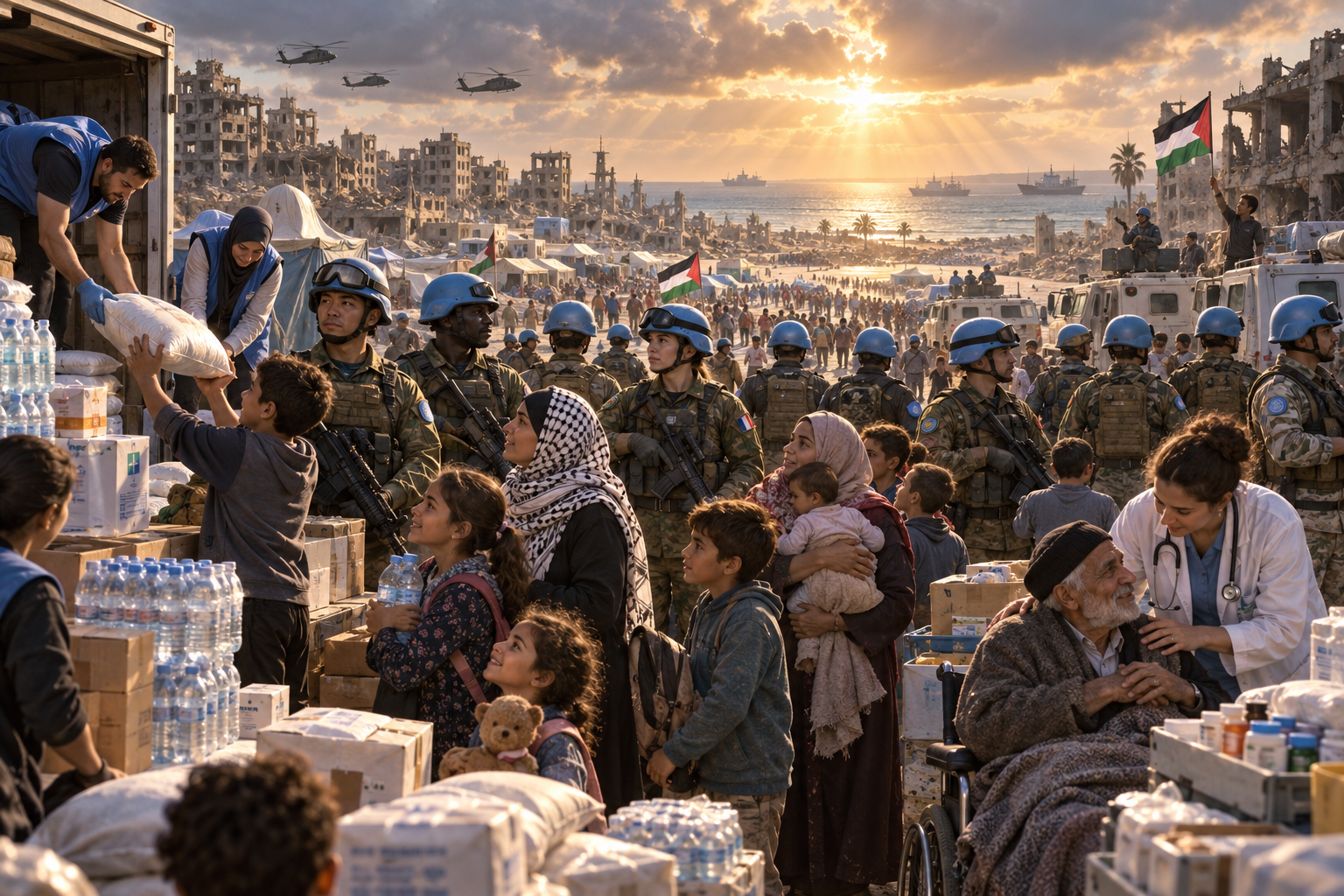
This is an AI-generated visual depiction of one of my fantasies about a multinational peacekeeping force in Gaza that protects the people from further Israeli attacks, provides lifesaving supplies such as food, water, and medicine, enables people who need urgent medical treatment to travel overseas, and evacuates students with overseas admission offers and funding so they can begin their studies.
Israel is playing the long game in its bloodstained pursuit of the regional land grab known as the Greater Israel project. Without this intervention or a comparable act, this rogue nation will continue its wholesale murder of innocents and other acts of cruelty, sadism, and spite.
هذا تصوير بصري مُولَّد بالذكاء الاصطناعي لإحدى أمنياتي، والمتمثلة في نشر قوة متعددة الجنسيات لحفظ السلام في غزة، تحمي السكان من مزيد من الهجمات الإسرائيلية، وتوفّر لهم الإمدادات المنقذة للحياة، مثل الغذاء والماء والدواء، وتُمكّن من يحتاجون إلى علاج طبي عاجل من السفر إلى الخارج، وتُجلي الطلاب الحاصلين على عروض قبول وتمويل للدراسة في الخارج، كي يتمكنوا من بدء دراستهم.
تتبع إسرائيل استراتيجية طويلة الأمد في سعيها الملطّخ بالدماء للاستيلاء على أراضي المنطقة، في إطار ما يُعرف بمشروع «إسرائيل الكبرى». ومن دون هذا التدخل أو إجراء مماثل، ستواصل هذه الدولة المارقة قتل الأبرياء بالجملة، إلى جانب غير ذلك من أعمال الوحشية والسادية والحقد.
As part of this exercise, I asked ChatGPT Plus which are the best countries to send peacekeeping troops to Gaza, and why. Here’s its detailed answer. I would add that this action should be taken immediately and with or without Israel’s approval since Gaza is part of Palestine, a sovereign nation. Some of its “preferred contributors” are questionable. (Check the “main drawback” column.) I suggested that it consider Vietnam. It provided solid reasons for doing so. NOTE: After “MAA” (my initials) are questions or comments.
ChatGPT’s Response
If the objective is a credible, genuinely neutral international force that can protect civilians, maintain a ceasefire, help establish Palestinian security institutions, and eventually withdraw, I would favor a mixed force rather than troops from one or two countries.
There is already a proposed International Stabilization Force (ISF) for Gaza, and the current discussion is moving in this direction. Recent reporting says Uganda, Morocco, Kosovo, Kazakhstan and Albania are among countries contributing or considering troops, while Indonesia’s much larger proposed contribution has been on hold.
My preferred contributors
| Country | Why it would be valuable | Main drawback |
|---|---|---|
| 🇮🇩 Indonesia | Large Muslim-majority country; strong legitimacy with Palestinians; substantial peacekeeping experience; no colonial history in Palestine | Israel may be reluctant; deployment has faced delays |
| 🇪🇬 Egypt | Shares Gaza border; enormous logistical advantage; Arabic-speaking; understands Palestinian politics | Too closely tied to Gaza’s security and regional politics to be the sole force |
| 🇯🇴 Jordan | Arabic-speaking, experienced military, close to Palestinians, extensive peacekeeping experience | Domestic sensitivity and proximity to the conflict |
| 🇲🇦 Morocco | Moderate Arab state, diplomatic relations with Israel, peacekeeping experience | Limited troop capacity |
| 🇹🇷 Turkey | Large, capable military; Muslim-majority; political influence with Hamas and Palestinians | Israel would strongly distrust a large Turkish contingent |
| 🇺🇬 Uganda | Significant African peacekeeping experience, including Somalia; relatively little direct involvement in the Israeli-Palestinian conflict | Less regional legitimacy and no Arabic capability |
| 🇰🇿 Kazakhstan | Muslim-majority but relatively neutral; experienced in multinational operations | Small potential contribution |
| 🇦🇱 Albania/Kosovo | European/NATO interoperability and relatively little stake in the Arab-Israeli conflict | Small forces |
| 🇳🇵 Nepal | Long UN peacekeeping experience and reputation for professional troops | Limited strategic/political influence |
| 🇮🇳 India | Huge military and extensive UN peacekeeping experience; potentially substantial logistical contribution | Its close relations with Israel could complicate perceptions of neutrality |
The ideal core, in my view
I’d build the force around five components:
1. Indonesia — perhaps 5,000–8,000 troops
Indonesia is probably the strongest candidate for the political legitimacy component. It is large enough to make a meaningful military contribution while being perceived very differently from a Western military power.
2. Egypt — perhaps 2,000–3,000
Egypt should have a major role in logistics, border security and liaison rather than being the dominant military power inside Gaza. Egypt’s geographic position makes it indispensable.
3. Jordan — 1,000–2,000
Jordanian troops could be particularly useful in training Palestinian police and security personnel and working with Arab communities.
4. Morocco — 500–1,000
Morocco provides an interesting bridge: it has relations with Israel while maintaining strong ties to the Arab world.
5. A substantial Asian/African UN component — Uganda, Nepal, India, Bangladesh, etc.
This is important because it makes the force look like an international peacekeeping mission rather than an Arab force or a Western occupation force.
Countries I would not put at the center
I would be cautious about deploying U.S., British, French or German combat troops. They have the military capability, but their involvement would make it much easier for Hamas or other armed groups to portray the force as an extension of Western/Israeli power.
I would also avoid making Turkey the dominant contributor. Turkish troops could be useful, but Ankara’s strong political relationship with Hamas makes Israel likely to reject a large Turkish presence.
And Israel should not be part of the peacekeeping force. Israel would remain an essential party to the security arrangements, but a force that is supposed to be perceived as impartial cannot simultaneously be one of the combatants.
One very important distinction
The force shouldn’t actually be called a conventional “peacekeeping” force unless there is a political settlement and consent from the relevant parties. The UN emphasizes that genuine peacekeeping rests on consent, impartiality, and limited use of force.
Gaza may initially require something closer to peace enforcement/stabilization: protecting civilians, preventing armed groups from reconstituting, securing aid routes, and separating combatants. That’s a substantially more dangerous mission than traditional UN peacekeeping.
That distinction matters enormously. The UN itself says robust peacekeeping and peace enforcement are different: peace enforcement can operate without consent and can involve strategic military force, whereas peacekeeping depends on consent and uses force primarily to defend itself and its mandate.
If I were designing the force, I’d therefore aim for roughly 15,000–20,000 personnel, with Indonesia, Egypt, Jordan, Morocco and several neutral Asian/African countries forming the backbone, under a genuinely international mandate. The force should have a very explicit mandate to protect Palestinians and Israelis, not to fight on behalf of either side.
And given the very recent Israeli proposals concerning removal of Palestinians from Gaza, the force’s mandate would also need an explicit prohibition on forced displacement.
If you’d like, I can also design a specific 20,000-troop Gaza peacekeeping force—country by country, including troop numbers, command structure, rules of engagement, weapons, and what each contingent would actually do.
Sources:
I’d structure it as a 20,000-person multinational Gaza Stabilization and Protection Force, with a deliberately mixed composition so that no single country dominates and no party can plausibly portray it as an occupying army.
Proposed 20,000-person force
| Country/group | Personnel | Primary role |
|---|---|---|
| 🇮🇩 Indonesia | 5,000 | Main ground-security contingent; civilian protection |
| 🇪🇬 Egypt | 3,000 | Rafah/aid corridor, logistics, border coordination |
| 🇯🇴 Jordan | 2,000 | Police training, security-sector reform |
| 🇲🇦 Morocco | 1,500 | Ground security and civil protection |
| 🇧🇩 Bangladesh | 2,000 | Infantry, engineering, medical |
| 🇳🇵 Nepal | 1,500 | Infantry, engineering, humanitarian security |
| 🇺🇬 Uganda | 1,500 | Infantry and perimeter security |
| 🇮🇳 India | 1,500 | Engineering, medical and logistics |
| 🇰🇿 Kazakhstan | 750 | Medical/logistics and security |
| 🇦🇱 Albania/Kosovo | 750 | Communications, logistics and specialized security |
| Total | 19,500 | |
| International specialists | 500 | Police, medical, engineering, intelligence liaison |
I’d deliberately leave the remaining 500 positions flexible, allowing countries such as Malaysia, Senegal, Ghana, Rwanda or European states to participate.
Command structure
I would not put the force under the command of Egypt, Indonesia, the United States or Israel.
Instead:
International Security Council mandate → Force Commander → multinational headquarters → national contingents
The commander should ideally be a senior officer from a country perceived as relatively neutral, with deputies from an Arab country and an Asian/African country.
Israel and the Palestinian authorities would have liaison officers, but neither would exercise operational command.
Rules of engagement
This is probably the most important part.
The force should have authority to:
- protect civilians;
- protect humanitarian workers and aid convoys;
- prevent attacks on civilians;
- establish weapons-exclusion zones;
- prevent armed groups from openly rearming;
- separate hostile armed groups;
- seize heavy weapons where authorized;
- protect designated humanitarian infrastructure;
- arrest individuals who attack the force or civilians, under an agreed legal framework.
But it should not have authority to:
- conduct offensive operations simply because someone is suspected of being affiliated with Hamas;
- participate in Israeli military operations;
- forcibly relocate Palestinian civilians;
- impose a political solution on Gaza;
- become Gaza’s permanent government.
The Palestinian component
This is essential.
The international force should not permanently perform ordinary policing.
Instead, I’d establish a Palestinian Civil Security Service recruited from vetted Palestinians in Gaza and the diaspora.
International troops would progressively transfer:
Month 0–6: International forces provide most security.
Month 6–18: Palestinian police assume responsibility for neighborhoods.
Month 18–36: International forces become a supporting presence.
After ~3 years: Most international combat forces leave, leaving behind a small training/monitoring mission.
That gives Palestinians an actual security institution rather than creating another foreign occupation.
Gaza should be divided into security sectors
I would divide Gaza into perhaps 6–8 security districts, each with:
- an international battalion;
- Palestinian police;
- medical facilities;
- humanitarian liaison personnel;
- engineers;
- explosive-ordnance teams;
- communications capability.
The international troops would live inside or immediately adjacent to the communities they protect, rather than operating from huge isolated bases.
One controversial but important issue: Hamas
The force cannot simply pretend Hamas doesn’t exist.
But I would distinguish between political affiliation and armed activity.
Someone who supports Hamas politically shouldn’t automatically become an enemy of the peacekeeping force.
The trigger for intervention should be things such as:
possession/use of unauthorized weapons, attacks, kidnapping, rocket launches, organized armed activity, or attempts to undermine the ceasefire.
That distinction would make the mission much more legitimate among ordinary Palestinians.
Israel’s role
Israel would need security guarantees in return.
The force could establish:
- monitored border crossings;
- weapons monitoring;
- early-warning systems;
- mechanisms for investigating attacks;
- a hotline between Israel and the force;
- independent investigations of alleged violations.
Israel would retain control of its own territory and borders, but Israeli forces should not routinely operate inside Gaza once the international force assumes responsibility.
That separation is critical to the credibility of the mission.
And the hardest question: disarmament
I would not begin by demanding that every Hamas member immediately surrender every weapon.
That could trigger another war.
Instead:
Phase 1: ceasefire and registration of heavy weapons.
Phase 2: heavy weapons and rockets removed from Gaza.
Phase 3: fighters who want to leave armed groups enter a supervised demobilization program.
Phase 4: eligible former fighters can receive vocational training and, after vetting, potentially join Palestinian security institutions.
Phase 5: remaining illegal weapons are progressively collected.
The objective is ultimately:
One legitimate Palestinian security authority, one police force and no independent armed militias.
The principle I’d use
The force should be visibly pro-civilian rather than pro-Israel or pro-Hamas.
Its credibility would come from doing the same thing regardless of who violates the agreement.
If Hamas attacks civilians → intervene.
If an Israeli unit violates the agreed Gaza security arrangements → investigate and challenge it.
If Palestinian civilians attack international troops → arrest the perpetrators.
If settlers or other armed groups attack Palestinians from outside Gaza → the force documents it and invokes the appropriate Israeli/international mechanism.
The rules have to apply symmetrically.
That is much more likely to produce Palestinian acceptance—and ultimately Israeli acceptance—than a force perceived as simply enforcing one side’s victory.
MAA: What about Vietnam?
Yes. Vietnam could actually be a very good contributor, particularly if the mission is designed as a genuinely multinational stabilization force rather than a Western-led military operation.
🇻🇳 Vietnam’s potential role
I’d put Vietnam in the second tier of major contributors, perhaps 500–1,000 personnel.
Its strongest contributions would be:
- Engineering — road clearance, reconstruction, water systems, debris removal and infrastructure repair.
- Medical teams — Vietnam has substantial experience operating field hospitals in UN missions.
- Peacekeeping infantry — Vietnamese forces have participated in UN peacekeeping, including in South Sudan and the Central African Republic.
- Explosive-ordnance clearance — particularly relevant given the enormous quantity of unexploded ordnance likely to remain in Gaza.
- Logistics and transport.
- Military police/security.
- Civilian liaison and humanitarian coordination.
Why Vietnam would be particularly interesting
Vietnam has several advantages that countries such as the US, UK or France don’t.
1. It isn’t a party to the conflict.
Vietnam has no territorial or military stake in Gaza.
2. It has considerable experience with the aftermath of war.
Vietnam itself has dealt with unexploded ordnance and enormous postwar reconstruction challenges. That experience could make Vietnamese engineers particularly useful in Gaza.
3. It has a strong UN peacekeeping identity.
Vietnam has deliberately developed its UN peacekeeping capabilities over the past decade.
4. It has relationships with both sides.
Vietnam maintains diplomatic relations with Israel while also maintaining relations with Palestine. That gives Hanoi some useful diplomatic flexibility.
5. It could be politically acceptable to Palestinians.
A Vietnamese contingent would probably be viewed very differently from an American, British or Israeli contingent.
I would actually modify my previous force
I’d add Vietnam and reduce some of the other contingents:
| Country | Troops |
|---|---|
| Indonesia | 4,000 |
| Egypt | 3,000 |
| Jordan | 2,000 |
| Bangladesh | 2,000 |
| Vietnam | 1,500 |
| Morocco | 1,500 |
| Nepal | 1,500 |
| Uganda | 1,000 |
| India | 1,000 |
| Kazakhstan | 750 |
| Albania/Kosovo | 750 |
| Other countries/specialists | 1,000 |
| Total | 20,000 |
I’d make Vietnam the principal engineering/UXO-clearance contingent.
There is also a symbolic advantage: Vietnam’s participation would reinforce the idea that this is an Asian-led international peacekeeping effort, rather than an extension of American or European power.
If Vietnam were willing to contribute 1,000–1,500 personnel, I would consider that one of the more valuable additions to the force.
MAA: Please summarize all of the above.
Proposed International Gaza Stabilization and Peacekeeping Force
Overall concept
The best approach would be a 20,000-person multinational Gaza Stabilization and Protection Force, rather than a force dominated by one country or by Western militaries.
The objective would be to:
- Protect Palestinian and Israeli civilians.
- Maintain a ceasefire.
- Protect humanitarian workers and aid deliveries.
- Prevent the re-establishment of independent armed groups.
- Support reconstruction and restoration of essential services.
- Train and progressively transfer responsibility to Palestinian security institutions.
- Eventually withdraw most international combat forces.
The force should be genuinely international and pro-civilian rather than pro-Israel or pro-Hamas.
Recommended troop composition
| Country/group | Approx. troops | Principal role |
|---|---|---|
| Indonesia | 4,000 | Main ground-security contingent; civilian protection |
| Egypt | 3,000 | Rafah, aid corridors, logistics and border coordination |
| Jordan | 2,000 | Police training and security-sector development |
| Bangladesh | 2,000 | Infantry, engineering and medical |
| Vietnam | 1,500 | Engineering, medical, UXO clearance and security |
| Morocco | 1,500 | Ground security and civil protection |
| Nepal | 1,500 | Infantry and engineering |
| Uganda | 1,000 | Infantry and perimeter security |
| India | 1,000 | Engineering, medical and logistics |
| Kazakhstan | 750 | Medical/logistics and security |
| Albania/Kosovo | 750 | Communications, logistics and specialized security |
| Other countries/specialists | 1,000 | Police, medical, engineering and specialist capabilities |
| Total | 20,000 |
The composition should remain flexible so countries such as Malaysia, Senegal, Ghana, Rwanda and selected European countries could participate.
Why Vietnam?
Vietnam could be one of the most useful contributors.
A 1,000–1,500-person Vietnamese contingent would make particular sense because Vietnam could contribute:
Engineering
- Clearing rubble.
- Rebuilding roads.
- Restoring water infrastructure.
- Repairing essential infrastructure.
- Supporting reconstruction.
Explosive-ordnance clearance
Gaza is likely to contain enormous quantities of unexploded ordnance. Vietnam’s own experience dealing with the legacy of war makes Vietnamese engineers particularly relevant.
Medical services
Vietnam could provide field hospitals, doctors, nurses and medical support.
Peacekeeping infantry
Vietnam has developed substantial UN peacekeeping experience and could provide professional security units.
Logistics
Vietnamese transport, engineering and logistics units could support humanitarian operations.
Political credibility
Vietnam is not a party to the conflict and maintains diplomatic relations with both Israel and Palestine. A Vietnamese contingent would probably be perceived very differently from an American, British or Israeli force.
Vietnam’s participation would also reinforce the idea that the mission is an international, particularly Asian/African, peacekeeping effort rather than a Western occupation force.
Command structure
The force should not be commanded by Israel, the United States, Egypt or Indonesia.
A preferable structure would be:
International mandate → International Force Commander → Multinational headquarters → National contingents
Israel and Palestinian authorities should have liaison officers but not operational command.
The Force Commander should ideally come from a country perceived as relatively neutral, with deputies from an Arab country and an Asian/African country.
Rules of engagement
The force should have authority to:
- Protect civilians.
- Protect humanitarian workers and aid convoys.
- Prevent attacks on civilians.
- Establish weapons-exclusion zones.
- Prevent armed groups from openly rearming.
- Separate hostile armed groups.
- Seize heavy weapons where specifically authorized.
- Protect humanitarian infrastructure.
- Arrest individuals who attack civilians or international personnel, subject to an agreed legal framework.
It should not:
- Conduct offensive military operations simply because someone is suspected of supporting Hamas.
- Participate in Israeli military operations.
- Forcibly relocate Palestinian civilians.
- Impose a political solution on Gaza.
- Become Gaza’s permanent government.
Palestinian security forces
The international force should not become Gaza’s permanent police force.
A Palestinian Civil Security Service should be created from vetted Palestinians from Gaza and the diaspora.
A possible transition:
Months 0–6
International forces provide most security.
Months 6–18
Palestinian police progressively assume responsibility for individual neighborhoods.
Months 18–36
International troops increasingly become a supporting and training force.
After approximately three years
Most international combat forces withdraw, leaving a smaller training, monitoring and advisory mission.
The objective should ultimately be:
One legitimate Palestinian security authority, one police force and no independent armed militias.
Gaza security districts
Gaza could be divided into approximately 6–8 security districts.
Each district could contain:
- An international battalion.
- Palestinian police.
- Medical facilities.
- Humanitarian liaison personnel.
- Engineers.
- Explosive-ordnance teams.
- Communications capability.
International forces should operate among communities rather than exclusively from large isolated military bases.
Dealing with Hamas and other armed groups
The mission should distinguish between political affiliation and armed activity.
Being politically sympathetic to Hamas should not automatically make someone an enemy of the international force.
The triggers for intervention should include:
- Unauthorized possession of weapons.
- Attacks on civilians.
- Rocket launches.
- Kidnapping.
- Organized armed activity.
- Attempts to undermine the ceasefire.
- Attacks on international personnel.
This distinction would be important for maintaining Palestinian acceptance.
Israel’s role
Israel would need credible security guarantees.
The international force could provide:
- Monitored border crossings.
- Weapons monitoring.
- Early-warning mechanisms.
- Investigation of alleged ceasefire violations.
- A permanent Israel–international-force hotline.
- Independent investigations of serious incidents.
Israel would retain control of its own territory and security outside Gaza.
However, once the international force assumes responsibility for Gaza security, Israeli forces should not routinely operate inside Gaza.
That separation would be critical to the force’s credibility.
Disarmament strategy
Immediate comprehensive disarmament could risk triggering another conflict.
A gradual approach would therefore be preferable:
Phase 1
Ceasefire and registration/monitoring of heavy weapons.
Phase 2
Removal of rockets and heavy weapons from Gaza.
Phase 3
Supervised demobilization programs for former fighters.
Phase 4
Vocational training and reintegration. Some former fighters could potentially join Palestinian security institutions after thorough vetting.
Phase 5
Collection of remaining illegal weapons.
The long-term objective would be a single legitimate Palestinian security authority with no independent armed militias.
Most important principle
The force must apply its mandate symmetrically.
If Hamas attacks civilians → the force intervenes.
If an armed Palestinian group attacks international personnel → the force intervenes.
If an Israeli unit violates agreed arrangements governing Gaza → the violation is investigated and addressed through the agreed mechanism.
If armed groups outside Gaza attack Palestinians in ways covered by the security agreement → the incident is documented and addressed through the appropriate Israeli/international mechanism.
The principle should be:
The force protects civilians, not political factions.
That is probably the single most important factor in making the mission credible to Palestinians while also providing meaningful security guarantees to Israel.
Peacekeeping versus peace enforcement
There is an important distinction.
Traditional UN peacekeeping generally depends on consent, impartiality and limited use of force.
Gaza could initially require something closer to stabilization or peace enforcement, because the force may encounter armed groups that do not accept the settlement.
Therefore the international mandate would need to be unusually clear about:
- When force can be used.
- When weapons can be seized.
- When arrests can be made.
- Who has authority to order military action.
- How allegations against international personnel are investigated.
- How the mission transitions from stabilization to conventional peacekeeping.
The mission should avoid becoming an indefinite occupation.
Bottom line
My preferred force would be approximately 20,000 personnel, built around:
Indonesia + Egypt + Jordan + Bangladesh + Vietnam + Morocco + Nepal + Uganda + India, supplemented by Kazakhstan, Albania/Kosovo and other countries.
Vietnam deserves a particularly significant role—perhaps 1,000–1,500 personnel—because its combination of UN peacekeeping experience, engineering capability, medical expertise and experience with unexploded ordnance could be exceptionally valuable in Gaza.
The overall objective should be:
Protect civilians → stabilize Gaza → rebuild essential infrastructure → establish legitimate Palestinian security institutions → transfer responsibility → withdraw international combat forces.
The force should be visibly international, impartial and temporary, with neither Israel nor Hamas controlling it.
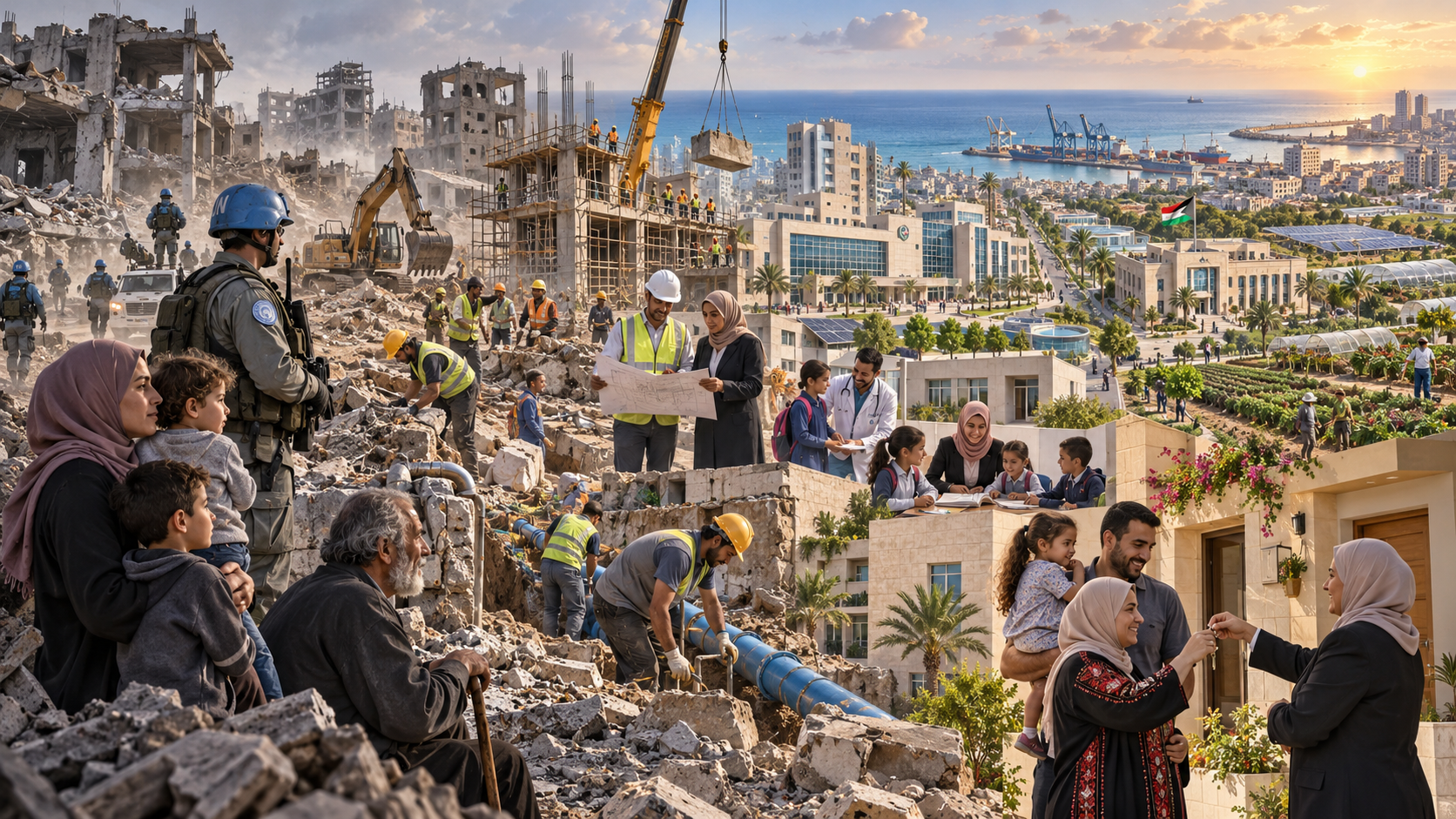
MAA: What about funding to rebuild Gaza and everything that Israel has destroyed?
That would have to be the second pillar of the plan, alongside security. A peacekeeping force without a credible reconstruction mechanism would stabilize rubble rather than create a viable future.
The scale is now enormous. The April 2026 Gaza Rapid Damage and Needs Assessment by the UN, World Bank and EU estimates $71.4 billion in recovery and reconstruction needs over the next decade, including $26.3 billion in the first 18 months. It estimates $35.2 billion in direct physical damage and $22.7 billion in economic and social losses. Housing alone accounts for about $16.2 billion in recovery needs.
I would therefore create a Gaza Reconstruction and Recovery Fund separate from, but coordinated with, the peacekeeping mission. It should be internationally administered, independently audited, and structured so that Palestinians have a meaningful role in deciding what gets rebuilt and where.
A plausible funding model would look something like this:
- Israel: $25–30 billion. Given that Israeli military operations caused a very large share of the physical destruction, I think Israel should make the single largest contribution. Whether this is framed legally as reparations, compensation, reconstruction payments, or a negotiated contribution would depend on the eventual political settlement.
- United States: $10–15 billion. The US has been Israel’s principal military and diplomatic backer and has the financial capacity to make a major contribution.
- European Union and European states: $10–15 billion.
- Gulf states — especially Saudi Arabia, UAE, Qatar and Kuwait: $10–15 billion.
- Japan, South Korea, Canada, Australia and other advanced economies: perhaps $3–5 billion collectively.
- World Bank, Islamic Development Bank and other multilateral institutions: concessional financing, guarantees and project management rather than relying mainly on loans that Palestinians would have to repay.
- Private-sector and diaspora investment: potentially several additional billions once basic security and property rights are restored.
That would readily put a $75–90 billion financing package within reach.
I would strongly resist making ordinary Palestinians borrow the money required to reconstruct homes and infrastructure destroyed during the war. Reconstruction loans that leave Gaza with decades of debt would be a very poor outcome.
The fund should also follow a clear hierarchy. The first $10–15 billion should go into emergency reconstruction: rubble and unexploded-ordnance clearance, temporary housing, water and sewage systems, electricity, hospitals, schools and food production. The latest assessment alone estimates $10.8 billion in immediate needs during roughly the first eight months.
Then I would move into permanent rebuilding: apartments and homes, universities and schools, hospitals, roads, telecommunications, businesses, farms, ports and potentially major new water and energy infrastructure.
One principle would be especially important: rebuilding should not mean merely restoring Gaza to October 6, 2023 conditions. Gaza should emerge with substantially better infrastructure than it had before—modern hospitals, reliable electricity, desalination, renewable energy, high-quality schools and universities, modern wastewater treatment, broadband infrastructure and an economy capable of employing its population.
There would also need to be a direct household compensation mechanism. Families whose homes were destroyed should receive grants to rebuild or purchase replacement housing. People who lost businesses, farms or equipment should have access to compensation and restart grants. Reconstruction cannot consist only of giant government contracts.
And Palestinians should do much of the rebuilding themselves. A massive reconstruction program could employ tens of thousands of Gazans as engineers, construction workers, architects, doctors, teachers, technicians and entrepreneurs. That would simultaneously reconstruct the territory and restart its economy.
The most difficult issue is who pays for destruction caused by whom. I would favor an independent international claims commission—similar in concept to mechanisms used after other wars—to document destroyed homes, businesses, farms, public infrastructure and other property. It would create an evidentiary record and adjudicate compensation claims rather than relying entirely on political bargaining.
Finally, the reconstruction agreement should contain a powerful safeguard:
No donor should spend billions rebuilding Gaza unless there are enforceable guarantees that the reconstructed infrastructure will not simply be destroyed again.
That means reconstruction, security arrangements and a durable political settlement have to be negotiated together. Otherwise the international community risks financing the same schools, hospitals and homes repeatedly.
So I would think of the overall project as three linked pillars:
Protect the population → rebuild Gaza → transfer sovereignty and security responsibility to legitimate Palestinian institutions.
And I would probably increase the target from the official $71.4 billion estimate to something closer to $80–100 billion over ten years, because a true recovery program should cover not only replacement of destroyed structures but economic revitalization, trauma care, education, environmental remediation and modernization.

