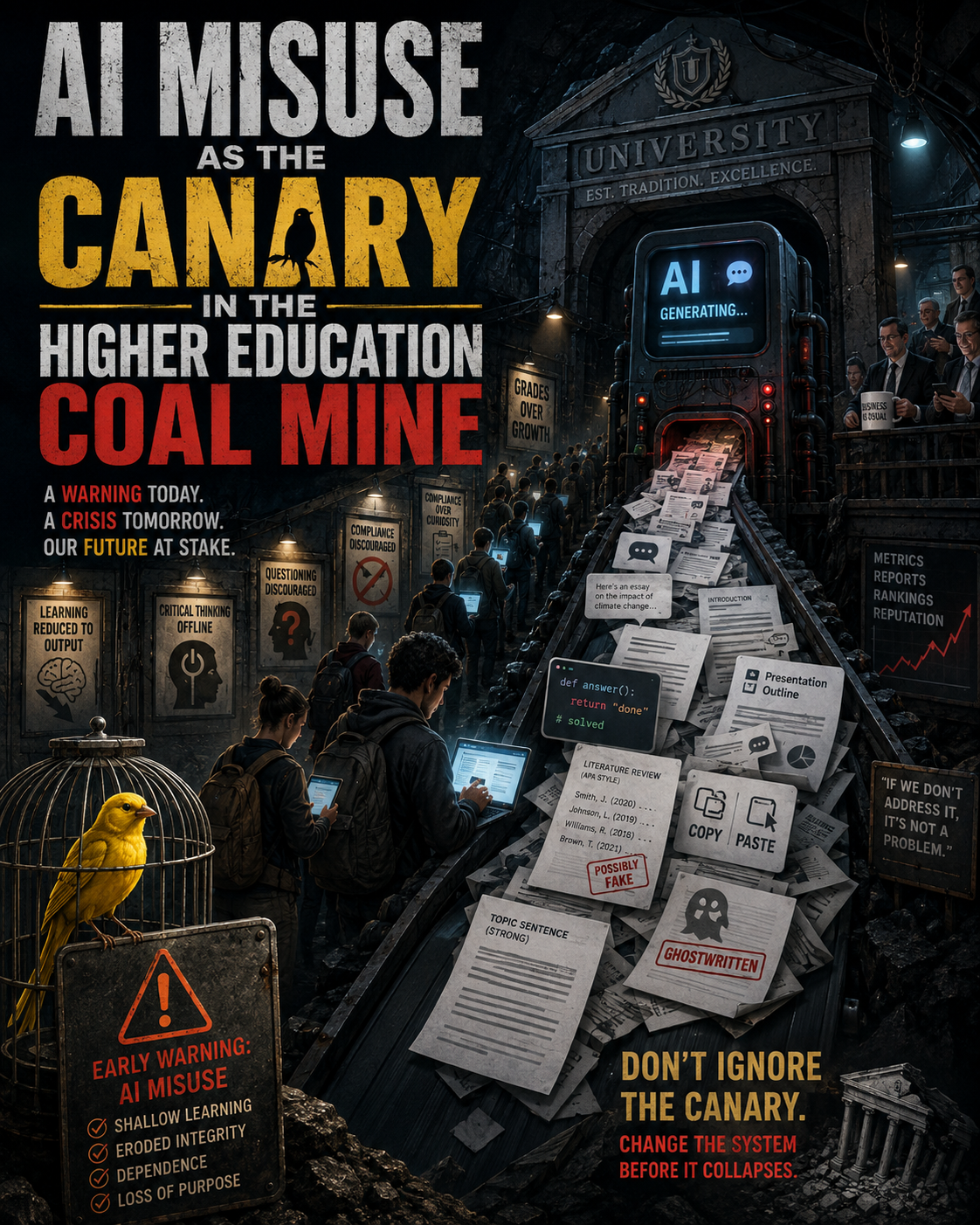
I follow a number of Subreddits in which young Vietnamese, i.e., Gen Z members, post about a variety of important issues, including education, relationships, family, mental health, corruption, the environment, justice, etc. This one appeared the other day in r/vozforums. The issue of AI use, misuse, and abuse in higher education is a canary in the coal mine of higher education. Below is a summary of the comments and a Vietnamese translation of the original post.
Bill Gates addresses some of these challenges in this recent post: The turbulent AI era is here. The choices we make now are critical. I’ll add a Vietnamese translation soon.
MAA
Universities and the Misuse of AI
I’m a third-year IT student at a university in Ho Chi Minh City. I feel that students—and even lecturers—are normalizing the use of AI for everything. Please read this and let me know what you think. Thank you!
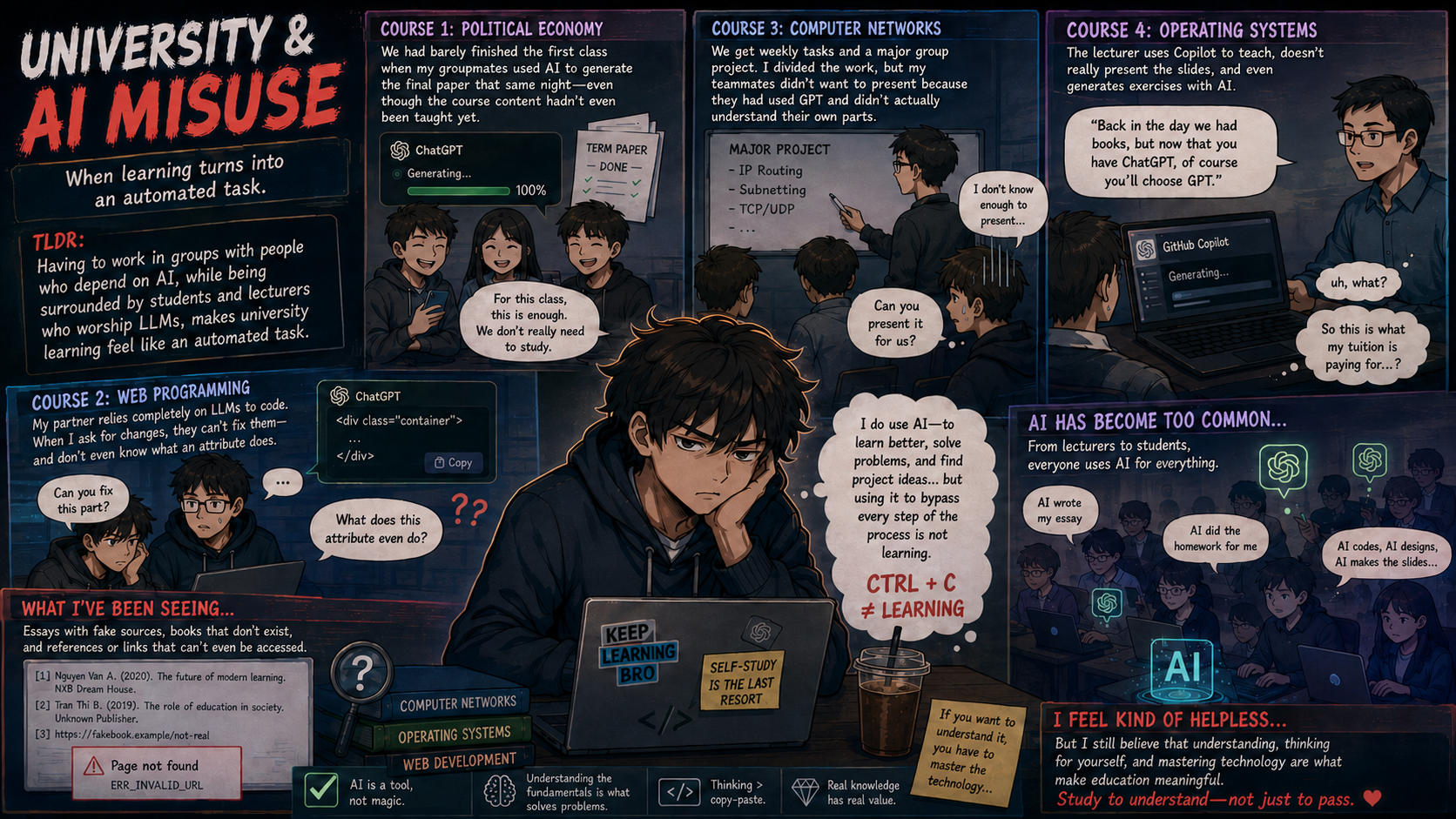
TL;DR (=too long; didn’t read): I have to work with classmates who depend on AI, and I’m surrounded by people—from lecturers to students—who practically worship large language models. It makes me feel as though university education has become an automated task.
This semester, I have several group projects, research papers, and major assignments. I’m taking six courses in total, and, surprisingly, in all four courses that require group work, projects, papers, or major assignments, I’ve encountered AI use—or, more accurately, AI misuse.
The first course is political economy. The lecturer divided us into groups and assigned a research paper that would count toward our final grade. I was placed in a group with three other students. We had only just finished the first class and learned what the final assignment would be, yet my groupmates completed the entire paper that very evening. What the hell? The paper was supposed to take the whole semester. We hadn’t even studied the material yet, but they had already used AI to generate the paper and were planning to submit it to the lecturer.
When I challenged them, they said that was good enough for this course and that there was no need to actually study it. I was stunned and decided to find another group.
The second course is web programming. The project is done in pairs, so I was partnered with another student. The web project was fairly easy for me, but my partner relied entirely on LLMs to write the code. In class, there were a few things I wasn’t satisfied with, so I asked them to make some changes. They didn’t know how to change anything. They didn’t even know what one of the attributes was for. I felt incredibly discouraged, while my partner just sat there looking completely unfazed.
The third course is computer networking. It includes both group work and a major assignment. Every week, the lecturer gives us tasks and exercises to complete, and the major assignment is done in groups. Once it is finished, we have to present it in class. I’m the group leader, so I assigned each member a section and told them they would also present that section. However, they refused and insisted that I do the entire presentation. I agreed.
After two weeks, I realized that they had absolutely no understanding of the subject because they had used GPT to complete the major assignment. As a result, they weren’t confident enough to stand in front of the class and present it themselves.
In my operating systems course, the lecturer uses Copilot to teach. He has slides but doesn’t like presenting them. Even the exercises are AI-generated. At that point, I was thinking, “What the hell—is this really what my university tuition is paying for?” It is something I could do entirely by myself at home. The lecturer also makes statements such as, “People in the past had books, but now that ChatGPT exists, of course you’re going to choose GPT.”
I have witnessed similar things since my first and second years. Some essays use fabricated data or nonexistent sources. For example, when I checked my classmates’ philosophy papers, some of the books listed in their references did not actually exist or could not be accessed. Recently, however, the problem has become widespread. Everyone seems to be doing it, and it really pisses me off.
I feel somewhat helpless about having to work or study with people who use AI to complete everything without understanding what they are doing or possessing any real knowledge—yet they sometimes receive high grades anyway.
I admit that I use AI too. It helps me study more effectively, approach problems more flexibly, and find ideas for projects. But I absolutely hate it when people use AI to bypass the entire learning process. Constantly hitting Ctrl+C and Ctrl+V is not learning—I swear.
Summary of Comments
I asked ChatGPT to summarize all of the comments as of this writing. (This is one of the many productive uses of a GPT.) I agree with the conclusion: AI itself isn’t the problem; using AI to eliminate the intellectual struggle through which students acquire knowledge is the problem—and universities haven’t yet redesigned themselves for that reality.
ChatGPT: The comments are surprisingly balanced. Most commenters agree with the student’s core complaint about AI misuse, but relatively few argue that students should avoid AI altogether. Instead, the dominant view is that the real dividing line is whether AI assists your thinking or replaces it. (Reddit)
Main themes in the comments
- “AI is a tool; you still need to understand what you’re doing.”
This is probably the strongest consensus. Several commenters compare AI to a worker, assistant, tractor, or coding tool: it can save enormous amounts of time, but the person directing it needs enough knowledge to evaluate its output, catch mistakes, make decisions, and take responsibility. One commenter makes the distinction especially clearly: being able to use AI and being able to use AI effectively are not the same thing. (Reddit) - Students who let AI do their thinking may eventually pay a price.
Many tell the original poster not to worry too much about classmates getting high grades through AI. Their argument is that deficiencies will eventually become visible—in job interviews, presentations, internships, actual programming work, communication with clients, or situations where someone has to explain why a solution works. Employers will distinguish between someone who uses AI intelligently and someone who cannot function without it. (Reddit) - Several commenters think the student actually has a long-term competitive advantage.
They encourage the poster to keep learning fundamentals, do personal projects, seek internships, and develop real understanding while classmates chase easy grades. Their reasoning is that when almost everyone can generate acceptable-looking work with AI, actual competence becomes more—not less—valuable. (Reddit) - But some commenters think resistance to AI is unrealistic.
Another camp points out that if AI can turn a day’s work into a 30-second task, people are inevitably going to use it. One commenter jokes that dependence on AI has already begun; another says opposing AI amounts to opposing the direction technology is moving. From this perspective, the appropriate response is not prohibition but learning how to work with it better than other people do. (Reddit) - The more interesting criticism is directed at universities themselves.
One of the strongest comments argues that assignments and grading systems were designed for a pre-AI world. If a semester-long essay or coding project can now be generated instantly, universities cannot simply continue assigning the same work and expect the old learning process to occur. The commenter proposes assessing understanding instead—for example, oral presentations, explanations of concepts, questioning students about their work, or other methods where students have to demonstrate what they actually know. Another commenter suggests written or oral examinations may need to replace some traditional projects and essays. (Reddit) - Some professors are already handling this by testing understanding rather than policing AI.
One commenter describes a lecturer who lets students use AI freely but then questions them closely during presentations; students who cannot explain the core ideas receive poor grades or fail. That approach implicitly accepts that AI use is unavoidable while making understanding the actual assessment criterion. (Reddit) - There is substantial sympathy for the complaint about lecturers using AI lazily.
Commenters distinguish between professors using AI as a teaching aid and professors essentially outsourcing teaching to it. Several agree that if students are paying tuition only to receive AI-generated exercises, slides, or explanations that they could generate themselves at home, they have legitimate grounds to wonder what educational value the university is adding. (Reddit) - Some commenters distinguish between core subjects and “box-checking” courses.
A minority are much less bothered by students using AI to get through compulsory political-economy or other peripheral courses they consider irrelevant. They become much more critical when IT students use AI to bypass learning programming, networking, operating systems, or other subjects directly related to their future profession. (Reddit) - A darker strand worries about genuine intellectual decline.
A few comments describe widespread AI dependence as the beginning of a broader erosion of human competence—people becoming incapable of working independently if ChatGPT, Claude, DeepSeek, or internet access disappears. This is the most pessimistic interpretation: not simply cheating, but a gradual loss of accumulated cognitive ability. (Reddit) - Others point out that this problem existed before AI.
Several commenters argue that universities have always contained two kinds of students: those interested in learning and those interested mainly in passing. Before ChatGPT there were solution manuals, copied assignments, Google, model essays, and other shortcuts. AI has therefore accelerated and amplified an old problem rather than creating an entirely new one. (Reddit)
The overall sentiment
If I condensed the discussion into one sentence, it would be:
AI itself isn’t the problem; using AI to eliminate the intellectual struggle through which students acquire knowledge is the problem—and universities haven’t yet redesigned themselves for that reality.
That is why I think your phrase “AI Misuse as the Canary in the Higher Education Coal Mine” fits the discussion extremely well. The commenters are indirectly pointing to something larger than student cheating: AI is exposing weaknesses that were already present in higher education—obsolete assessment, credentialism, students optimizing for grades instead of mastery, mediocre teaching, and assignments that measure output rather than understanding. (Reddit)
The original student is therefore not really arguing against AI. In fact, they explicitly use it themselves. Their position—and the position of many commenters—is closer to: use AI to learn faster, explore ideas, solve problems, and eliminate low-value repetitive work; don’t use it to bypass learning itself. (Reddit)
Đại học và lạm dụng AI
Em đang là sinh viên năm 3 IT của một trường đại học tại TPHCM. Em đang cảm thấy sinh viên thậm chí là giảng viên đang bình thường hóa việc dùng AI cho mọi thứ. Mọi người hãy đọc và cho em xin cảm nhận nhé, em xin cảm ơn ạa
TLDR: phải làm nhóm chung những người bạn lệ thuộc vào AI, xung quanh là người tôn thờ llms từ giảng viến đến sinh viên, làm em cảm thấy việc học trên giảng đường như một nhiệm vụ được tự động hóa.
Chuyện là kì này em phải làm nhóm và cả đồ án, tiểu luận. Em học tổng cộng 6 môn cho kì này và surprisingly cả 4 môn làm nhóm, đồ án or tiểu luận/bài tập lớn thì em đều bắt gặp việc dùng AI (lạm dụng thì đúng hơn).
Môn đầu là kinh tế chính trị, cô phân chia và cho làm tiểu luận để lấy điểm cuối kì, em có làm nhóm chung với 3 bạn, vừa học buổi đầu xong và sau khi biết được nội dung cuối kì, các bạn đã làm xong luôn cái tiểu luận trong buổi tối hôm đấy (wtf), cái tiểu luận phải tốn cả kì, thậm chí nội dung chưa học nhưng đã dùng AI để generated ra rồi định đem nộp cho cô??
Khi em chất vấn thì các bạn bảo môn này làm vậy được rồi, không cần phải học, lúc đó mình đơ cái người ra và quyết định kiếm nhóm khác.
Môn thứ hai là lập trình web, môn này làm đồ án 2 người, em có chung nhóm một bạn kia, đồ án web đối với em là khá dễ, tuy nhiên bạn trong nhóm em hoàn toàn dựa vào LLMs để code, lúc trên lớp có mấy chỗ em chưa ưng thì có nhờ bạn sửa thì bạn không biết sửa, thậm chí không biết cái attribute của nó để làm gì? em thật sự rất nản luôn, còn bạn đó thì trơ trơ cái mặt ra.
Môn thứ ba là mạng máy tính, môn này em làm nhóm và cả bài tập lớn. Thầy mỗi tuần sẽ giao task và bài tập về để làm, và bài tập lớn thì sẽ làm theo nhóm. Sau khi làm xong sẽ trình bày trên lớp. Em làm leader và có phân cho mỗi bạn trong nhóm một phần, và người đó cũng sẽ trình bày phần đó luôn, tuy nhiên các b lại không chịu và bắt em trình bày, và em cũng oke. Sau 2 tuần học thì em mới nhận ra là các bạn ko có một chút kiến thức gì cả, vì các bạn dùng gpt để làm bài tập lớn, thành ra không thể tự tin đứng trước lớp để trình bày.
Ở môn hệ điều hành, thì giảng viên dùng copilot để giảng dạy, có slide nhưng không thích trình bày, :)) kể cả bài tập thì thầy cũng generate ra để làm, lúc đó em kiểu ô wtf tiền học đại học của em đây sao, thứ mà em có thể hoàn toàn tự làm ở nhà. và có những phát biểu kiểu “thời đại trước có sách nhưng bây giờ có chatgpt thì các bạn chắc chắn sẽ chọn gpt rồi”
Em đã chứng kiến những việc tương tự từ năm 1, năm 2. Mấy bài luận dùng dữ liệu or nguồn ảo, vd môn triết em tra các bài luận của các bạn thì cái nguồn của cuốn sách tham khảo lại k có thật, hoặc không thể truy cập. những dạo gần đây thì có thể gọi là tràn lan, ai ai cũng dùng và nó pisses me off 
Em cảm thấy hơi bất lực trong việc phải làm nhóm, hoặc học với những người dùng AI để hoàn thành mọi thứ mà không hiểu hoặc không có một chút kiến thức nào, thậm chí đạt điểm cao nữa. và em thừa nhận em vẫn dùng AI, nó giúp em học tốt hơn, giải quyết vấn đề linh hoạt hơn, tìm kiếm ý tưởng project, nhưng em cực kì ghét cái kiểu dùng nó để bypass tất cả mọi quá trình, spam nút ctrl c và ctrl v không phải là học đâu, thề lun ý.

