This is a brilliant essay by Hani Almadhoun, co-founder of Gaza Soup Kitchen (please donate if you have the means!) and vice president of philanthropy at UNRWA USA. (Please donate to one or both if you have the means. They are doing lifesaving work in Gaza.) You can follow Hani on Facebook (click on his full name) and/or on LinkedIn. Note: I am someone who uses the word “brilliant” selectively and rarely.
Hani’s essay reminds me of Benjamin Fondane’s poem Preface in Prose. Follow this link to read an essay I wrote about this poem. Fondane was murdered in October 1944 in a gas chamber at the Auschwitz-Birkenau death camp.
MAA
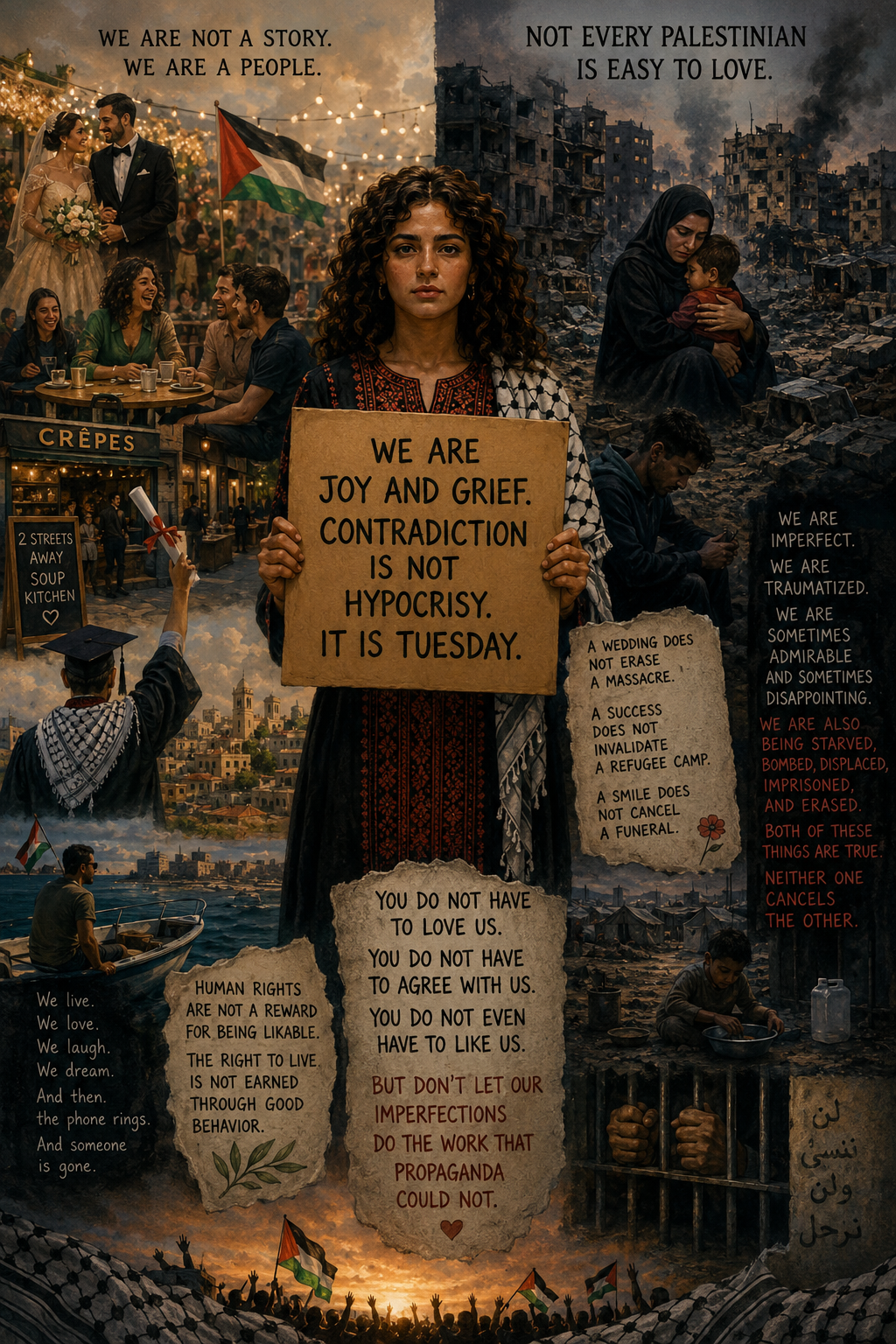
Not every Palestinian is easy to love.
Some are difficult. Some are selfish. Some will disappoint you, argue with you, break your heart, vote for people you despise, or take your support for granted. Some threw lavish weddings while Gaza burned and posted every photo. Some collaborated. Some still hand you products from the boycott list. Some stayed silent when they should have spoken.
We are not a people of saints.
We never claimed to be.
We are a people, which is a far messier thing.
What I have watched happen over and over is this: some people love Palestinians until they meet one.
They love the idea of us. The symbol. The child under the rubble. The grieving mother. The refugee. The victim.
Then they meet an actual Palestinian.
A Palestinian who is successful. Loud. Complicated. Political. Apolitical. Religious. Not religious. Rich. Annoying. Arrogant. Funny. Wrong.
Human.
And suddenly something shifts.
The moment a Palestinian steps outside the frame of perfect victimhood, some people seem relieved. Like they’ve been waiting for an excuse.
One disagreement.
One offensive opinion.
One flashy wedding.
One successful business.
One ordinary human flaw.
And suddenly the bombs become “complicated.” The siege becomes “nuanced.” The children become harder to mourn.
That is not solidarity.
That is a transaction with a hidden clause.
We see it.
I’ve heard people throw our suffering at us during arguments as if it were an insult.
As if a refugee camp is something to weaponize.
As if hunger is a character flaw.
As if living in a tent somehow makes you less entitled to your dignity.
I’ve watched people remind Palestinians of donations they made years ago, as though compassion came with ownership papers.
As though support purchased the right to judge every wedding, every celebration, every success story, every imperfect reaction.
A population is not a mascot for its own tragedy.
We do not owe the world permanent sadness to prove our pain is real.
A Palestinian can brag about his boat, his car, or his business and still spend the evening mourning the boy from his village who was killed at a playground.
A restaurant can sell overpriced crepes while a soup kitchen two streets away feeds families who have not eaten since yesterday.
A wedding in Ramallah does not erase a massacre in Gaza.
A successful surgeon does not invalidate a refugee camp.
A smiling photograph does not cancel a funeral.
This is what people miss.
Contradiction is not hypocrisy here.
It is just Tuesday.
We carry joy and grief at the same time because we do not have the luxury of carrying them separately.
Life does not pause for our tragedies.
Children still fall in love. Students still graduate. Families still celebrate. Friends still laugh at stupid jokes.
And then the phone rings.
And someone is gone.
That is how many of us have lived.
You do not get to donate to a cause and then hold the receipt over the heads of the people it was meant to serve.
You do not get to revoke someone’s humanity because they were arrogant, ungrateful, politically inconvenient, or simply human in a way you did not expect.
Human rights are not a reward for being likable.
The right to live is not earned through good behavior.
We are imperfect.
We are traumatized.
We are sometimes admirable and sometimes disappointing.
We are also being starved, bombed, displaced, imprisoned, and erased.
Both of these things are true.
Neither one cancels the other.
You do not have to love us.
You do not have to agree with us.
You do not even have to like us.
But don’t let our imperfections do the work that propaganda could not.

