What’s Past is Prologue (W. Shakespeare, The Tempest,1610/11)
I like Heather Cox Richardson’s updates about events from US history. She takes a “just the facts, mam” approach that usually speaks volumes. In this case, the focus is on slavery, the main reason for the US Civil War from 1861-1865. I know this dates me but that was less than a century before I was born.
The spirit of this odious March 1858 quote from South Carolina senator James Henry Hammond is very much alive in 2026. As Cox Richardson notes, he explained to his colleagues that “the ‘harmonious…and prosperous” system of the South worked precisely because a few wealthy men ruled over a larger class with a low order of intellect and but little skill.” Hammond dismissed ‘as ridiculously absurd’ the idea that ‘all men are born equal.’ Sadly, Hammond didn’t live to witness the defeat of the South. (Yet another example of my settler colonial bona fides, Hammond is a paternal 5th cousin five times removed. We’re both direct descendants of prominent New England settler colonizer families, e.g., Freeman.)
It’s worth reminding you, dear reader, that the main reason for the (US) American Revolution from the perspective of the elite, most of whom were slaveowners, was the retention of slavery as a foundation of the new nation’s economy. If this is news to you, check out Gerald Horne’s book The Counter-Revolution of 1776: Slave Resistance and the Origins of the United States of America, which argues that the American Revolution was fought partly to protect slavery in response to growing abolitionist sentiment in Britain, particularly the 1772 Somerset case. In essence the revolution was a counter-revolution to maintain the profitable institution of slavery and the associated “way of life.” A short 85 years later, this pivotal issue reared its ugly head again with the US Civil War. As we all know, the mentality in which slavery is embedded is alive and well at the highest levels in the USA of 2026.
The US has failed utterly to overcome its past in the spirit of Vergangenheitsbewältigung. How could it be otherwise in the face of nationalism, racism and, more recently, evangelical Christianity?
April 11, 2026 Update
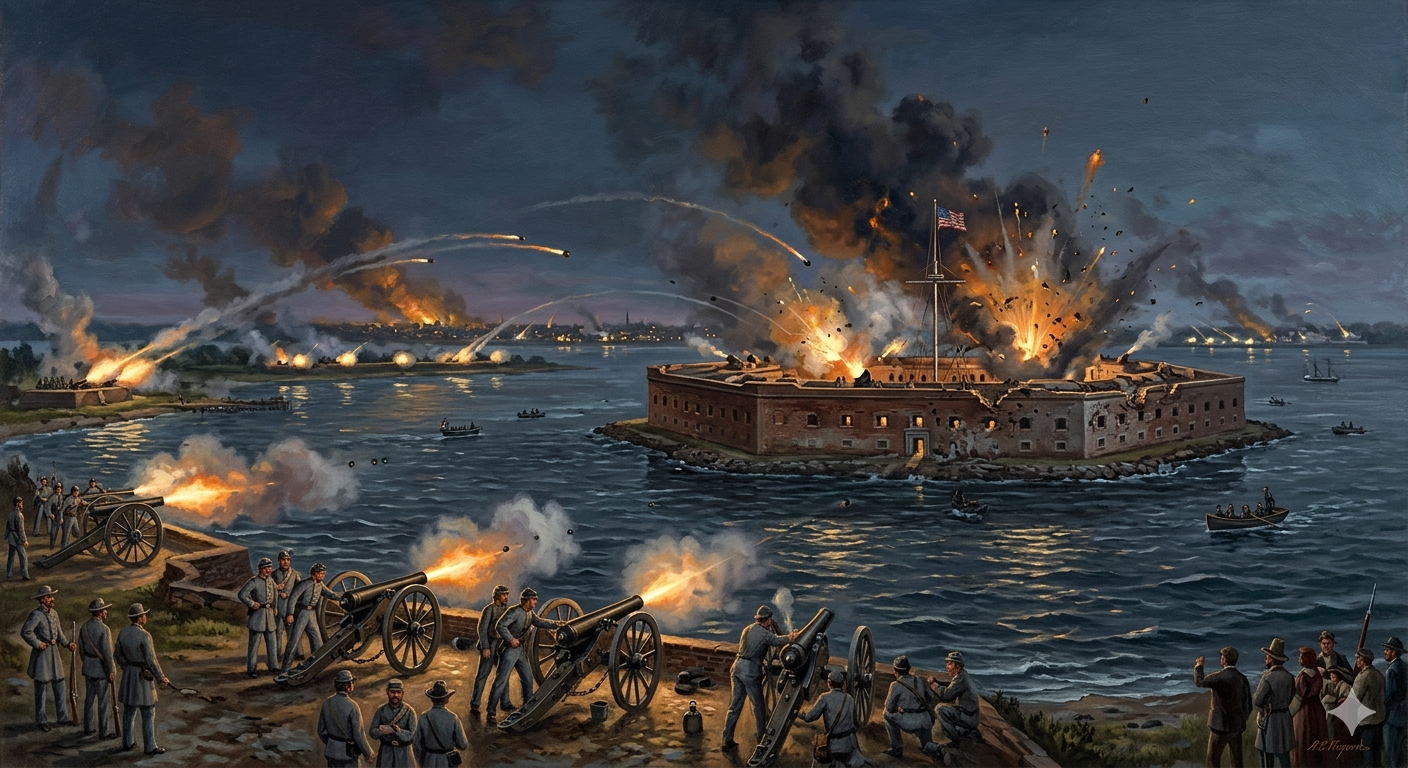
At 4:30 a.m. on April 12, 1861, Confederate forces fired on Fort Sumter, a federal fort built on an artificial island in Charleston Harbor.
Attacking the fort seemed a logical outcome of events that had been in play for at least four months. On December 20, 1860, as soon as it was clear Abraham Lincoln had won the 1860 presidential election, South Carolina lawmakers had taken their state out of the Union. “The whole town [of Charleston] was in an uproar,” Elizabeth Allston recalled. “Parades, shouting, firecrackers, bells ringing, cannon on the forts booming, flags waving, and excited people thronging the streets.”
Mississippi had followed suit on January 9, 1861; Florida on January 10; Alabama on January 11; Georgia on January 19; Louisiana on January 26; and Texas on February 1. By the time Lincoln took the oath of office on March 4, 1861, seven southern states had left the Union and formed their own provisional government that protected human enslavement.
Their move had come because the elite enslavers who controlled those southern states believed that Lincoln’s election to the presidency in 1860 itself marked the end of their way of life. Badly outnumbered by the northerners who insisted that the West must be reserved for free men, southern elites were afraid that northerners would bottle up enslavement in the South and gradually whittle away at it. Those boundaries would mean that white southerners would soon be outnumbered by the Black Americans they enslaved, putting not only their economy but also their very lives at risk.
To defend their system, elite southern enslavers rewrote American democracy. They insisted that the government of the United States of America envisioned by the Founders who wrote the Declaration of Independence had a fatal flaw: it declared that all men were created equal. In contrast, the southern enslavers were openly embracing the belief that some people were better than others and had the right to rule.
They looked around at their great wealth—the European masters hanging in their parlors, the fine dresses in which they clothed their wives and daughters, and the imported olive oil on their tables—and concluded they were the ones who had figured out the true plan for human society. As South Carolina senator James Henry Hammond explained to his colleagues in March 1858, the “harmonious…and prosperous” system of the South worked precisely because a few wealthy men ruled over a larger class with “a low order of intellect and but little skill.” Hammond dismissed “as ridiculously absurd” the idea that “all men are born equal.”
On March 21, 1861, Georgia’s Alexander Stephens, the newly elected vice president of the Confederacy, explained to a crowd that the Confederate government rested on the “great truth” that the Black man “is not equal to the white man; that…subordination to the superior race is his natural and normal condition.” Stephens told listeners that the Confederate government “is the first, in the history of the world, based upon this great physical, philosophical, and moral truth.”
Not every white southerner thought secession from the United States was a good idea. Especially as the winter wore into spring and Lincoln made no effort to attack the South, conservative leaders urged their hot-headed neighbors to slow down. But for decades, southerners had marinated in rhetoric about their strength and independence from the federal government, and as Senator Judah P. Benjamin of Louisiana later wrote, “[t]he prudent and conservative men” of the South were not “able to stem the wild torrent of passion which is carrying everything before it…. It is a revolution…of the most intense character…and it can no more be checked by human effort, for the time, than a prairie fire by a gardener’s watering pot.”
Southern white elites celebrated the idea of a new nation, one they dominated, convinced that the despised Yankees would never fight. “So far as civil war is concerned,” one Atlanta newspaper wrote in January 1861, “we have no fears of that in Atlanta.” White southerners boasted that “a lady’s thimble will hold all the blood that will be shed” in establishing a new nation. Senator James Chesnut of South Carolina went so far as to vow that he would drink all the blood shed as a consequence of southern secession.
Chesnut’s promise misread the situation. Northerners recognized that if Americans accepted the principle that some men were better than others, and permitted southern Democrats to spread that principle by destroying the United States, they had lost democracy. “I should like to know, if taking this old Declaration of Independence, which declares that all men are equal upon principle, and making exceptions to it, where will it stop?” Lincoln had asked in 1858.
Northerners rejected the white southerners’ radical attempt to destroy the principles of the Declaration of Independence. They understood that it was not just Black rights at stake. Arguments like that of Stephens, that some men were better than others, “are the arguments that kings have made for enslaving the people in all ages of the world,” Lincoln said. “You will find that all the arguments in favor of king-craft were of this class; they always bestrode the necks of the people, not that they wanted to do it, but because the people were better off for being ridden…. Turn in whatever way you will—whether it come from the mouth of a King, an excuse for enslaving the people of his country, or from the mouth of men of one race as a reason for enslaving the men of another race, it is all the same old serpent….”
Northerners rejected the slaveholders’ unequal view of the world, seeing it as a radical reworking of the nation’s founding principles. After the Confederates fired on Fort Sumter, Lincoln called for 75,000 troops to put down the rebellion against the government. He called for “loyal citizens to favor, facilitate, and aid this effort to maintain the honor, the integrity, and the existence of our National Union, and the perpetuity of popular government; and to redress wrongs already long enough endured.”
Like their southern counterparts, northerners also dismissed the idea that a civil war would be bloody. They were so convinced that a single battle would bring southerners to their senses that inhabitants of Washington, D.C., as well as congressmen and their wives packed picnics and took carriages out to Manassas, Virginia, to watch the Battle of Bull Run in July 1861. They decamped in panic as the battle turned against the United States army and soldiers bolted past them, flinging haversacks and rifles as they fled.
For their part, southerners were as shocked by the battle as the people of the North were. “Never have I conceived,” one South Carolina soldier wrote, “of such a continuous, rushing hailstorm of shot, shell, and musketry as fell around and among us for hours together. We who escaped are constantly wondering how we could possibly have come out of the action alive.”
Over the next four years, the Civil War would take more than 620,000 lives and cost the United States more than $5 billion. By 1865, two thirds of the assessed value of southern wealth had evaporated; two fifths of the livestock—horses and draft animals for tilling fields as well as pigs and sheep for food—were dead. Over half the region’s farm machinery had been destroyed, most factories were burned, and railroads were gone, either destroyed or worn out. But by the end of the conflagration, the institution of human enslavement as the central labor system for the American South was destroyed.
On March 4, 1865, when a weary Lincoln took the oath of office for a second time, he reviewed the war’s history. “To strengthen, perpetuate and extend [slavery] was the object for which the insurgents would rend the Union even by war while the government claimed no right to do more than to restrict the territorial enlargement of it,” he said. “Neither party expected for the war the magnitude or the duration which it has already attained. Neither anticipated that the cause of the conflict might cease with or even before the conflict itself should cease. Each looked for an easier triumph and a result less fundamental and astounding.
“Both read the same Bible and pray to the same God and each invokes His aid against the other. It may seem strange that any men should dare to ask a just God’s assistance in wringing their bread from the sweat of other men’s faces but let us judge not that we be not judged. The prayers of both could not be answered—that of neither has been answered fully. The Almighty has His own purposes.”
“Both parties deprecated war but one of them would make war rather than let the nation survive, and the other would accept war rather than let it perish,” he said.
“And the war came.”
—
Notes:
https://www.nps.gov/kemo/learn/historyculture/wardeclared.htm
https://www.nps.gov/linc/learn/historyculture/lincoln-second-inaugural.htm
Elizabeth Waties Allston Pringle, Chronicles of Chicora Wood (1922), at https://www.google.com/books/edition/Chronicles_of_Chicora_Wood/yFtAAAAAYAAJ (if anyone is interested, there are stories in this book of making clothes from curtains, just as Carol Burnett’s character did in “Went with the Wind.”)
Henry Cleveland, Alexander H. Stephens in Public and Private with Letters and Speeches (1866), at https://www.google.com/books/edition/Alexander_H_Stephens_in_Public_and_Priva/qjA6AAAAcAAJ
Selections from the Letters and Speeches of the Hon. James Henry Hammond (1866), at: https://www.google.com/books/edition/Selections_from_the_Letters_and_Speeches/FvMeZzrWW3AC
 An International Educator in Vietnam
A related post by HCR: April 15, 2026 (Wednesday)
Heather Cox Richardson
On the evening of April 14, 1865, President Abraham Lincoln and First Lady Mary Todd Lincoln went to Ford’s Theater in Washington, D.C., to see a production of the comedy Our American Cousin. The Lincolns had spent the afternoon taking a carriage ride together and discussing the future, including the travel they hoped for, to Europe and to California to see the Pacific Ocean.
One of the last men to speak with the president before he left for the theater said it seemed the cares of the previous four years were melting away. The Confederacy was all but defeated, and the nation seemed to be on its way to a prosperous, inclusive new future.
The very heavens seemed to reflect the dawn of a new era. Poet Walt Whitman noted that after months of fog and clouds, the weather had cleared. “The western star, Venus, in the earlier hours of evening, has never been so large, so clear,” he wrote. “It seems as if it told something as if it held rapport indulgent with humanity, with us Americans.”
When the Lincolns and their guests arrived at the theater at about 8:30, the people in the audience leaped to their feet to applaud and the actors stopped the production while the orchestra played “Hail to the Chief.” About a half-hour later, the president felt chilly and put on his overcoat but was clearly relaxed and enjoying the play. Shortly after 10:00 the Lincolns were holding hands, and Mrs. Lincoln worried their public affection would scandalize the young Clara Harris, daughter of New York senator Ira Harris, who shared their box with her fiance, Major Henry Rathbone. Mrs. Lincoln whispered to her husband that she wondered what Clara would think of them holding hands, and Lincoln answered: “She won’t think anything about it.”
They would be the last words he ever spoke. On the stage, the play had just reached its best joke, and as the audience roared with laughter, actor John Wilkes Booth entered the presidential box and shot Lincoln in the head, then slashed Rathbone’s arm as the officer tried to stop him from getting away. He jumped to the stage, breaking his leg, and shouted the state motto of Virginia, “Sic Semper Tyrannis,” thus always to tyrants.
As Booth escaped, news spread that Secretary of State William Henry Seward had also been attacked, and in the days to follow, the euphoria of the last days of the war gave way to grief. The windows in Washington, D.C., were hung with black garlands. And then the rain came back. In New York City, Whitman wrote in his diary: “Lincoln’s death—black, black, black—as you look toward the sky—long broad black like great serpents slowly undulating in every direction—New York is distinguished for its countless gay flags—every house seems to have a flag staff—on all these the colors were at half mast.”
At first, Americans wanted revenge against the men who had slain their president. After a two-week investigation in which they questioned hundreds of people, investigators identified ten people they believed responsible for Lincoln’s death. Booth himself had been killed on April 26 as officers tried to take him into custody. Another conspirator had fled the country. The other eight stood trial for seven weeks before a military commission in May and June 1865. Four were sentenced to death by hanging; four were imprisoned.
But while Americans mourned Lincoln, the new president, Andrew Johnson, restored the political power of Confederates. On May 28, he issued a blanket pardon for most former Confederates except certain leaders and wealthy southern planters. Those he said could apply to him directly for a presidential pardon, which he promised would be “liberally extended.” They were. By December 1865 he had pardoned all but about 1,500 former Confederate leaders.
At the same time, Johnson either looked the other way or cheered as southern state legislatures passed Black Codes, laws that worked to push Black Americans back into subservience. Congress had adjourned in March 1865, the day of Lincoln’s second inauguration, and Johnson refused to call it back into emergency session after Lincoln’s death. When it convened in December, Johnson told the congressmen that Reconstruction was over. Northern congressmen simply had to seat newly elected southern congressmen—some of whom had led the Confederacy less than a year before—to end the unpleasantness of the war years.
Congress fought back, trying to protect the principles for which Lincoln had died, but with no accountability for a war that had left 620,000 Americans dead and cost more than $5 billion, the ideas of the Confederacy never became odious. Former Confederates still talked to newspapermen, gave speeches, ran for office, and garnered support.
By the 1870s, after the establishment of the Department of Justice meant that discrimination based on race could result in federal charges, former Confederates switched their rhetoric from race to economics. Because most Black men were impoverished, their votes for roads and schools and hospitals translated into tax levies on white men with property. Former Confederates argued that Black voting was just a redistribution of wealth from white taxpayers to Black Americans, a form of socialism.
That rhetoric appealed to northern Americans who worried about immigrants voting in cities. Increasingly, they listened as former Confederates began to argue that their fight had not been to spread human enslavement—despite their many declarations saying exactly that—but to preserve individualism from a grasping federal government.
By the 1890s, towns not only across the South but also in the North and West were putting up statues of Confederate soldiers as symbols of true America.
In the 1930s, with the southern economy dependent on New Deal programs from the federal government, Confederate iconography fell out of sight, but it sprang back to popularity after President Harry S. Truman, a Democrat, ordered the integration of the U.S. military in 1948. That year, the Democratic Party split in two as half of the party followed Truman and half refused. Southern racists under then–South Carolina governor Strom Thurmond—who had fathered the child of his family’s teenaged Black housekeeper in 1925—formed the segregationist States Rights Democratic Party, called “Dixiecrat” in a play on the South’s nickname, and took the Confederate battle flag as their party flag.
The ruling of a unanimous Supreme Court that racial segregation in the public schools was unconstitutional in the May 1954 Brown v. Board of Education of Topeka, Kansas, decision resurrected Confederate ideology more widely. In Georgia the Ku Klux Klan had reformed near Stone Mountain outside of Atlanta in the early twentieth century, and the United Daughters of the Confederacy set out to create a giant carving of Confederate leaders on the side of the mountain. The plan had been abandoned by 1928 as interest in the project waned, but it was reborn after Brown v. Board. Vice President Spiro Agnew dedicated the monument, which features Confederate leaders Jefferson Davis, Robert E. Lee, and Stonewall Jackson, in May 1970.
The idea that those embracing the iconography of the Confederacy were simply defending individual liberty against an overreaching government became an article of faith among the radical right, especially as the Republican Party complained that the taxes necessary to run a modern government that included everyone were promoting socialism.
Former Army gunner Timothy McVeigh wrote to a newspaper in 1992, saying: “Taxes are a joke. More taxes are always the answer to government mismanagement…. Is a Civil War Imminent? Do we have to shed blood to reform the current system? I hope it doesn’t come to that. But it might.”. Three years later, McVeigh set off a bomb at the Alfred P. Murrah Federal Building in Oklahoma City, Oklahoma, killing 168 people, including nineteen children younger than six, and wounding more than 800 others. When captured, he was wearing a T-shirt with a picture of Abraham Lincoln and the words “Sic Semper Tyrannis.”
In 2009, Elmer Stewart Rhodes, a lawyer and former paratrooper who had been a staffer for Representative Ron Paul (R-TX), started a right-wing gang called the “Oath Keepers.” Claiming to take their inspiration from the patriots who stood against the British regulars on Lexington Green in 1775, they pledged to stand against what they considered a tyrannical government.
In 2021, Rhodes and the Oath Keepers, along with the right-wing Proud Boys, were part of the planning and execution of the January 6 attack on the U.S. Capitol when they tried to stop the counting of the electoral votes that would make Democrat Joe Biden president. Biden had won both the electoral vote and the popular vote by more than 7 million votes, but the insurrectionists wanted their own leader, President Donald Trump, to stay in office. One of the rioters accomplished what the southern troops during the Civil War had never been able to: he carried the Confederate flag into the United States Capitol.
In November 2022 a federal jury convicted Rhodes of seditious conspiracy for using force and violence to try to stop the process of the democratic election of a president. Juries found at least a dozen other Oath Keepers guilty of seditious conspiracy or other serious crimes.
As soon as he retook office in 2025, Trump issued a sweeping pardon to the participants in the January 6 attack who had been convicted of crimes, including the crimes of using a deadly weapon and causing serious bodily injury to an officer, removing accountability for their attempt to overturn the nation’s democratic process and releasing them back into the streets. At the time, he commuted the sentence of fourteen of the leading Oath Keepers and Proud Boys, ending prison sentences that had been as long as 22 years.
Because he did not pardon those leaders, but commuted their sentences, their cases continued to work their way through the appeals court. Yesterday the Department of Justice moved to wipe out the seditious conspiracy convictions altogether. “The United States has determined in its prosecutorial discretion that dismissal of this criminal case is in the interests of justice,” Assistant U.S. Attorney Daniel Lenerz of the U.S. Attorney’s Office in Washington, D.C., wrote.
Exactly 161 years before, on the night of April 14, 1865, bystanders at Ford’s Theater had carried the grievously wounded Lincoln to a boardinghouse across the street, where members of his Cabinet crowded around his bed. At 7:22 on the morning of April 15, 1865, President Abraham Lincoln breathed his last. His secretary of war, Edwin Stanton, stood heartbroken by the bedside of the man who had tried to preserve American democracy and said, “Now he belongs to the ages.”
When he tried to put his own loss, and that of the nation, to poetry, Walt Whitman thought back to the heady days of Spring 1865 when the heavens themselves seemed to promise a glorious democratic future, and their contrast to what came after.
“When lilacs last in the dooryard bloom’d,” he wrote, “And the great star early droop’d in the western sky in the night,
“I mourn’d, and yet shall mourn with ever-returning spring.”
[Image of Abraham Lincoln by Alexander Gardner, 1863]
Notes:
Excerpts from Walt Whitman’s Diary, reprinted in Charles I. Glicksberg, “Walt Whitman and the Civil War,” PhD thesis (Philadelphia: n.p., 1933), pp. 174–175.
https://www.nps.gov/foth/learn/historyculture/the-lincoln-conspirators.htm
https://millercenter.org/the-presidency/presidential-speeches/may-29-1865-proclamation-pardoning-persons-who-participated
David Willman, “McVeigh Lashed Out at Government in ‘92 Letters,” Los Angeles Times, April 27, 1995.
Ryan Lucas, “Who Are the Oath Keepers” Militia Group, Founder Scrutinized in Capitol Riot Probe, WBUR, April 10, 2021.
https://www.pbs.org/newshour/show/oath-keepers-founder-convicted-of-seditious-conspiracy-for-role-in-jan-6-attack
https://www.politico.com/news/2025/11/10/donald-trump-pardon-2020-election-allies-00646073
https://www.bbc.com/news/articles/c5y7l47xrpko
https://www.cnn.com/2026/04/14/politics/justice-department-vacate-seditious-conspiracy-convictions-proud-boys-oath-keepers