Celebrating the 50th anniversary of the end of the US war and the reunification of Vietnam. It’s been my privilege and honor to be a resident of Vietnam for 20 of those 50 years. This national holiday is also known as “Victory Day” and “Day of the Liberation of the South.” The most common reference is Reunification Day.
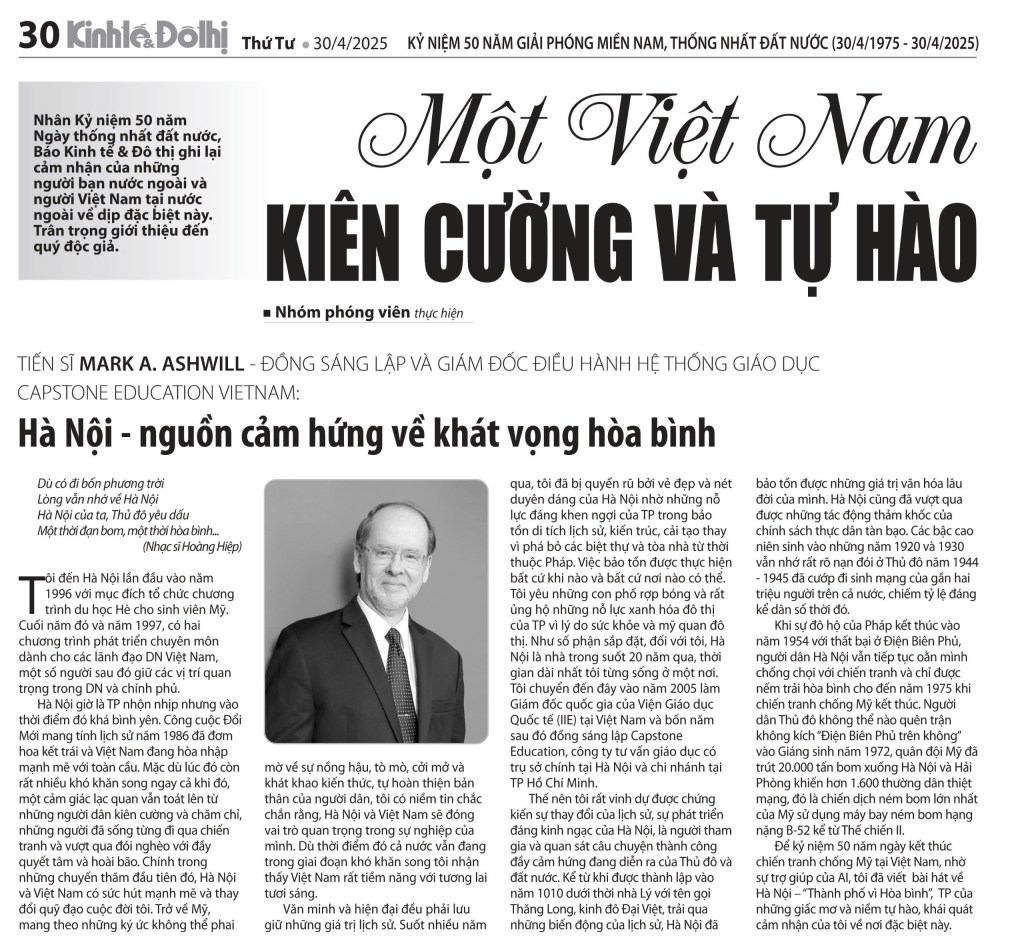
Here’s an article I wrote for Hanoi Times. Below are some excerpts from a Vietnamese version.
Our Hanoi
Even if I travel to the four corners of the world, I still remember Hanoi
Our Hanoi, beloved capital
A time of bullets, a time of peace
Longing for Hanoi, Hoàng Hiệp
It was early 1996 when I embarked on my first journey to Hanoi to create a summer study abroad program for US students, one of the first of its kind in the postwar era. Later that year and in 1997, two professional development programs for Vietnamese business leaders, some of whom subsequently ascended to prominent positions in business and government, were spinoffs of that partnership.
Hanoi, now a bustling city of over 8 million souls, was a much quieter, almost serene place with few cars and even fewer stoplights. The historic 1986 renovation (Đổi Mới) reforms were just beginning to bear fruit, and Vietnam was joining the global community. It was the proud yet still subdued and sleepy capital of one of the poorest countries in the world. Yet even the,n an unparalleled sense of optimism was palpable among its hardworking and long-suffering people who had survived war and poverty only to emerge determined and full of dreams.
One of many lasting memories from those early days is the surreal experience of riding around Hanoi on a sultry June evening in a friend’s big black Mercedes, Vietnamese music playing in the background. Đức was a successful entrepreneur who had studied in the former German Democratic Republic (East Germany) and became wealthy with a chain of photo processing labs and various import-export ventures at a time when it was not yet fashionable to be rich and flaunt it. He was ahead of his time, but a role model for others who realized that the future of Vietnam would be determined by smart government policies and a strong private sector.
It was during those initial visits that Hanoi and Vietnam cast their spell on me and changed the trajectory of my life. I boarded my flights home with a tinge of sadness and indelible memories of a people’s warmth, curiosity, openness, and an unquenchable thirst for knowledge and self-improvement. I also returned to the USA, my home country, with the certain knowledge that Hanoi and Vietnam would play a pivotal role in my personal and professional future. Though still in the early stages of recovery from war, dislocation, and poverty, it was clear to me as a casual observer that Vietnam was a country with deep reservoirs of untapped potential and a bright future.
Over the years, I’ve been captivated by Hanoi’s charm and beauty, including the city’s laudable efforts to preserve its architectural history by renovating rather than razing the villas and other buildings from the French colonial era. Progress and modernity must also embrace the preservation of history whenever and wherever possible.
I love Hanoi’s tree-lined streets and support official efforts to keep replanting trees for aesthetic and health-related reasons. As I once wrote, “There are many miracles in our midst if we only take the time and have the eyes to see them. The life cycle and annual metamorphosis of the trees of Hanoi, such as the cây bằng lăng (giant crape myrtle) and the cây gạo (red silk cotton tree), are certainly one of them.” Like other trees in the city, they are beautiful, graceful, and tough. Many grow away from the buildings towards the sun and must contend with air pollution and nails hammered into them to hang signs selling whatever, yet they survive and prosper. Like many people who live in their midst, they are resilient survivors.
As fate would have it, I have happily called Hanoi home for 20 years, the most time I’ve ever lived in one place. I moved here in 2005 to become country director of the Institute of International Education (IIE) in Vietnam. My shift to the private sector came four years later when I co-founded Capstone Education, a full-service educational consulting company with its headquarters in Hanoi and a branch office in Ho Chi Minh City (HCMC). It is my privilege to be an eyewitness to history in the making, a participant-observer in an exhilarating and unfolding success story of Hanoi and the nation.
Hanoi as a Source of Inspiration
The people of Hanoi have survived so much since the city’s founding in 1010 under the Lý dynasty as Thăng Long, the capital of the imperial Vietnamese nation Đại Việt. Against daunting odds, they have preserved their culture. Hanoi has also overcome the disastrous effects of brutal colonial policies. Older Hanoians who were born in the 1920s and 1930s, vividly remember the Hanoi famine of 1944-45 that claimed the lives of 400,000 to 2 million people in the city and surrounding provinces, a significant percentage of the area’s population.
While the French occupation ended in 1954 with its defeat in Điện Biên Phủ, Hanoians would not know peace defined as the absence of war until 1975. In one of the last acts of aerial war against the city and its people in the “Christmas bombings” of 1972, the US military dropped 20,000 tons of ordnance on targets in Hanoi and Haiphong resulting in the deaths of over 1,600 civilians, the largest US bombing campaign using heavy bombers since World War II.
Thankfully, contemporary problems have nothing to do with war or widespread poverty, but there is one that is nevertheless existential in nature, environmental, and most notably, air pollution. Hanoi often finds itself in the unenviable position of being one of the most polluted cities in the world, especially during the winter and early spring months. The main causes are fine particulate matter (PM2.5) from transportation, construction, industrial activities, and open burning. Nearly 6,000 Hanoians die every year from related diseases, according to the World Bank. This is a problem that must be solved for the sake of people’s health and sustainable development. The people of Hanoi have overcome far greater challenges in their city’s long and illustrious history.
Another vexing issue related to population density and the shift from collectivism to individualism is the dog-eat-dog nature of traffic. It’s what I refer to as Jekyll and Hyde on wheels. I once wrote that, “It’s as if jumping on a motorbike or into a car transforms most Vietnamese into aggressive individuals who only care about themselves. Most people are normally polite and civilized off the highway and would likely go out of their way to help if needed. Once they’re behind the wheel (or handlebars), all bets are off; the herd mentality takes over.” I concluded that “Getting from point A to point B, whether for business or pleasure, is not a zero-sum game” and issued a heartfelt plea to Vietnamese drivers and foreigners who have gone local: Treat all of us, your fellow human beings, with respect. Embrace mutually beneficial cooperation over cutthroat competition.
Hanoi and the End of the US War
Finally, in commemorating the 50th anniversary of the end of the US war in Vietnam, I created a song about the City for Peace entitled Hanoi, City of Dreams and Pride that sums up much of how I feel about this special place. Click on this link to listen to my favorite version. (NOTE: You can find a second version on my YouTube account.)
(Verse 1) By the banks of the Red River, where the old streets wind, Echoes of the past still linger, in the heart of time. From the days of Thang Long, where the dragons soared, To the bustling city now, with its open doors.
(Chorus) Oh, Hanoi, city of dreams and pride, Through the wars, through the storms, still you rise. From the Old Quarter’s charm to the skyline so high, Hanoi, forever, where history and future collide.
(Verse 2) Temple of Literature, wisdom’s embrace, Hoan Kiem’s waters tell legends of grace. French-styled villas with colors so bright, Standing strong in the morning light.
(Chorus) Oh, Hanoi, city of dreams and pride, Through the wars, through the storms, still you rise. From the Old Quarter’s charm to the skyline so high, Hanoi, forever, where history and future collide.
(Bridge) Motorbikes racing, neon lights gleam, A city that never stops chasing its dream. Yet down every alley, past echoes remain, The spirit of Hanoi will never be tamed.
(Verse 3) Now high-rises tower, new bridges expand, Yet the soul of the city still walks hand in hand. FrompPhở on the sidewalks to markets alive, Hanoi’s beating heart forever survives.
(Chorus) Oh, Hanoi, city of dreams and pride, Through the wars, through the storms, still you rise. From the Old Quarter’s charm to the skyline so high, Hanoi, forever, where history and future collide.
(Outro) As the sun sets over West Lake’s shore, Hanoi, my love, forevermore.
I’m grateful that Hanoi is my adopted hometown and look forward to many more years of living here as an outsider who belongs.
 An International Educator in Vietnam
Hanoi – a source of inspiration (1.5.25) https://hanoitimes.vn/hanoi-a-source-of-inspiration.691720.html
Hanoi, City of Dreams and Pride (#1) https://www.youtube.com/watch?v=5qZMfVKoPro
Hanoi, City of Dreams and Pride (#2) https://www.youtube.com/watch?v=7fKw-h4h6JQ