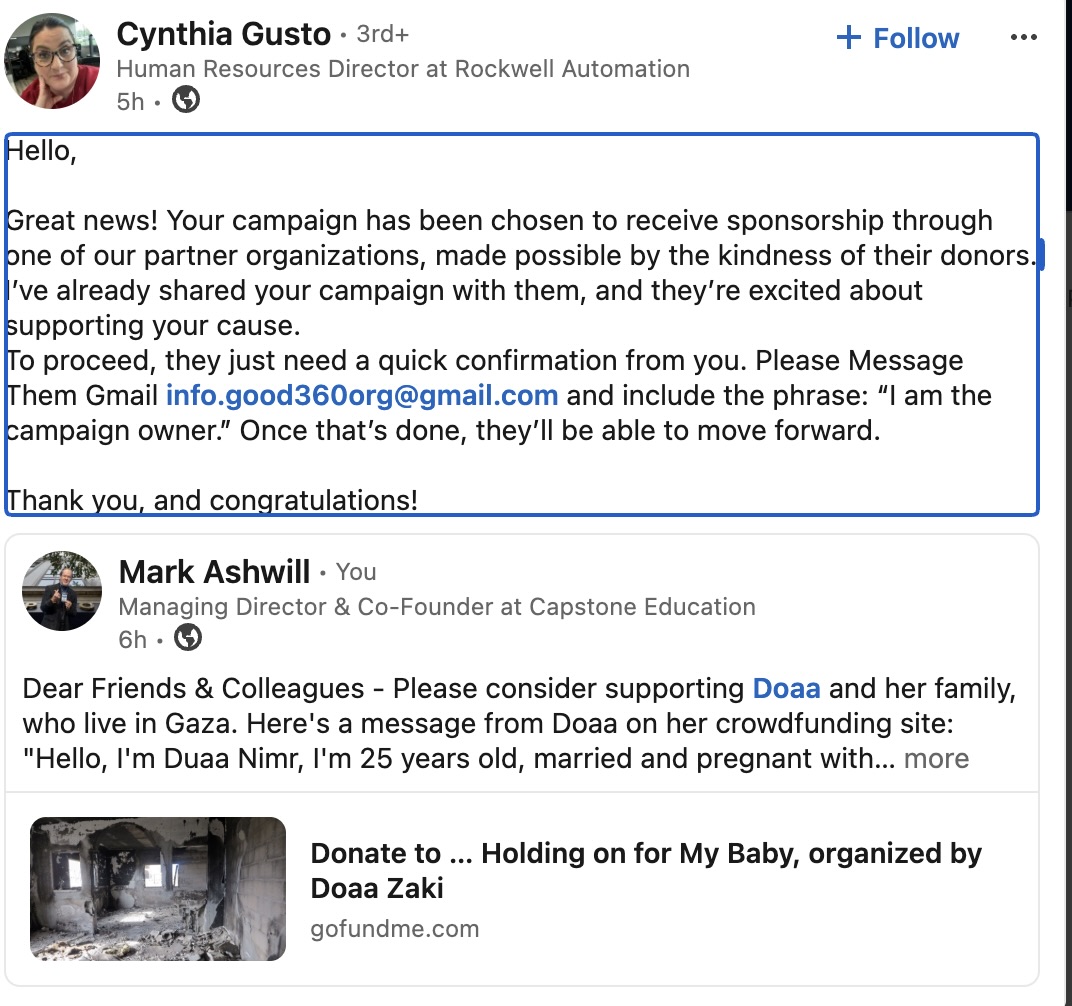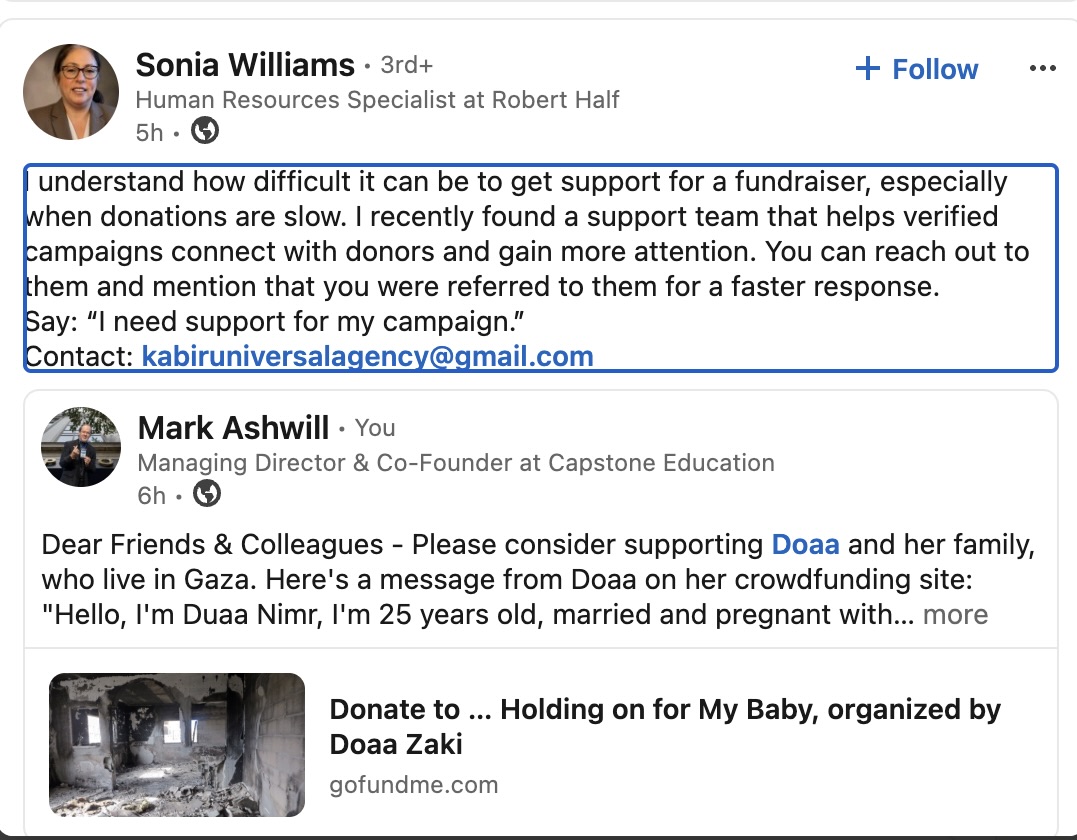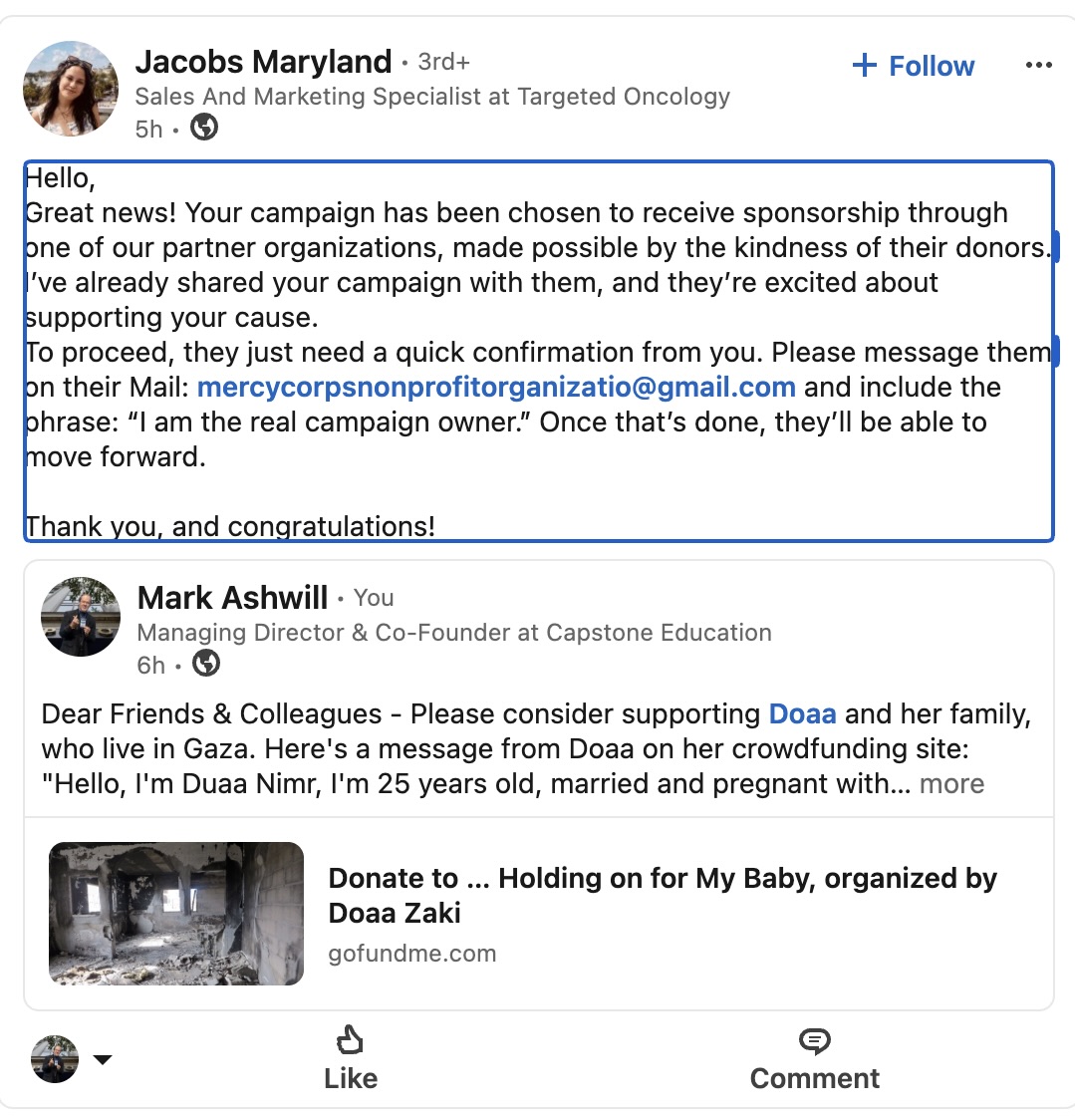
Congratulations! You’re about to take the first step towards having some unscrupulous miscreant lift your wallet out of your pocket, figuratively speaking. Like flies to honey, it didn’t take long for these digital predators to spot a potential opportunity. I posted an announcement and a link to crowdfunding site on behalf of a young woman and her family in Gaza who, like so many, desperately need financial support.
I shared the screenshots with one of my digital servants (they hate to be called that, by the way), who responded thus:
Yes, it has several scam markers.
Here’s how it likely works:
Someone replies to your crowdfunding post pretending to represent a sponsor, donor network, or charity partner. They say your campaign has been “chosen” for support, which creates urgency and hope. Then they ask you to contact a Gmail address and confirm: “I am the campaign owner.”
That phrase is suspicious because it may be used to:
- Start a phishing conversation
Once you email them, they may ask for your GoFundMe login, verification codes, ID, bank details, PayPal, Wise, WhatsApp, or “processing fees.” - Hijack or clone the campaign
By getting you to identify yourself as the campaign owner, they may try to gather enough information to impersonate you with GoFundMe support, donors, or payment processors. - Run an advance-fee scam
They may say a large donation or sponsorship is approved but requires a “registration fee,” “tax clearance,” “transfer fee,” “charity verification fee,” or “donor release fee.” - Move you off-platform
Asking you to message a Gmail address is a major red flag. Real sponsors, charities, and GoFundMe-related support usually do not require public LinkedIn commenters to email a random Gmail account. - Exploit Gaza-related fundraising emotionally
Scammers often target humanitarian campaigns because the campaign owner is under pressure, donors are emotionally engaged, and any promise of major support feels urgent.
Other red flags in the screenshot:
The email address info.good360org@gmail.com looks like an impersonation attempt. A real organization would normally use its official domain email, not Gmail. The message is generic, names no actual partner organization, gives no official website, no named contact, no due diligence process, and uses vague phrases like “one of our partner organizations.”
I would not email them. Report the comment/post to LinkedIn, delete or hide it if you can, and warn Doaa or anyone helping with the campaign not to share login details, codes, IDs, bank details, or pay any “fee” to receive donations.
I deleted my original post and reported all three accounts to LinkedIn. Great news! They were promptly “disappeared.” Now, there’s only a “Cynthia Gusto” in Nairobi, Kenya, probably a fake account. There are two “Sonia Williams” with the title “Human Resources Specialist” at Robert Half Stoke-On-Trent, England, United Kingdom) and Robert Half West Calder, Scotland, United Kingdom. “Jacobs Maryland,” a really bad fake name, is history.
It wouldn’t surprise me if these scammer had ties to Israel. Or, they’re just run-of-the-mill scammers who are happy to exploit and profit from their fellow human beings’ suffering.
At any rate, good riddance to bad rubbish.
Postscript: I wonder why LinkedIn (Microsoft) makes it so easy for scammers to join its network.