I saw this Reddit post in which a tourist summarized her/his unpleasant experiences with Indian tourists in Phu Quoc. It’s not an anti-Indian rant but a thoughtful accounting of his/her encounters. It’s becoming an issue to the point that growing numbers of Vietnamese are becoming anti-Indian. Just do a search for Indian tourists behaving badly in Vietnam. Exhibit A and B. You’ll also find posts about Indian tourists who encounter discrimination because of their nationality. The possibility is that more Vietnamese will begin to paint all of them with the same tar-black brush.
MAA
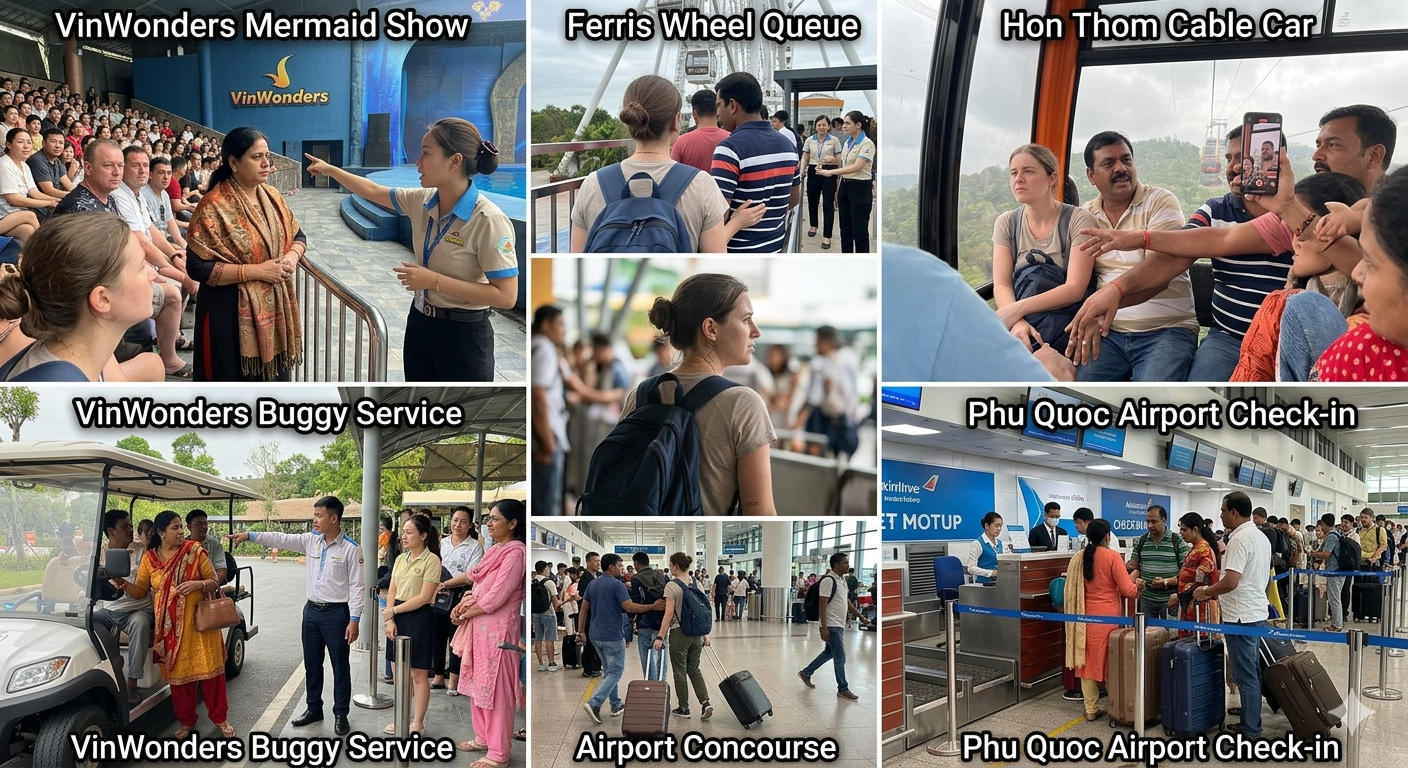
Gemini created this image based on the text.
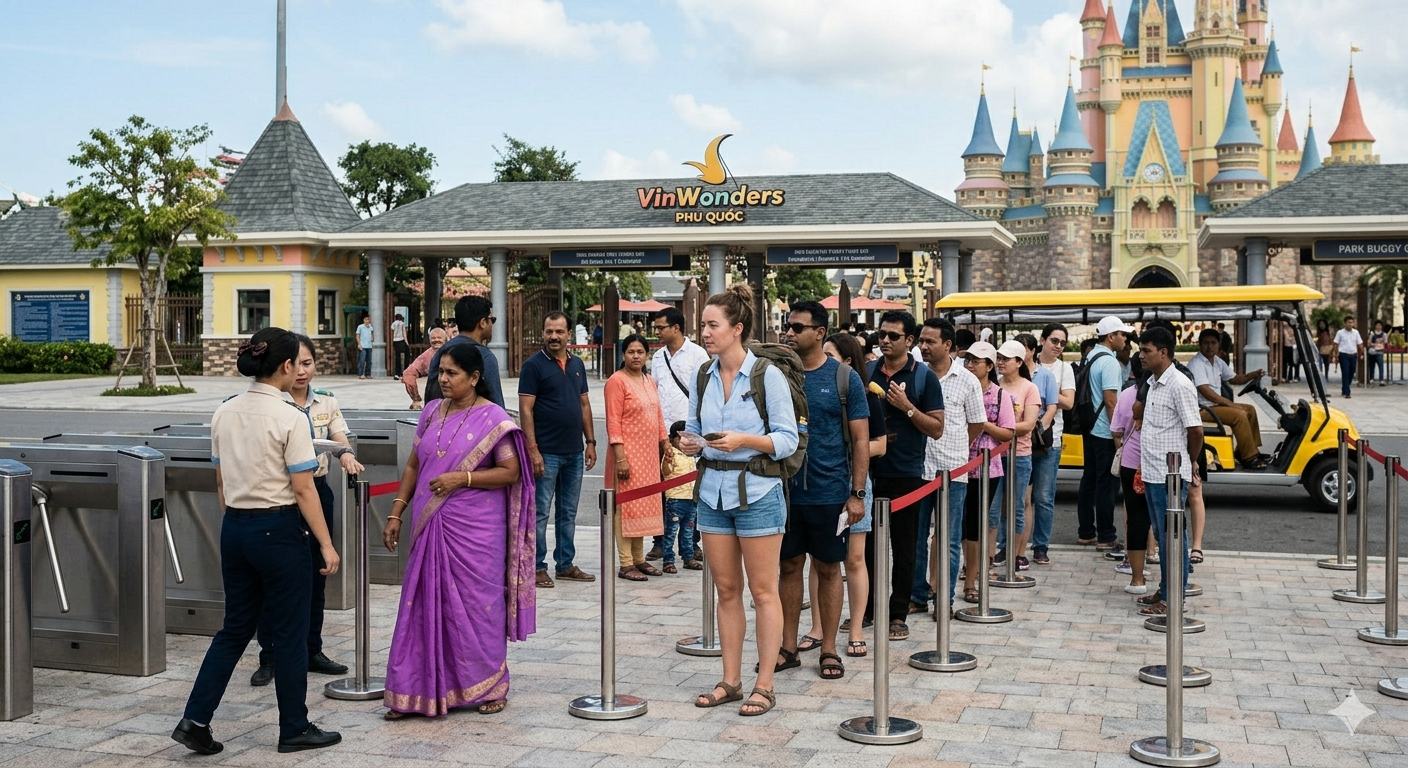
Gemini created this image based on the text.
I visited Phu Quoc, Vietnam last December as a solo traveler. During my trip, I noticed there were many Indian tourists visiting the island. Before I continue, I want to make it clear that this post is based only on my personal experiences with some of the people I encountered. I am not claiming that these experiences represent all Indians orall Indian tourists.
One of the first things I noticed was repeated instances of queue-cutting. At a mermaid show in VinWonders, everyone had been lining up for more than 30 minutes before the show started. As soon as the show began, an Indian woman pushed her way to the front, blocking the view of people who had been waiting much longer. Staff asked her to move back, but she argued and refused until other guests behind her started complaining because she was obstructing everyone’s view.
At first, I thought maybe it was just one person being inconsiderate. However, later that day while waiting for a buggy service in the same theme park, I saw an Indian family attempt to bypass the queue when a buggy arrived. The driver stopped them and directed them to the back of the line. Everyone else had been waiting properly, so it was frustrating to see people trying to skip ahead.
Another incident happened while I was waiting in line for the Ferris wheel. An Indian man was standing behind me and kept pushing forward every time riders exited and new guests were about to board. The staff were still organizing the queue, so there was no reason for anyone to move yet, but he continued pressing into me repeatedly. After a while, I turned around and asked him to please give me some personal space and stop pushing. I don’t think he understood what I said, but by that point I was already frustrated. Combined with the other experiences I had that day, it really affected my mood and made me want to leave the theme park earlier than planned.
I also noticed similar behavior at the airport. While waiting to check in, I saw an Indian family cut ahead in the queue instead of waiting their turn. Throughout the airport, I also experienced people rushing through crowded areas, bumping into me or my luggage without acknowledging it or apologizing. To be honest, I would have gladly let someone go ahead of me if they were in a hurry, but what bothered me was the lack of courtesy.
Another airport incident involved an Indian woman traveling with a young child. The child was repeatedly running around the queue area, bumping into people and wandering through a crowded space while the adults were talking among themselves. At one point, another traveler accidentally bumped into the child while walking through the airport. The mother became upset, but from my perspective, the situation could have been avoided if the child had been supervised more closely, especially in a busy airport where people are constantly moving around.
I also had an uncomfortable experience on the cable car to Hon Thom Island. An Indian family sat near me and wanted to sit together, so I moved seats. I had no issue with that. What made me uncomfortable was that they were constantly taking photos and videos while I was sitting in the middle and clearly appearing in the background. I tried to stay out of frame, but they continued taking selfies and recording videos without any apparent concern that I was being included. They were also speaking loudly and frequently reaching across my personal space. By the end of the 15-minute ride, I felt quite uncomfortable.
Another thing I noticed was that some Indian tourists I encountered had strong body odor in crowded public spaces such as buses, restaurants, airports, and other tourist areas. Obviously, this does not apply to everyone, and factors like climate, travel conditions, and individual hygiene vary from person to person. However, it was something I noticed multiple times throughout my trip and it affected my comfort in certain situations.
To be clear, I am not trying to generalize all Indians based on my experiences. I know that every nationality has respectful people and inconsiderate people, and similar behavior can be found among tourists from many different countries.
I’m only sharing what I personally experienced during my trip to Phu Quoc in December. The reason these incidents stood out to me is because they happened repeatedly over the course of a relatively short vacation. Whether it was queue-cutting, lack of personal space, loud behavior in shared spaces, or other uncomfortable encounters, they collectively had a significant impact on my overall experience.
What makes this disappointing for me is that I genuinely loved Phu Quoc. I thought the island was beautiful, the attractions were great, and I had many positive experiences there. In fact, I had been considering returning in the future.
However, when I think back on the trip, I also remember how frequently I encountered these situations. Because there were so many Indian tourists on the island at the time and many of my negative experiences happened to involve Indian tourists, it has made me hesitant about returning. I’m not saying everyone was like this, and I’m certainly not saying all Indian tourists behave this way. I’m simply being honest about how those repeated experiences affected my perception of the trip and my desire to visit again.
I’m curious whether other travelers have had similar experiences, or whether I was simply unlucky during my visit.
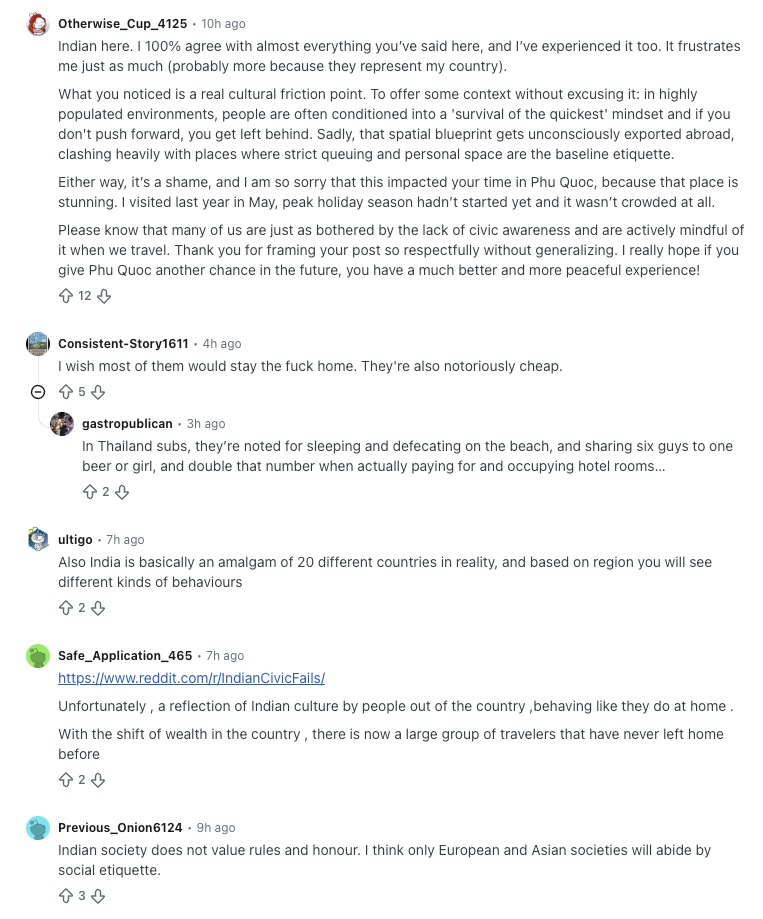
MAA: Here are some choice comments in response to the above post. I had to use a screenshot because I wasn’t able to copy/paste the text. The first one was written by an Indian who agrees with the OP.
Screenshot
Gemini created this image based on a related prompt.
Another relevant post from Facebook. Highly recommended for its insights and brutal honesty.
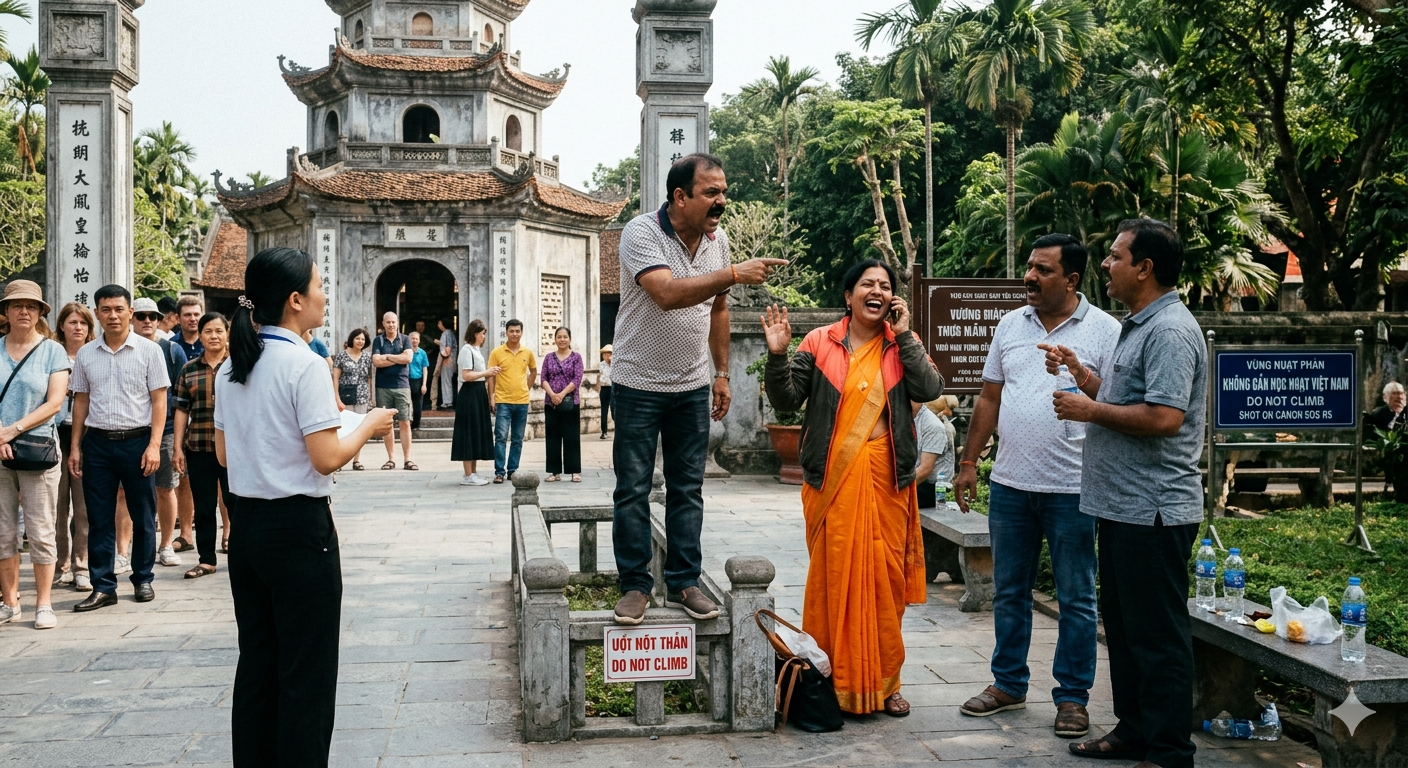
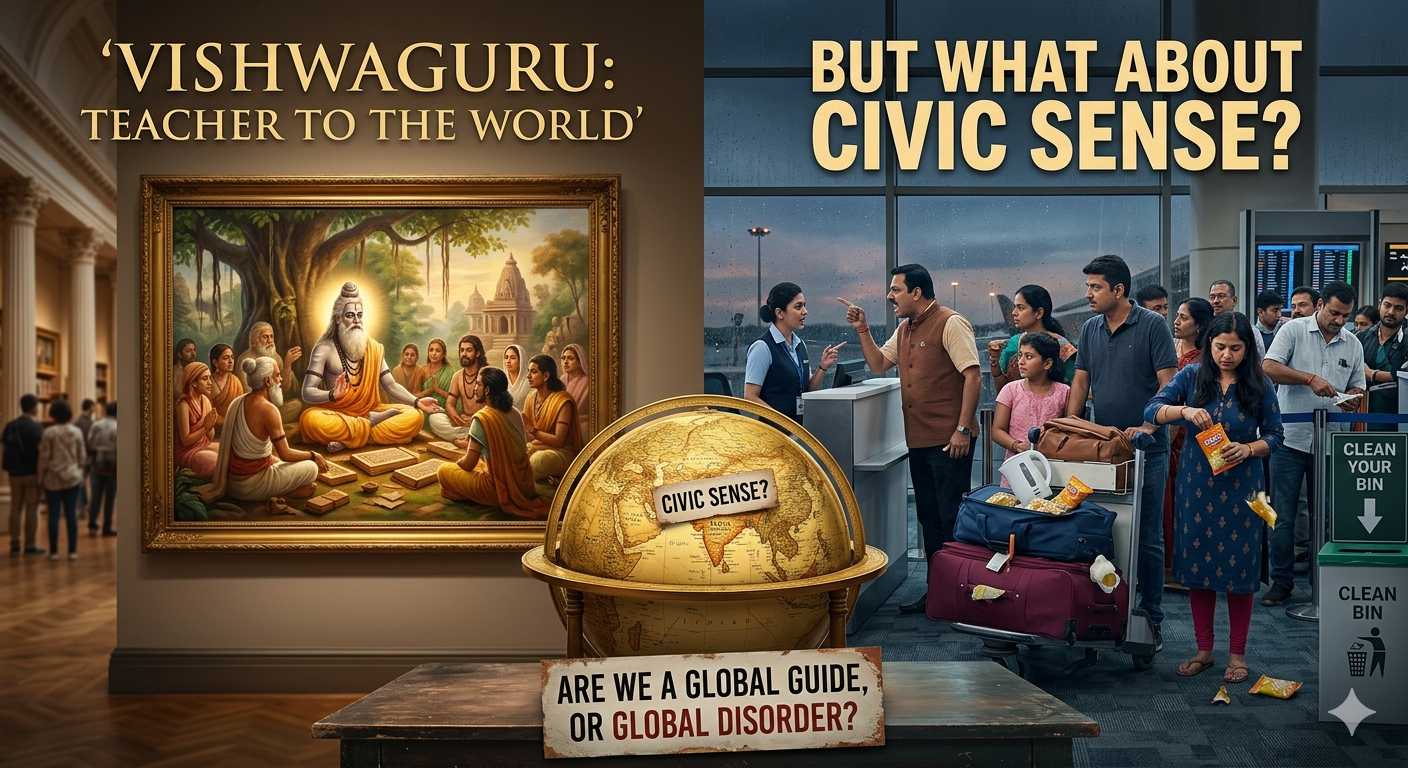
Gemini created this image based on Sujit Nair’s essay. “This image illustrates the contrast between the ideal of a spiritual leader and the everyday reality described in the essay. It juxtaposes the “Vishwaguru” as a museum piece—representing ancient wisdom and respect—with the modern scenario of disorganized behavior in public spaces. The specific details, such as littering, skipping lines, and arguing with airport staff, reflect the core argument about the necessity of aligning our actions with the image we wish to project to the world.”
Many Indians genuinely believe the world looks at us with admiration and awe. We are constantly told that India is becoming a “Vishwaguru.” A moral and cultural guide to humanity. But step outside India and observe carefully. The reality is often very different. MAA: Vishvaguru (Sanskrit: विश्वगुरु) translates to ‘teacher to the world’ or ‘global guide’. Deeply rooted in Indian civilizational history, it represents the aspiration for India to serve as a moral, spiritual, and intellectual leader to humanity. Source: AI Overview
Across airports, hotels, beaches, public transport systems and tourist destinations worldwide, Indians are increasingly developing a reputation that should worry us deeply. Too many Indians travel abroad carrying entitlement instead of civic sense.
Anyone who has travelled extensively has seen it. Families speaking loudly inside silent trains in Japan. People cutting queues at airports in Europe. Tourists touching protected monuments despite repeated warnings. Groups blasting music on peaceful beaches in Thailand and Bali. Passengers aggressively arguing with airline staff over baggage rules that everyone else quietly follows. Some even proudly try “Indian tricks” abroad, sneaking extra people into hotel rooms, hiding food in restricted places, or treating every rule as a system to outsmart rather than respect.
In India, this behaviour is often romanticised as smartness or “jugaad.” Abroad, it is seen for what it actually is, dishonesty, disorder and lack of civic culture.
Not all Indians behave this way, of course. But enough do for the stereotype to now exist globally.
A few years ago, a viral incident from Bali showed an Indian family caught stuffing hotel accessories into their luggage. Hair dryers, decorative items and bathroom fittings. The defence was immediate, offering to pay once caught, as though money could erase the behaviour itself. The incident became social media comedy. But the deeper issue was the mindset. The belief that rules apply to others, not to us.
And unfortunately, this mindset travels with us everywhere.
We speak emotionally about India’s ancient civilisation. But civilisation is not measured by old scriptures alone. It is measured by how citizens behave in public spaces. Do we keep our surroundings clean? Do we respect silence where silence is expected? Do we follow rules without supervision? Do we think about the comfort of strangers?
Slowly, the consequences appear. More scrutiny at immigration. More stereotypes. More silent distancing. More frustration from hosts who no longer see Indian tourists as easy guests.
The uncomfortable truth is this. No country becomes respected because its citizens loudly declare themselves superior. Real respect is earned quietly. Japanese football fans clean stadiums after matches. Singaporeans follow rules even when there is no policeman in sight. Many European societies function smoothly because people treat public spaces with dignity and think collectively, not selfishly.
Meanwhile, many Indians increasingly mistake loud nationalism for global admiration. It is not the same thing.
If India genuinely wants respect on the world stage, we need less chest thumping and more introspection. Less obsession with “Vishwaguru” and more focus on civic sense, humility, honesty and discipline.
Because the world is judging us by how we behave when nobody is watching
2 thoughts on “Curious If Others Have Experienced This in Phu Quoc”
Indians behaving badly in India. From a subreddit called “r/IndianCivicFails:”
“Breakfast buffets in India bring out the absolute worst in people.”
“I’m currently staying at a luxury hotel in Jaipur, and the breakfast buffet has reminded me that money and manners are two completely different things.
Some observations:
People pile their plates with enough food to feed a family, take two bites and leave the rest. Mountains of perfectly good food end up in the trash.
It’s not eating anymore it’s consuming, hunting and devouring. Grab everything first, think later.
Parents let children run around the buffet, screaming as if it’s a playground, while everyone else is trying to have a peaceful breakfast.
I watched a child poke multiple donuts with their fingers just to eat the sprinkles, then put the donuts back on the tray. No parent intervened.
People use serving spoons from one dish in another, mixing food and making a mess.
Some guests stand right in front of the buffet, deciding what to take while blocking everyone else.
Others treat the buffet like it’s a race, cutting queues and reaching across people.
Conversations happen at such high volume that the dining hall starts feeling like a crowded railway station rather than a five-star hotel. This morning, one large group (dont want to reveal the state) was practically shouting across the room.
Phones on speaker, video calls at the table, kids watching cartoons at full volume; apparently headphones are optional.
Half-eaten food, spilled juice, used napkins and crumbs are left behind because someone else will clean it.
People touch bread, fruit, or pastries with bare hands before deciding they don’t want them.
Some guests keep making multiple oversized rounds as though the buffet is about to disappear.
None of this has anything to do with being rich or middle class, or with any particular community. It’s simply a lack of civic sense and basic etiquette.
A luxury hotel can provide beautiful interiors, expensive cutlery and premium food, but it can’t manufacture basic public behaviour. Sometimes the breakfast hall feels less like a fine-dining space and more like a zoo.
Does anyone else notice this, or have I just been particularly unlucky?”


Indians behaving badly in India. From a subreddit called “r/IndianCivicFails:”
“Breakfast buffets in India bring out the absolute worst in people.”
“I’m currently staying at a luxury hotel in Jaipur, and the breakfast buffet has reminded me that money and manners are two completely different things.
Some observations:
People pile their plates with enough food to feed a family, take two bites and leave the rest. Mountains of perfectly good food end up in the trash.
It’s not eating anymore it’s consuming, hunting and devouring. Grab everything first, think later.
Parents let children run around the buffet, screaming as if it’s a playground, while everyone else is trying to have a peaceful breakfast.
I watched a child poke multiple donuts with their fingers just to eat the sprinkles, then put the donuts back on the tray. No parent intervened.
People use serving spoons from one dish in another, mixing food and making a mess.
Some guests stand right in front of the buffet, deciding what to take while blocking everyone else.
Others treat the buffet like it’s a race, cutting queues and reaching across people.
Conversations happen at such high volume that the dining hall starts feeling like a crowded railway station rather than a five-star hotel. This morning, one large group (dont want to reveal the state) was practically shouting across the room.
Phones on speaker, video calls at the table, kids watching cartoons at full volume; apparently headphones are optional.
Half-eaten food, spilled juice, used napkins and crumbs are left behind because someone else will clean it.
People touch bread, fruit, or pastries with bare hands before deciding they don’t want them.
Some guests keep making multiple oversized rounds as though the buffet is about to disappear.
None of this has anything to do with being rich or middle class, or with any particular community. It’s simply a lack of civic sense and basic etiquette.
A luxury hotel can provide beautiful interiors, expensive cutlery and premium food, but it can’t manufacture basic public behaviour. Sometimes the breakfast hall feels less like a fine-dining space and more like a zoo.
Does anyone else notice this, or have I just been particularly unlucky?”
Don’t miss the comments. https://www.reddit.com/r/IndianCivicFails/comments/1ugutse/breakfast_buffets_in_india_bring_out_the_absolute/
Yet another incident at an Indian restaurant in HCMC: https://www.youtube.com/watch?v=HJ3uN6Oi_78