By Shams Mazen Rajab
This is a question I ask myself every day as the Israeli-executed genocide in Gaza continues unabated. This article was originally published in Italian by Kritica. Kritica devotes about a third of its resources each month to the work of journalists and photographers on the ground in Gaza.
The author, Shams Mazen Rajab, is a 23-year-old writer, translator, poet, and essayist from Gaza. She holds a degree in English Language and Teaching Methods from Al-Aqsa University in Gaza and a continuing education certificate in Equality, Diversity, and Inclusion from University College Cork, Ireland. She teaches Arabic to non-native speakers and, through her bilingual writing, seeks to preserve memory and build bridges between cultures.
Here are some other works by Shams that I turned into songs:
A Spring in Autumn (12.8.25)
Stolen Beauty (5.8.25)
Sun of Hope (1.7.25)
Finally, check out this February 2026 podcast with Shams.
MAA
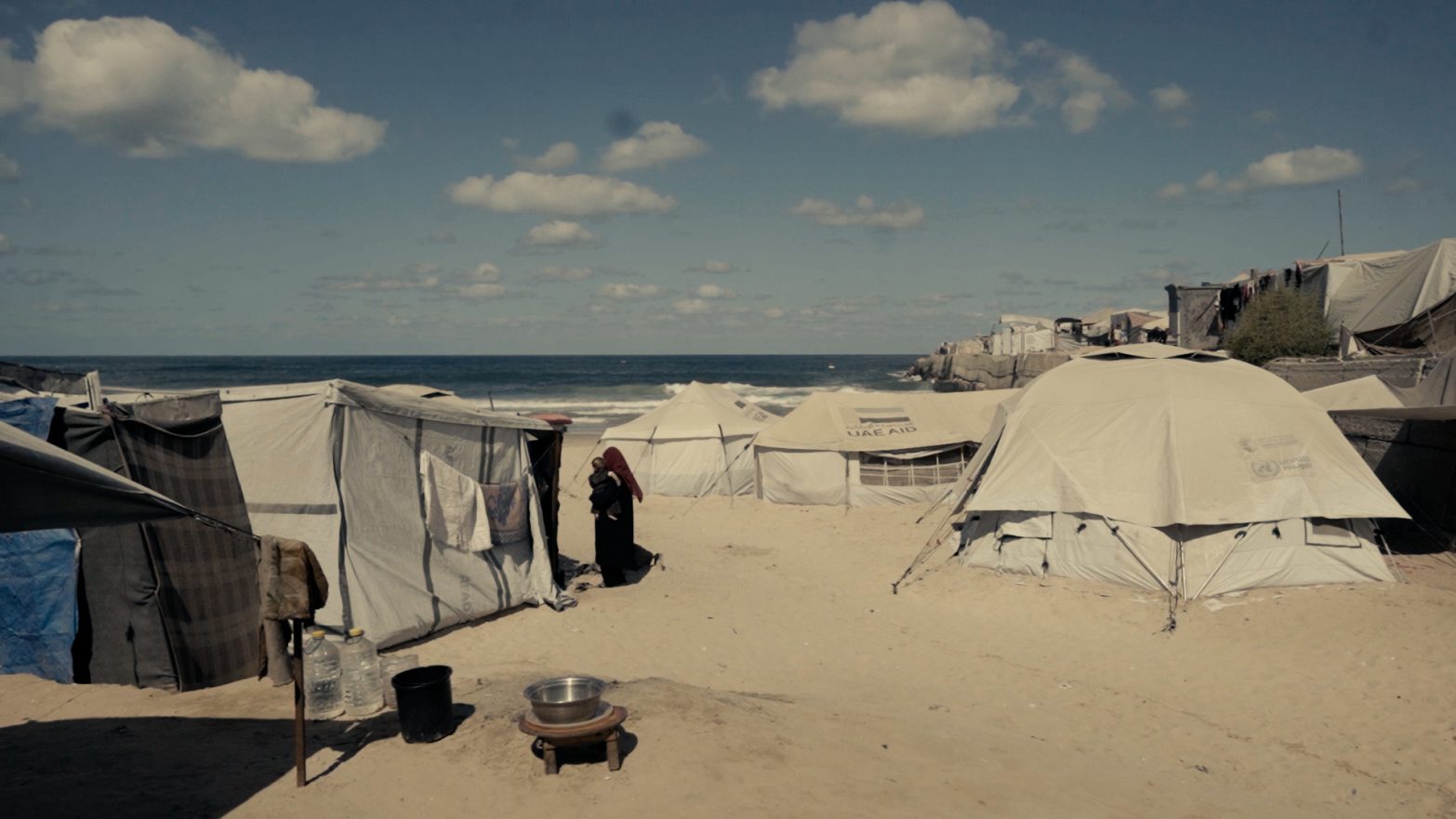
Once, a home had solid walls to protect us, a roof to shelter us, and warmth to embrace us on winter nights. It was the memory of childhood, the laughter of evenings, the scent of fresh bread, and endless family conversations. Suddenly, everything collapsed, and the home turned into fragile fabric: no walls, no doors—just a cramped space trembling in the wind, suffocating in the summer heat, and flooding at the first drops of rain.
What was once a home became a temporary stop, but days turned into months, and the waiting grew heavier, until the temporary became reality, and memory became heavier than the present. The tent was never meant to be a home, but a symbol of endless waiting, of postponed dignity, of a homeland kept far away behind fences and sieges. As the days pass, the question becomes more urgent: can worn-out fabric ever be a home? Can it ever offer the warmth and security of a real house?
According to United Nations reports, more than 1.9 million people in Gaza are currently internally displaced—nearly four-fifths of the population (and maps revealed by Reuters on April 29, 2026 show that Israel now controls about 65% of the territory of the Strip, editor’s note). Many live in tents or temporary shelters that provide neither safety nor dignity. In November 2025 alone, more than 1.3 million meals were distributed through 195 community kitchens, yet daily needs remain far greater than what is available. Emergency campaigns vaccinated over 7,000 children under the age of three against diseases, in an attempt to reduce health risks within the camps. These figures reveal that the tent is no longer just a symbolic image, but a lived reality for millions—where statistics intertwine with the daily stories of families struggling to survive under harsh conditions.
When I asked my neighbors in the camp, “Do you think we will ever have a real home again?”, they burst into laughter. One of them exclaimed, “A home?!” and reminded me of the words of Mahmoud Darwish: “Once we had a home, once we had a homeland.” Some told me they got married in a tent, gave birth in a tent, and now their children believe that worn fabric is the only home they will ever know. These voices reveal that the tent is no longer just a temporary shelter, but a reality shaping memory and consciousness; laughter becomes a mirror of despair, and stories turn into testimonies of time’s cruelty. The tent now embodies a collective memory: generations born within it, children growing up believing that fabric is their home.
In the camp, education has become a distant dream. According to UNICEF reports from 2025, over 97% of Gaza’s schools have been damaged or destroyed, and many have been turned into shelters for the displaced. More than 658,000 school-age children have not received formal education for over two years. Some sit in cramped tents with torn books, trying to write on damp ground, as if the letters themselves resist collapse. A mother of two says: “I fear my children will grow up without diplomas, without a window to the world.”
Health is a daily wound. According to the WHO and OCHA, diseases spread rapidly due to humidity and contaminated water, with over 13,000 families affected by flooding inside the camps. Health centers are destroyed or overwhelmed, and essential medicines remain scarce. More than 219 health points have been set up to assist about 180,000 people, but the pressure is immense and needs far exceed capacity. A father recalls: “I lost my brother because he couldn’t find a simple medicine. His death was not fate, but the result of the siege and harsh conditions.”
In the camp, women carry the heaviest burden of daily survival. They spend long hours waiting in line for water or food, striving to turn worn fabric into a home. Many cook over simple fires, wash clothes in small basins with little water, or manage the tent as if it were a real house, despite its fragility.
Sarah, while washing clothes in a small basin, says: “I want my children to know that a real home has walls and a roof, not just sheets that tremble in the wind.” Women also carry the memory of the camp, telling stories to children and planting hope despite exhaustion. Some have lost husbands or children, yet they continue to shoulder responsibilities, becoming pillars of resilience that keep the tent from collapsing. In every corner of the camp, one can see a woman striving to preserve life, to plant hope in a child’s heart, or to sew a new dress from scraps of old fabric.
Children in the camps live an incomplete childhood. Some play among the tents with toys made from scraps of plastic or wood, while others draw houses on canvas walls, insisting on imagining a different homeland. Many have lost their schools, learning letters on the ground or writing in torn notebooks.
My mother, sitting with the women of the camp, says: “I see my son writing on the sand, as if planting a small dream in a vast land.” Children also face daily fear—the sound of airplanes, the biting cold, and the darkness inside the tent push them to cling to their mothers for safety. Yet they invent small moments of joy: a ball made of cloth, a group game among the tents, or a song they sing together. These details reveal that childhood in the camp is not only about loss, but also about resistance; children strive to create life among the ruins.
The tent was never meant to be a home, but a temporary stop imposed by time and siege. Yet as days turned into months, it became a heavy reality that tests memory and patience. Still, hope remains stronger than worn fabric, the right of return greater than the boundaries of the camp, and the homeland lives in the heart, no matter how distant.
We are not children of the tent; we are children of the home that was destroyed, of the homeland that awaits us. One day, the tents will be folded, doors will open again, and children will draw houses with walls and roofs—not just fabric trembling in the wind. The camp is not an eternal destiny, but a testimony to passing injustice and unyielding resilience.

