Below is an excerpt of a 1 March 2026 post by Kim Komando. As a late baby boomer, I remember those moments of “boredom” and all of the ideas they generated. I am grateful for them. To this day, while I spend a lot of time on my laptop for professional and personal purposes, I value the time I spend offline. This includes the ideas that pop into my head while sleeping that I either write down or repeat in my mind like a mantra so I don’t forget.
It saddens me to see young people, including babies, glued to electronic devices instead of engaging in play or socializing with those around them. Thanks to their parents, the ones who are at fault, they live most of their young lives in a digital world that does not require them to think, create, or develop social and other soft skills.
Correction #1: It’s not boredom; it’s the exciting world of imagination and creativity.
Correction #2: While J.K. Rowling may not have “mapped out” seven books, the train ride and the time spent in thought did result in the beginning of the Harry Potter series and everything that followed.
Postscript: The boy in Kim’s Gemini image in her post was me.
MAA
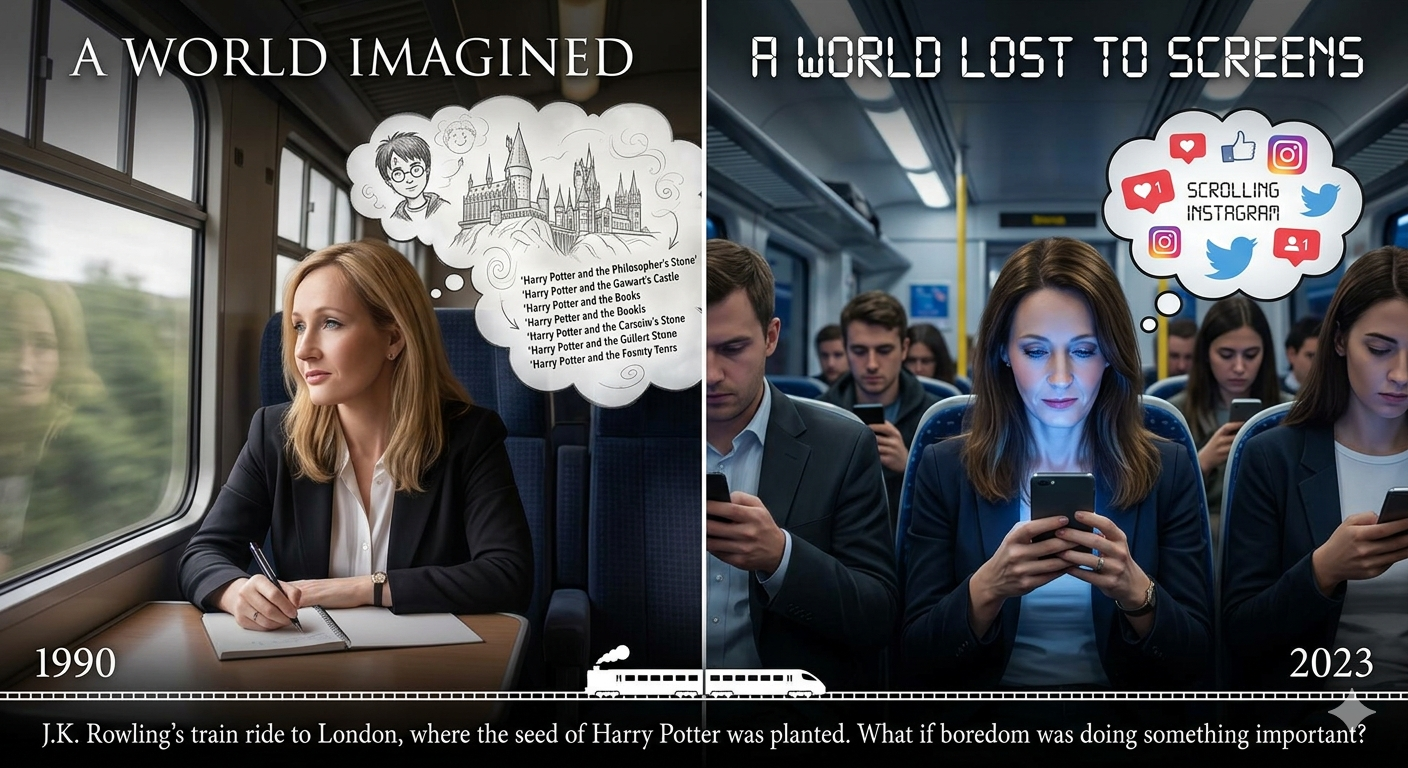
- Americans pick up their phones 186 times a day and spend over 7 hours on screens. We have eliminated virtually every moment of stillness from our lives.
- Creativity scores have been declining since 1990, right when screens started filling idle time.
- Boredom activates the brain’s “default mode network,” the state where original thinking, problem-solving and self-reflection happen. We didn’t just kill boredom. We killed the conditions for our best ideas.
Let me tell you a story. In 1990, a young woman sat on a delayed train from Manchester to London. Four hours. No smartphone. No earbuds. No Wi-Fi. She didn’t even have a pen.
So she just sat there, staring out the window.
By the time that train pulled into London, she had imagined an entire world: a boy wizard, a school called Hogwarts, seven books mapped out in her head. Her name was J.K. Rowling. That idea became Harry Potter, a franchise worth over $15 billion.
If that train ride happened today, she would have scrolled Instagram for four hours. And you and I would have never heard of Harry Potter.
That’s not a hypothetical. That’s math.
The average American picks up their phone 186 times a day. That’s once every five minutes during waking hours. We spend over seven hours daily staring at screens. And 53% of us say we want to cut back but can’t.
We have done something no other generation in human history has done. We eliminated boredom. Completely. Every idle moment, every waiting room, every quiet car ride, every line at the grocery store gets filled with a screen.
We did it so fast we never stopped to ask: What if boredom was doing something important?
 An International Educator in Vietnam