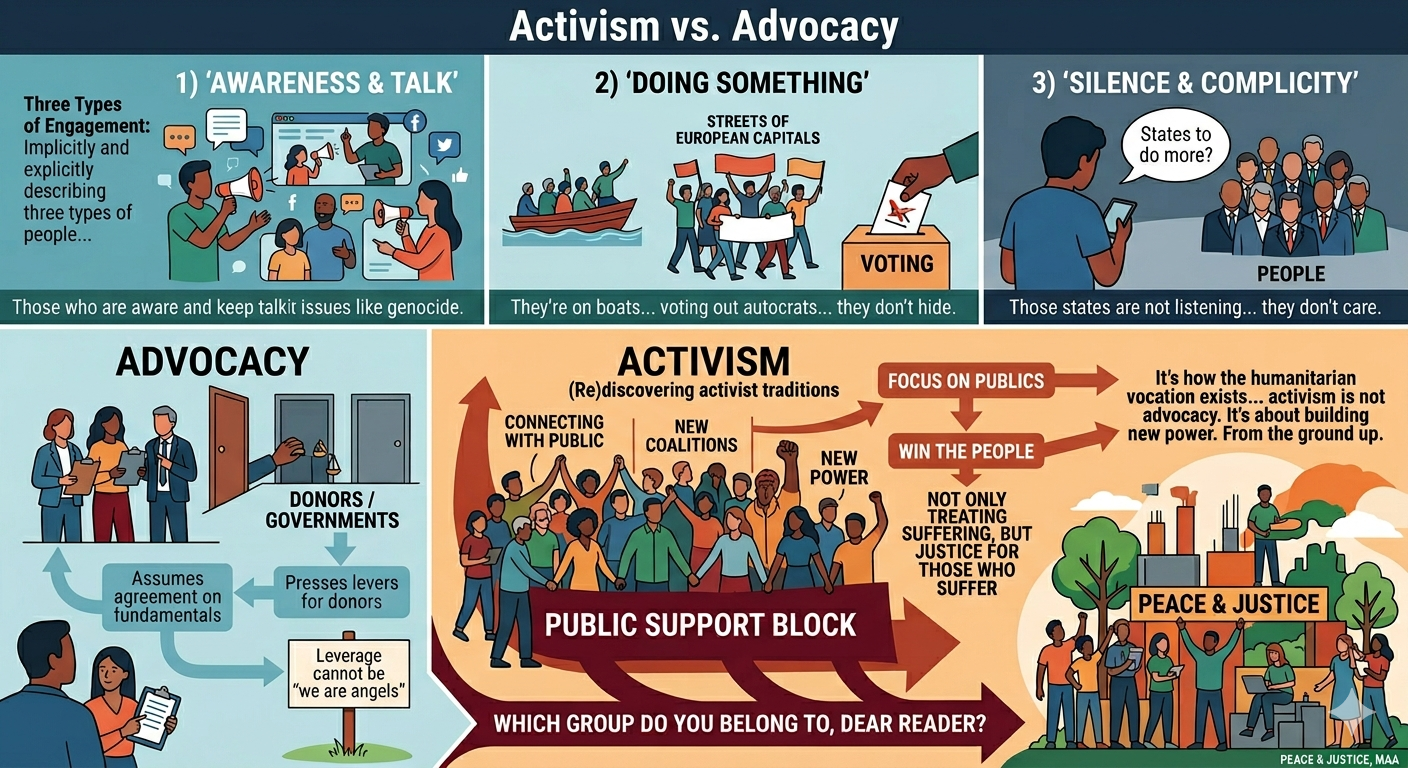
I took the liberty of reposting this from Philip Proudfoot’s LinkedIn account. Philip is a UK-based researcher in development and humanitarianism, with a focus on Middle East. Implicitly and explicitly, he’s basically describing three types of people: 1) those who are aware of and keep talking about issues like genocide, 2) those who are actually doing something, and 3) those who remain on the sidelines and are complicit in their silence.
Which group do you belong to, dear reader?
A few unsolicited thoughts on What Is to be Done (about aid)
I know it’s easy to be a critic when humanitarianism is imploding. But when people ask what I’m arguing in my book about the end of aid — what actually is to be done — I don’t hide with “it’s not for me to say” or “there are no easy answers.” I do try and suggest some answers, but maybe they’re not easy.
However we first need to be honest about the predicament.
A moral and political argument for aid was once won: that we should care for others simply because they are humans like us. That argument built something — humanitarian space, international norms, a politics of solidarity, even.
Yes, we can argue it always served an imperialist realpolitik, that humanitarianism reduced people to bare life, that it was a biopolitical form of domination, etc. but all those previous arguments assumed the existence of a humanitarian system that was to some extent “stable”
But that space is now closing. This leads to a different set of predicaments: does even the final line of defence — “we are soft power!” — no longer work?
So what is to be done?
I think we need to become activists. Or maybe we never should have stopped being activists.
But what that actually means is this: we need to focus on *publics.* Not donors. Donors are governments, and governments — in theory — answer to their people, to their publics. We might have lost the governments but we can win the people.
We need to connect, then, with a public that
cares about the suffering of strangers.
The problem is encapsulated by the endless calls on “states to do more” to protect aid workers, facilitate access, support accountability, whatever. Those states are not listening. They don’t care. The calls seem politically naive at best — infuriating at worst. We have no leverage. The leverage cannot be “we are angels, let us just do our good work” — we need a base, a political support block.
And in finding this block, we don’t have to start from zero. That public already exists. They’re on boats heading towards Gaza right now. They’re on the streets of European capitals. They’re voting out autocrats and walking away from parties that stopped representing them and voting for new progressive forces. It’s not all darkness.
But that public isn’t interested in only treating suffering, but also in justice for those who suffer at the hands of monsters.
Aid, I think, has to (re)discover its activist traditions. And activism is not the same as advocacy. Advocacy assumes we already agree on fundamentals, that we just need to press the right levers for donors. Activism is about building new coalitions. New power. From the ground up.
That’s harder, true, but it’s also the only thing that has ever worked. It’s why the humanitarian vocation exists in the first place.

