Jeffrey St. Clair, co-editor of CounterPunch, and several other writers were asked by the Toni Morrison Foundation to do exactly that. Below is a slightly expanded version with 331 words. Jeff’s original version appeared in the fall issue of Ishmael Reed’s new magazine, Tar Baby.
Knowing that every word counts, what would you say, dear reader? I love the use of the word “predicament,” defined as “a difficult, unpleasant, or embarrassing situation.” It reminds me of the old-fashioned phrase “in a pickle.” What’s happening in the US far transcends either definition.
Scroll down to read two ChatGPT responses to this prompt.
October 23, 2025
The Mirror Stage of US Politics

“Columbia’s Easter Bonnet,” Puck. (1901). Library of Congress.
The US has been transformed into a mirror world, the mirror world of a pathological narcissist, a world of reverse images where victims are flipped into perpetrators, the poor portrayed as exploiters of the super-rich, the weak as persecutors of the strong and where the law is used to perpetuate lawlessness. The police conceal their faces behind the masks of thieves, while thieves loot the public estate unmolested. Public corruption has been legalized, and exposing graft made a crime.
The right of free speech has been rendered into an obligation to be obsequious in the face of power. The history of the country is being erased and rewritten to honor some of its most infamous villains and traitors and airbrush out defenders of liberty, diversity and equality. The sins of the past are promoted as virtues. People are judged based on the color of their skin and the size of their portfolios. Domestic tranquillity has been supplanted by an atmosphere of fear and manufactured dread, where everything and everyone is suspect and no one is even sure what a citizen is or whether they are one. Not even the weather is to be believed.
This mirror world’s aesthetic is the grotesque, the bloated, the cannabilistic and the country feeding upon itself is presented as a kind of cage match for the entertainment of the elite. Even the people’s house, built, maintained and served by the enslaved, has been retrofitted into a gilt-fringed Versailles on the Potomac.
This is, of course, the mirror world’s fatal weakness: a hollow hubris. Deep down a secret voice whispers to the narcissist that he’s not worthy of the power he holds. His crippling anxiety is that the people he despises the most will see through him to the fraud within, that his grip on power is maintained by an illusion of force–not real authority–and that once exposed, the mirror will crack and he will crumble by his own accord at the feet of those he tormented.
MAA: I decided to ask our loyal digital servant, ChatGPT, to offer its own description. Here’s the result. What biases do you detect in the image and the text?
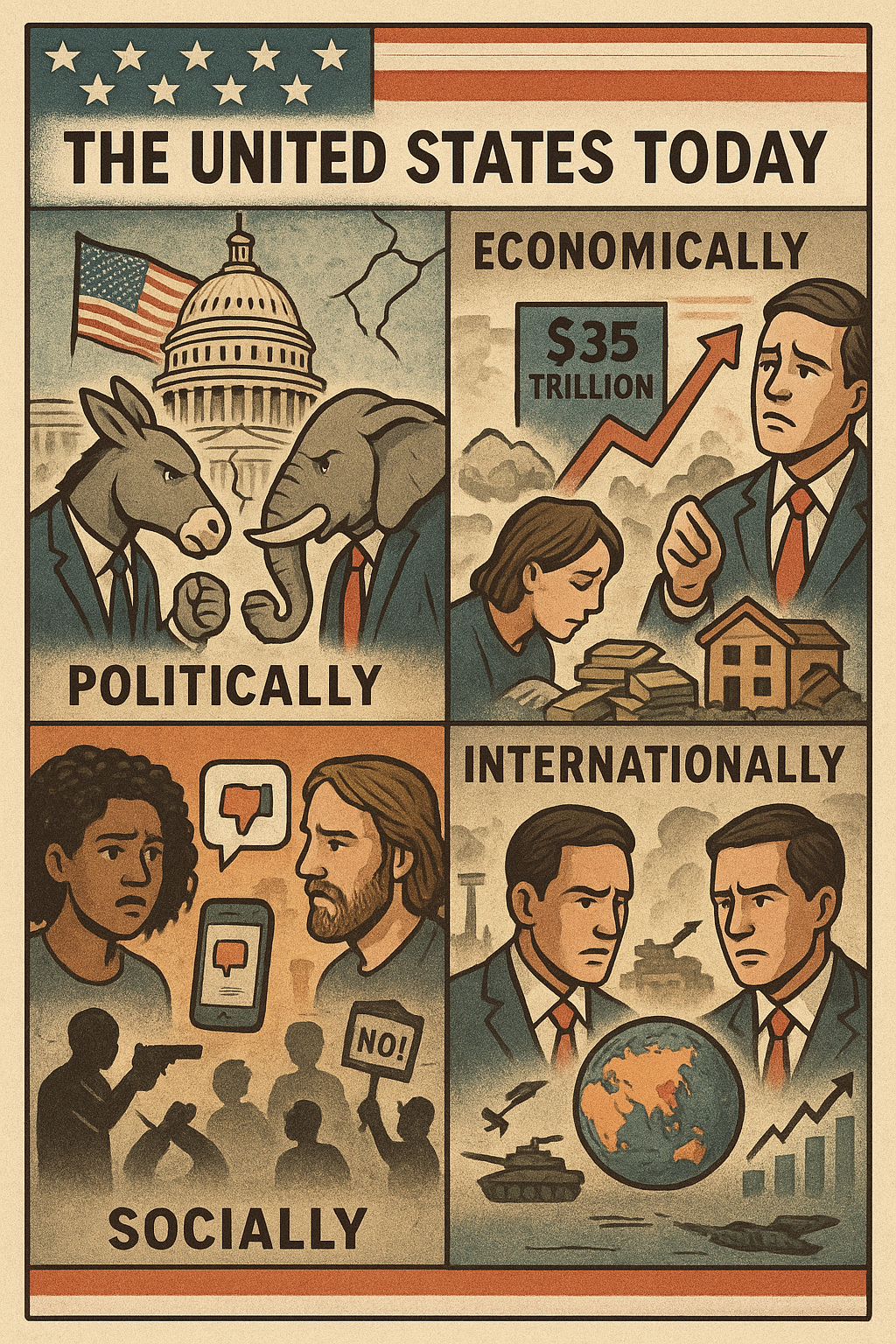
The United States today faces a complex and deeply polarized predicament—socially, politically, and economically. Politically, partisan division has reached historic levels, eroding trust in institutions and weakening the ability of government to address long-term challenges. The 2024 election cycle intensified these fractures, leaving questions about democracy, election integrity, and national unity unresolved.
Economically, the U.S. remains a global leader in innovation and productivity, yet wealth inequality continues to widen. Rising costs of living, housing shortages, and medical expenses burden the middle and working classes, while automation and global competition reshape the job market. The national debt has surpassed $35 trillion, fueling debate over fiscal sustainability and generational responsibility.
Socially, the country wrestles with cultural fragmentation and misinformation amplified by social media. Debates over race, gender, immigration, and climate policy often overshadow shared goals. Meanwhile, gun violence, opioid addiction, and mental health crises persist as pressing domestic challenges.
Internationally, the U.S. faces a shifting world order marked by China’s rise, Russia’s aggression, and the uncertain role of American leadership. Balancing military commitments abroad with domestic renewal at home tests the limits of U.S. power and purpose.
Yet amid uncertainty, the nation retains remarkable resilience—its universities, technology, and democratic ideals continue to inspire. The American predicament lies not in its decline, but in its struggle to reconcile freedom with unity, prosperity with fairness, and power with moral clarity.
The United States today faces a complex and deeply polarized predicament—socially, politically, and economically. Politically, partisan division has reached historic levels, eroding trust in institutions and weakening the ability of government to address long-term challenges. The 2024 election cycle intensified these fractures, leaving questions about democracy, election integrity, and national unity unresolved.
Economically, the U.S. remains a global leader in innovation and productivity, yet wealth inequality continues to widen. Rising costs of living, housing shortages, and medical expenses burden the middle and working classes, while automation and global competition reshape the job market. The national debt has surpassed $35 trillion, fueling debate over fiscal sustainability and generational responsibility.
Socially, the country wrestles with cultural fragmentation and misinformation amplified by social media. Debates over race, gender, immigration, and climate policy often overshadow shared goals. Meanwhile, gun violence, opioid addiction, and mental health crises persist as pressing domestic challenges.
Internationally, the U.S. faces a shifting world order marked by China’s rise, Russia’s aggression, and the uncertain role of American leadership. Balancing military commitments abroad with domestic renewal at home tests the limits of U.S. power and purpose.
Yet amid uncertainty, the nation retains remarkable resilience—its universities, technology, and democratic ideals continue to inspire. The American predicament lies not in its decline, but in its struggle to reconcile freedom with unity, prosperity with fairness, and power with moral clarity.
MAA: In case you’re counting, that’s 452 words, yet another example that chatbots are works in progress. Here’s the final version, which came in at 247 words.
The United States faces a turbulent and uncertain moment defined by political division, economic strain, and cultural fragmentation. Polarization has eroded trust in government and media, making consensus on critical issues increasingly elusive. The lingering fallout from recent elections has deepened doubts about democratic integrity, while partisan battles stall action on urgent problems such as climate change, immigration, and gun violence.
Economically, the nation remains dynamic yet deeply unequal. Inflation and housing costs weigh heavily on working families, while automation and global competition threaten traditional jobs. The national debt, now exceeding $35 trillion, fuels debate over fiscal responsibility and the future of social programs. Despite strong innovation in technology and energy, many Americans feel left behind by an economy that seems to reward speculation over hard work.
Culturally, the country struggles to find common ground amid competing narratives of identity and history. Misinformation spreads rapidly, undermining shared reality and civic trust. Social media intensifies outrage, turning politics into performance and discouraging compromise.
Abroad, the U.S. faces a world in flux. China’s economic rise, Russia’s aggression, and regional instability challenge American influence. Balancing global leadership with domestic renewal remains a defining test.
Yet the U.S. retains formidable strengths—its creativity, institutions, and enduring democratic ideals. The nation’s predicament is not its decline, but its struggle to align freedom with unity and prosperity with justice. Whether it can rediscover a shared sense of purpose will determine its future.
 An International Educator in Vietnam
I’m Done Watching America Destroy Itself from Within (3.11.25) Mitch Jackson https://mitchthelawyer.substack.com/p/im-done-watching-america-destroy