By Eric Olander, Editor-in-Chief of The China-Global South Project (Source: LinkedIn)

December 17, 2024
There is a delusion circulating today in many parts of the U.S. policymaking community that Vietnam is going to emerge as the “next China.”
Former United States National Security Advisor Robert O’Brien is the latest high-profile pundit to call for Vietnam to play a central role in the U.S. campaign to isolate China and “send a clear signal to Beijing that its coercive economic practices will only push global businesses and governments closer together in opposition.”
They seem to think major American manufacturers are going to close their operations in China and set up comparable facilities in Vietnam and other Southeast Asian countries, and they’re hoping Trump’s anticipated tariffs are going to expedite that process.
That fantasy is even popular in Vietnam itself. The day after the election, the Ho Chi Minh City stock exchange surged in anticipation that Vietnamese companies would be among the biggest beneficiaries of Trump’s tariffs.
It all sounds great until you actually start to look at the numbers.
Vietnam’s $429 billion GDP would only rank 18th on the list of regional GDPs in China — about the same size as the southwestern city of Chongqing.
Just 1% of China’s annual shipping volume would overwhelm Vietnam’s port system.
The unemployment rate among Vietnam’s 53 million strong labor force is just 2.27%, so even if a small share of China’s factories relocated across the border, there probably wouldn’t be enough workers.
More importantly, this country doesn’t have the vast supply chain and logistics networks that give China such a huge manufacturing advantage. Most of the inputs that go into making products in Vietnam come from China. So, “friend-shoring” production to Vietnam doesn’t automatically guarantee that the Chinese are cut out of the system.
The bigger problem, though, is that Vietnam doesn’t have anywhere the capacity that China has to produce the volume of goods needed to supply companies like Walmart, Target, and Amazon. The road-to-rail-to-port infrastructure isn’t sufficient, there’s a serious lack of managerial expertise, and the government’s weak regulatory capacity is hindered by inexperience, incompetence, and corruption.
Don’t get me wrong, here. Vietnam is undoubtedly going to be a major manufacturing hub and will definitely benefit from the Chinese offshoring trend that started more than a decade ago. It’s just not going to be the “next China.”
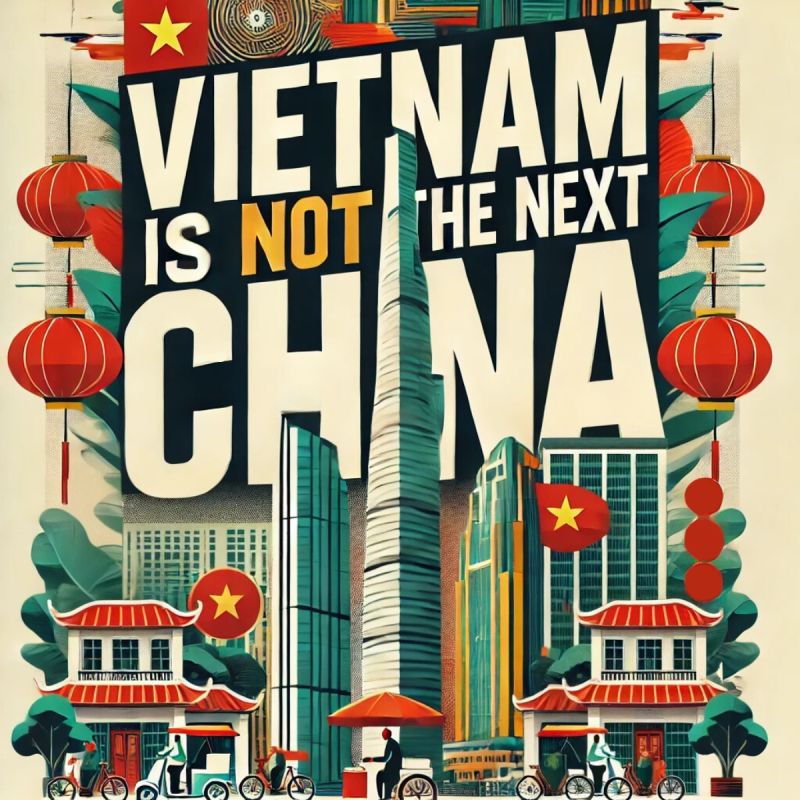
Here’s a summary from Hiroko Kato.
Vietnam is not the next China.
It never was.
Here’s why:
1. Size matters.
↳ Vietnam’s GDP is $429 billion. Just a fraction of China’s.
↳ It’s like comparing a city to a country.
2. Port capacity.
↳ Vietnam’s ports can’t handle China’s shipping volume.
↳ Just 1% of China’s shipping would overwhelm them.
3. Labor force.
↳ Vietnam’s unemployment rate is only 2.27%.
↳ There aren’t enough workers to take over China’s factories.
4. Supply chains.
↳ Most inputs in Vietnam’s products come from China.
↳ Moving factories doesn’t cut China out of the loop.
5. Infrastructure.
↳ Vietnam lacks the road-to-rail-to-port systems.
↳ It can’t support the volume needed by big companies.
6. Managerial expertise.
↳ There’s a shortage of experienced managers.
↳ The government’s regulatory capacity is weak.
7. Economic reality.
↳ Vietnam will benefit from offshoring trends.
↳ But it’s not going to be the “next China.”
Vietnam has potential.
It’s a growing hub.
But it’s not a replacement for China.
It’s an alternative.
And that’s okay.
MAA: This also applies to student recruitment. When you consider that Vietnam has a population of 100 million and a much lower GDP, i.e., less ability to afford big-ticket items like overseas study, recruiters should gauge their expectations accordingly.
 An International Educator in Vietnam
For many Viets this is a bitter pill to swallow, but as one myself I can’t help but agree with you. To be honest it would probably be better if U.S. – China relation were amicable at least. I certainly don’t want Vietnam to be caught in the crossfire.