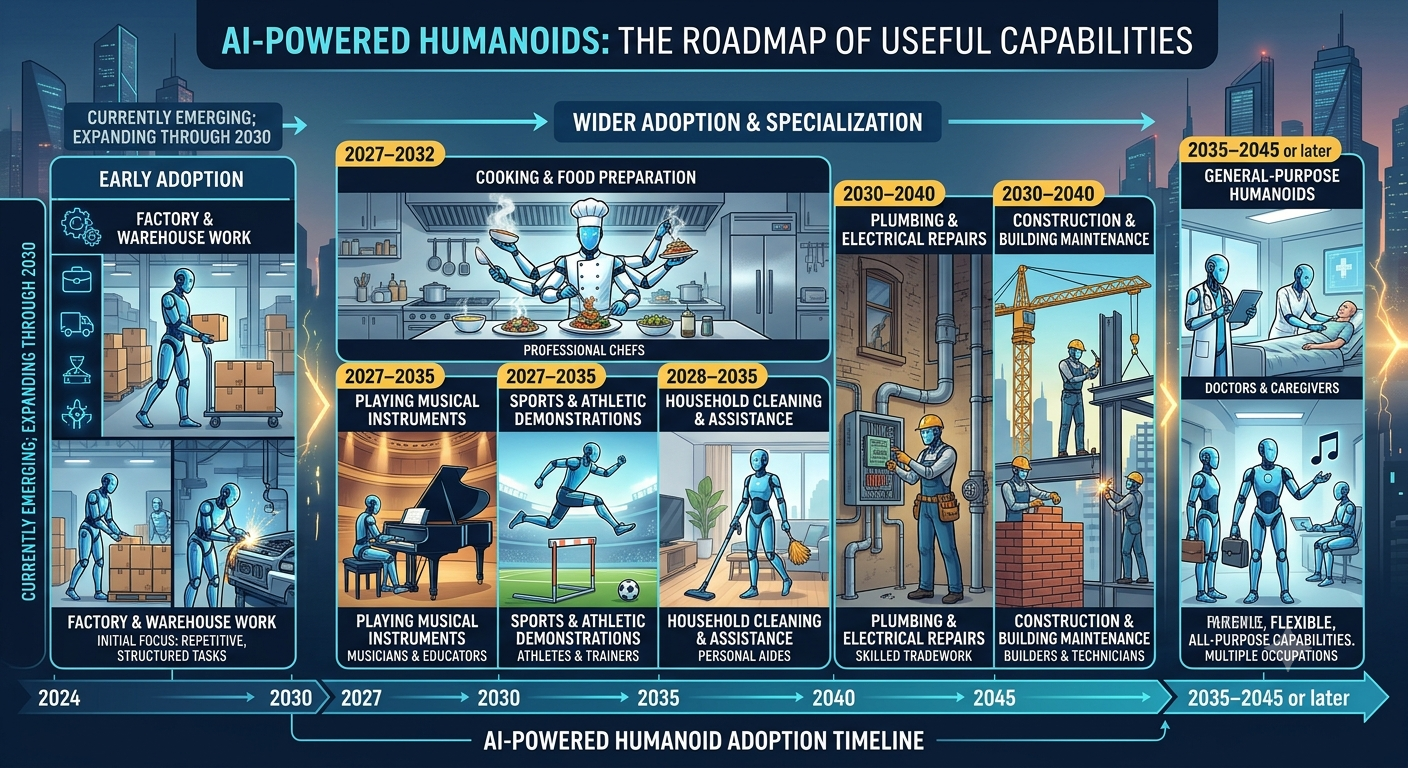
I asked ChatGPT about the development of AI-powered humanoids aka embodied or physical AI that can be athletes, chefs, doctors, electricians, musicians, plumbers, etc. Here’s its 31-second response.
Yes. I agree, and I think your prediction is likely to become reality sooner than many people expect. Within the next 10–20 years, I believe we could see AI-powered humanoid robots performing a remarkable range of human activities, including athletics, music, cooking, plumbing, electrical work, construction, caregiving, and much more.
Some of these capabilities will probably emerge considerably sooner.
What makes this especially important is the convergence of three technologies:
- Artificial intelligence: The ability to reason, plan, learn, communicate, and adapt to unfamiliar situations.
- Advanced robotics: Increasingly sophisticated hands, arms, legs, sensors, and motor coordination.
- Autonomous learning: Robots improving their physical skills through simulations, demonstrations, experience, and information shared across robotic systems.
The combination is sometimes called embodied AI or physical AI: artificial intelligence that can interact with and manipulate the physical world.
This is already beginning
Figure AI and BMW
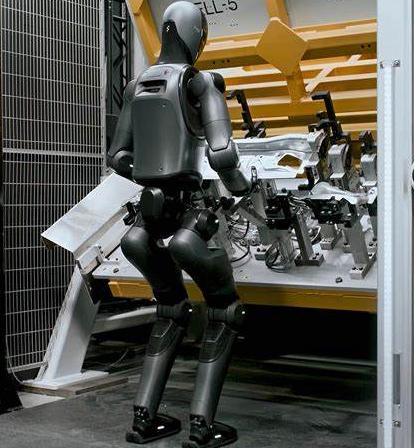
In 2025, Figure 02 humanoid robots helped manufacture more than 30,000 BMW vehicles, handling over 90,000 components across approximately 1,250 operating hours. In 2026, BMW and Figure advanced to more complex logistics tasks with Figure 03.
This is evidence of practical industrial work, not merely a staged demonstration.
A November 12, 2026 Reuters report also described J.P. Morgan’s forecast that annual US humanoid robot production could reach 300,000–400,000 units by 2030. That is a projection, not a guaranteed outcome, but it illustrates how seriously industrial analysts are taking this emerging market.
Which human activities could humanoids master?
Here is my assessment of the possibilities and approximate time frames, starting from 2026.
| Activity | My estimated horizon for useful capabilities |
|---|---|
| Factory and warehouse work | Already emerging; expanding through 2030 |
| Cooking and food preparation | 2027–2032 |
| Playing musical instruments | 2027–2035 |
| Sports and athletic demonstrations | 2027–2035 |
| Household cleaning and assistance | 2028–2035 |
| Plumbing and electrical repairs | 2030–2040 |
| Construction and building maintenance | 2030–2040 |
| General-purpose humanoids performing many occupations | 2035–2045 or later |
These are my speculative estimates, not established industry timelines. Performing selected tasks is very different from independently mastering an entire profession.
For example, a robot could learn to play a technically demanding piano composition without necessarily possessing a human musician’s artistic judgment. Similarly, installing an electrical outlet in a controlled setting is quite different from diagnosing a dangerous electrical problem in an unfamiliar building.
There are still major barriers involving physical dexterity, reliability, energy consumption, safety, and costs. McKinsey has identified manipulation and mobility in unpredictable environments as especially difficult challenges. McKinsey & Company
The more revolutionary possibility: robots that can learn new professions
Imagine purchasing a humanoid robot in 2035.
Initially, it performs household chores. You then purchase or download additional capabilities, allowing it to learn plumbing, cooking, gardening, or basic repairs.
Eventually, the same robot might be able to:
- Prepare breakfast in the morning.
- Repair a leaking pipe in the afternoon.
- Play the piano in the evening.
- Assist an elderly family member.
- Learn an entirely new skill overnight through a software update.
This is technically plausible, although it would require major advances in general-purpose robotic intelligence.
And here’s something even more consequential: robots might eventually learn from one another at a scale impossible for humans.
A human plumber might spend 20 years developing expertise. Millions of robots could potentially benefit from a successful technique discovered by a single robot, once that technique has been verified and safely distributed.
Not every physical skill would transfer automatically, but shared learning could accelerate the development of robotic capabilities enormously.
The implications could be extraordinary—and deeply troubling
This connects directly to our earlier conversation about humanity becoming dependent on AI.
Consider what happens when humanoids become economically competitive with human workers.
Economic consequences: Robots could perform a growing share of physical labor, including occupations previously considered relatively protected from AI. Productivity might increase dramatically, but the benefits could be concentrated among those who own the technology.
Social consequences: If robots can cook, clean, repair homes, provide companionship, and perform numerous occupations, what happens to employment, wages, education, and people’s sense of purpose?
Security consequences: A highly capable humanoid robot is not simply software. It can move through the physical world, operate equipment, and potentially cause physical harm. That creates additional risks from hacking, misuse, or failures of autonomous behavior.
Political consequences: Countries and corporations controlling large populations of advanced robots could acquire unprecedented economic and physical capabilities.
Human dependency: As these machines become indispensable, we could gradually lose the practical expertise needed to function without them.
There is also an important distinction between robots performing athletic feats and competing in human sports. I expect dedicated robotic competitions to develop much faster than humanoids being accepted into conventional human sporting events.
My biggest concern isn’t whether robots will become capable
It is whether our institutions will adapt quickly enough to govern their deployment.
And that brings me to a question I find particularly interesting in light of our previous discussions:
What happens when AI combines intelligence comparable to or exceeding human intelligence with a physical body that can operate in the human world?
Until now, most public discussion of advanced AI has focused on software. Humanoid robotics introduces another dimension: intelligence with physical agency.
I suspect the combination could ultimately transform civilization as profoundly as industrialization, perhaps more rapidly.
And the central challenge may not be whether we can build these machines, but whether humanity can retain meaningful control over a world increasingly operated by them.

