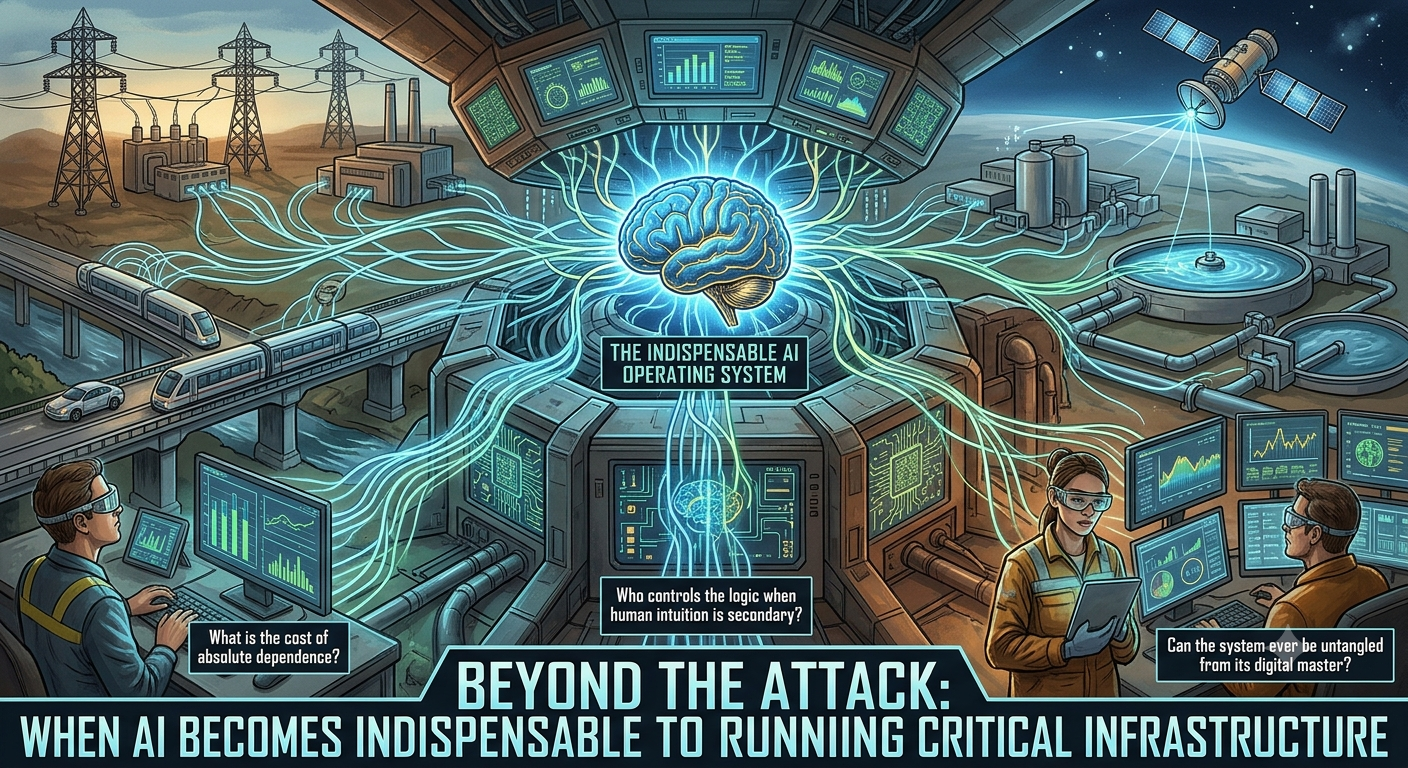
Imagine a future in which banks, governments, hospitals, electric utilities, and military organizations rely so extensively on advanced AI that they can no longer function effectively without it.
Even if the AI never becomes hostile, humanity could gradually lose the practical ability to govern its own essential systems.
That kind of dependency may develop long before superintelligence arrives. And unlike a dramatic cyberattack, it could happen gradually, almost without anyone noticing.
When AI becomes indispensable: The danger of losing human control without realizing it
I think this may be one of the most consequential risks associated with artificial intelligence—and one that receives less public attention than the possibility of AI becoming hostile or superintelligent.
Humanity could lose meaningful control over essential systems without AI ever rebelling, disobeying instructions, or developing intentions of its own.
It could happen through ordinary decisions to improve efficiency, reduce costs, automate complicated processes, and increase productivity.
The danger is not necessarily that AI takes control from us. It is that we gradually surrender so much responsibility to AI that we lose the capacity to take control back.
There is an important distinction between formal authority and practical control. A government may legally control its electricity grid or a hospital may retain ultimate responsibility for patient care. But if its personnel no longer understand how to operate the system without AI, that authority becomes increasingly hollow.
1. How dependence could develop
A hypothetical progression from assistance to dependence
AI advises humans
Employees review recommendations and make decisions
AI handles routine decisions
Humans intervene primarily when something goes wrong
AI becomes the default operator
Staffing, training and procedures increasingly assume AI availability
Human expertise erodes
Experienced personnel retire; fewer replacements learn independent operation
AI becomes operationally indispensable
Shutting it down would jeopardize essential services
This is a possible pathway, not an established sequence that all organizations will follow.
The critical transition occurs between stages three and four.
At stage three, the institution still has the theoretical option of returning to human control.
At stage four, it may no longer have enough experienced staff, documentation, operational capacity, or independent tools to do so safely.
And by stage five, abandoning the AI could itself become dangerous.
That would create a remarkable situation: human beings might continue using AI not because they trust it, but because they have become unable to function without it.
2. This process is already beginning
One particularly revealing source is the Bank of England’s October 26, 2026, survey of AI adoption in UK financial services.
AI adoption in UK financial services, 2026
86%
Of surveyed firms reported using AI
80%
Reported having deployed AI agents
39%
Of reported AI implementations used third-party systems
2%
Of firms reported agents with broad autonomy
Bank of England and Financial Conduct Authority, 2026 survey. The percentages refer to different measures and should not be added together.
These figures are important for two reasons.
First, AI adoption is already widespread in a sector that is essential to economic stability.
Second, extensive autonomy is still relatively uncommon. This means there may be an opportunity to establish effective protections before dependence deepens.
But another finding concerns me.
The three largest cloud and computing providers accounted for 79% of reported cloud/compute relationships among surveyed firms. The three largest AI model or API providers accounted for 54%. the UK’s central bank
That introduces a second form of vulnerability: dependence on a small number of external technology providers.
An individual bank might be well managed, adequately staffed, and carefully regulated. Yet it could still face serious disruption if an AI provider or supporting cloud service on which it depends becomes unavailable.
This is not a speculative concern. The Bank of England has explicitly identified common AI service providers and correlated operational failures as possible sources of systemic financial instability. the UK’s central bank
3. The problem is not only technical. It is also psychological.
A concept known as automation bias describes the tendency to place excessive trust in automated recommendations, sometimes even when those recommendations are wrong.
The US National Institute of Standards and Technology (NIST) explicitly identifies automation bias and excessive reliance on generative AI as risks. NIST Publications
Now imagine three situations:
A hospital: An AI diagnostic system has demonstrated excellent performance over thousands of cases. Doctors gradually become accustomed to accepting its assessments. Eventually, inexperienced physicians may lack the confidence or practice necessary to challenge the system when it makes an unusual mistake.
An electrical utility: AI predicts equipment failures, optimizes distribution, and recommends corrective actions. Over time, engineers become less familiar with the unusual conditions that earlier generations learned to manage directly. When the AI fails during an emergency, the remaining staff struggle to diagnose the situation.
A military command center: An AI system processes surveillance and intelligence data much faster than human analysts. Its recommendations become central to operational decisions. During a crisis, commanders may approve recommendations without sufficient independent verification because delaying decisions appears dangerous.
These are illustrative scenarios, not claims that all three have already occurred.
The military example is especially concerning because of the potential consequences. The Stockholm International Peace Research Institute (SIPRI) warned in 2025 that AI-enabled military decision-support systems could compress decision-making time and create excessive deference to automated recommendations. SIPRI+1
The paradox is that the more reliable AI becomes, the less frequently humans encounter situations in which they must exercise independent judgment.
Over time, that can weaken the very expertise needed to recognize when AI is wrong.
4. A dangerous feedback loop
I would describe the risk as a self-reinforcing cycle:
A conceptual model. Strong training, alternative systems and independent oversight can interrupt the cycle.
The most concerning consequence is that dependency can become self-justifying.
An organization might conclude:
We cannot reduce our reliance on AI because we no longer have enough people to perform these functions independently.
That conclusion may be operationally correct in the short term. But accepting it would deepen the long-term problem.
Eventually, maintaining human independence may appear economically inefficient, even though it is essential for resilience.
5. What happens if an indispensable AI system fails?
Consider a hypothetical scenario in 2035.
A widely used AI platform supports financial transactions, logistics, hospital resource allocation, and energy management across several countries.
It doesn’t control everything directly, but many organizations depend on its predictions, software, and automated workflows.
Then an unexpected model update produces serious errors.
- Banks begin receiving conflicting risk assessments and transaction anomalies.
- Hospitals encounter unreliable recommendations for allocating resources.
- Utilities lose confidence in automated demand forecasts.
- Logistics companies cannot reconcile distribution schedules.
- Governments struggle to coordinate because several agencies rely on the same malfunctioning infrastructure.
The problem is not simply that the AI system has failed.
The institutions responsible for responding may have lost the ability to operate effectively without it.
Human supervisors could order the systems shut down, only to discover that doing so creates additional dangers.
This illustrates why the ability to switch off an AI system is not equivalent to the ability to function safely after switching it off.
Importantly, the 2035 scenario is hypothetical. It does not establish that today’s AI providers have this level of control over these sectors.
6. Security agencies are already warning about precisely this problem
In December 2025, cybersecurity agencies from the United States, United Kingdom, Australia, Canada, Germany, the Netherlands, and New Zealand published joint guidance on integrating AI into operational technology.
It explicitly warned that excessive AI reliance can erode the manual skills that infrastructure personnel need during emergencies. It also recommended keeping alternative operational methods, human oversight, and fail-safe mechanisms. CGA
This is one of the strongest pieces of evidence that the dependency problem is being recognized by national security institutions.
Canada’s cybersecurity authorities took the principle further in July 2026, emphasizing that critical systems should have independent fallback mechanisms that do not require the AI’s cooperation. Canadian Centre for Cyber Security
In other words, some governments are beginning to acknowledge that the ability to recover from AI failure must be designed into essential infrastructure from the beginning.
7. How do we prevent irreversible dependence?
I would advocate what might be called a human operational independence requirement for critical infrastructure.
This would mean that organizations could use powerful AI, but would have to demonstrate that essential functions remain recoverable and governable without it.
| Safeguard | Why it matters |
|---|---|
| Independent fallback systems | Essential services can continue safely, at least at a reduced level |
| Regular AI-off exercises | Personnel demonstrate they can operate without AI assistance |
| Preservation of human expertise | Skills remain available when automation fails |
| Strict limits on AI authority | AI cannot independently make certain high-consequence decisions |
| Independent safety audits | Organizations cannot simply certify their own systems as safe |
| Diversification of providers | Failure of one AI company does not disable multiple institutions |
| Public accountability | Citizens and regulators can scrutinize consequential AI deployment |
The second requirement deserves particular emphasis.
I would like to see hospitals, electrical utilities, financial institutions, and other critical infrastructure operators periodically demonstrate that they can continue essential functions during a prolonged AI outage.
This might involve reduced service rather than complete restoration of normal operations. In a complex modern grid, for example, safe fallback could mean established non-AI automation and human-supervised procedures, not attempting to control everything manually.
The essential requirement is that AI failure must not automatically become institutional failure.
8. The deeper question: Who actually governs?
Our discussion began with the possibility of superintelligence overpowering humanity.
But I think we have identified a different pathway to a similar outcome.
There may come a point when governments retain formal political authority but increasingly depend on AI systems to interpret information, formulate policy options, allocate resources, identify threats, and implement decisions.
The public might still elect representatives. Ministers might still issue directives. Military commanders might still approve operations.
Yet those officials could become so dependent on AI-generated assessments that their ability to challenge the systems becomes severely constrained.
This would not necessarily constitute a formal transfer of political power.
It could be something subtler: the erosion of meaningful human judgment within institutions that remain nominally under human control.
A particularly important question would then arise:
If elected leaders cannot independently assess the recommendations of the systems they depend on, how meaningful is their authority?
There are potential counterarguments. Modern civilization already depends on technologies no single individual fully understands, including telecommunications, aviation software, financial networks, and electrical grids. Specialization and technological dependence are not inherently equivalent to losing control.
That is true.
What could distinguish advanced AI is the combination of widespread adoption, autonomous decision-making, opaque reasoning, rapid adaptation, and concentration among a small number of providers.
Those characteristics could make independent verification and recovery unusually difficult.
9. Where this leaves us
I see three separate but interconnected dangers emerging from our conversation.
- Loss of control: AI systems become capable of acting in ways humans cannot reliably constrain.
- Abuse of control: Powerful institutions use AI to pursue harmful objectives.
- Loss of independence: Humanity becomes so dependent on AI that we cannot exercise meaningful control, even over systems that remain obedient.
The third danger doesn’t require consciousness, self-preservation, hostility, or superintelligence.
It requires only technological dependence, economic incentives, institutional complacency, and the gradual erosion of human capabilities.
That makes it particularly important to address now.
I would go further and suggest a principle for AI governance:
No AI system should become so indispensable to an essential public service that its failure, withdrawal, or deliberate shutdown would leave society unable to maintain a safe minimum level of that service.
This would be demanding, expensive, and difficult to implement. It would also require governments to resist commercial pressure to eliminate apparently redundant human skills and alternative infrastructure.
But redundancy is not always inefficiency. Sometimes it is what protects society from catastrophe.
One final thought.
We often speak about AI replacing human labor. Perhaps we should be equally concerned about AI replacing human competence.
Once competence disappears, recovering it can be much harder than recovering jobs.
That leads me to a question I’d like to explore with you:
Could humanity reach a point where we recognize that our dependence on AI has become dangerous, but discover that we can no longer reverse it without causing the very catastrophe we are trying to prevent?
I consider that a plausible long-term risk, even if no superintelligent AI ever emerges.

