I urge to take 18 minutes of your precious time and watch this interview with Dr. Gabor Maté, a Hungarian Canadian physician, author, and Holocaust survivor. He has worked in family practices and specializes in childhood development and trauma, including long-term effects on physical and mental health, such as autoimmune diseases, cancer, attention deficit hyperactivity disorder (ADHD), and addiction.
According to his Wikipedia profile, Dr. Maté was born in Budapest, Hungary, in 1944 to a Jewish family. His maternal grandparents, Josef Lövi and Hannah Lövi, who came from the town of Košice in modern eastern Slovakia, were killed in Auschwitz when he was five months old. His aunt disappeared during the war, and his father endured forced labour at the hands of the Nazi Party. The mass deportations of Hungarian Jews began after the German occupation on 19 March 1944. It’s estimated the 430,000 to 440,000 Jews, mainly from rural areas, were deported between 15 May and 9 July, mostly to Auschwitz-Birkenau.
Below are a description, some notable quotes from the interview, a link to the video, a transcript I created with TurboScribe, and an AI (ChatGPT) analysis. I added some links to people of interest and a bonus interview at the end. (Note: This is a 30-minute read, plus the time spend watching one or both videos.)
Physician and renowned trauma expert Dr. Gabor Maté delivers a devastating psychological and historical deconstruction of Israeli state ideology, collective victimhood, and Western foreign policy.
Moving beyond standard political commentary, Dr. Maté examines how intergenerational trauma is weaponised to justify perpetual conflict, why nationalism has supplanted ancient spiritual traditions, and what history tells us about militarised states reliant on declining global empires.
Drawing on his personal family history, epigenetic studies on Palestinian youth, and the long line of Jewish moral thinkers who warned against this trajectory, Dr. Maté offers an essential diagnosis of a society operating within an infrastructure of impunity.
Orly Noy’s 2025 essay, Israel is waging a holocaust in Gaza. Denazification is our only remedy, is more relevant than ever.
Notable Quotes
Israel right now is a psychopath functioning in an infrastructure of impunity. For a lot of Jews today, and a lot of Jewish institutions, including religious institutions, Israel has replaced Jewish spirituality. It is the religion.
So there are a lot of people who are otherwise decent individuals, and they’re very kind to their children, good to their dogs, but who can watch Palestinians being murdered and justify it. To my ‘Zionist friends,’ and I put that in quotation marks, because I have no Zionist friends, if you perceive yourself as a perpetual victim, then everything you do is justified, and everything that’s done to you is a crime. And so there is what I call a culture of entitled victimhood.
And I can quote you a whole number of examples of Jewish Israeli soldiers or scholars or citizens who say that we’re behaving in ways that are just like the Nazis.
So what we have is this culture of entitled victimhood that’s driving a lot of the reactions. And that’s what we see in this Holocaust remembrance pornography that’s perpetrated upon us. Not that the Holocaust should not be remembered, but should be remembered for what it was, of what happens when a society goes psychotic.
It’s very accurate to describe Israeli society as psychotically brutal. When you look at the TikToks that Israeli soldiers proudly broadcast their utter contempt for life and for Palestinians, when you look at the polls in Israel, where a significant percentage of Israelis think that it’s okay to expel Palestinians from all of Palestine, and certainly from Gaza, what you’ve got is a brutal society that’s functioning like a psychopath on whom there are no limits.
So the synagogue I used to go to, where my kids were having their bar mitzvahs, there’d be a prayer for the state of Israel. Why on earth would you have a prayer for a state? A state is just a political entity like every other state. But to confuse it with religion?
What’s Israel? It’s a state of 7 million people that’s lording it over the Middle East, that’s fomenting wars all over the place, that’s mercilessly killing people every day. Why is it able to do that? Because there’s a Big Daddy behind it.
Israel right now is a psychopath functioning in an infrastructure of impunity. For a lot of Jews today, and a lot of Jewish institutions, including religious institutions, Israel has replaced Jewish spirituality. It is the religion.
So there are a lot of people who are otherwise decent individuals, and they’re very kind to their children, good to their dogs, but who can watch Palestinians being murdered and justify it. To my “Zionist friends,” and I put that in quotation marks, because I have no Zionist friends, if you perceive yourself as a perpetual victim, then everything you do is justified, and everything that’s done to you is a crime. And so there is what I call a culture of entitled victimhood.
We’re always the victims, therefore we’re entitled to do anything we want. It doesn’t matter what anybody thinks. And morality is a joke.
The Jewish trauma, horrible as it was, is not denied. The Palestinian trauma is denied.
Interviewer: For Israel, the suffering in Gaza is it not a genocide.
The Holocaust educational mistrust is what I would call it. The Holocaust industry is nothing but a propaganda arm of the Israeli Hasbara. The whole Holocaust memorial movement has been used to justify Israeli actions.
The Hebrew word for the Holocaust is shoah. There’s no business like shoah business, the business of selling the Holocaust as a way of selling Israel. And whether they’re up to that way consciously, or whether they’re driven to behave that way unconsciously, practically it’s the same thing.
My mother and I easily could have ended up in Auschwitz when I was six months of age, as my grandparents did. But that doesn’t give me any authority. The only thing it does, it breaks the mythology that somehow Jewish suffering justifies what we’re doing to the Palestinians.
And it also breaks the monolithic sense that all Jews see things exactly the same way. And that anybody, whether it’s Benjamin Netanyahu or the chief rabbi of England, or anyone, has got the right to speak for all Jews.
So I visited Auschwitz for the first time last year. And I hadn’t been there before. Something in me actually resisted going there because I kind of thought of it as a Holocaust Disneyland kind of display. I was surprised and moved when I was there.
It’s a powerful experience being there and hearing the record and seeing the record of what was done there and standing on the same spot that my grandparents would have landed at with the train on their way, direct way to the gas chamber. And when I came up, they asked me, What are your thoughts? And the first thought I had was that those of my fellow Jews who fully identify with Auschwitz, as that being the summation, the essence of Jewish experience, that victimhood will never understand the Palestinians. Because if you perceive yourself as a perpetual victim, then everything you do is justified and everything that’s done to you is a crime.
And so there is what I call a culture of entitled victimhood. We’re always the victims. Therefore, we’re entitled to do anything we want.
It doesn’t matter what anybody thinks. And morality is a joke. It has nothing to do with it.
So there’s this entitled victimhood. Now, there’s something about victimhood that really appeals to human beings. Not that anybody wants to be a victim or victimized.
But if you look at your personal relationships, and I’ve talked about this before, like in my marriage, I often see myself as a victim. Because when I see myself as a victim, I don’t have to look at what I’m doing. I don’t have to take responsibility for my own actions, attitudes, beliefs, and behaviors.
It’s a kind of comfortable position because it absolves me of responsibility. And that applies almost anything that you can say about individual psychology also applies to collective psychology, but in a more exacerbated way. So that sense of victimhood, which a lot of people have, based on their own traumas, and they bring it into their relationships, is magnified on a national and collective scale.
So what we have is this culture of entitled victimhood that’s driving a lot of the reactions. And that’s what we see in this Holocaust remembrance pornography that’s perpetrated upon us. Not that the Holocaust should not be remembered, but should be remembered for what it was, of what happens when a society goes psychotic.
There’s a kind of uniqueness to it, a kind of mechanized, motorized, planned, industrially conducted mass murder. I can’t think of other examples like that. So that makes it unique.
But in terms of the broader themes of psychotic behavior, of brutality, of utter contempt for human dignity and human life, it’s not unique. And we see it today. And I can quote you a whole number of examples of Jewish Israeli soldiers or scholars or citizens who say that we’re behaving in ways that are just like the Nazis.
So lest anybody think that’s sort of an anti-Semitic slander, these are Israelis saying it. If you look at the original founders of Zionism, there was actually a lot of idealism there. Now, that idealism ignored the Palestinian reality.
But they did talk about, think about, and envision a society that was socialist and just and human. Now, they always excluded the Palestinians from that vision. But I think, like, my grandfather was a Zionist.
He was a Zionist leader in southern Slovakia, northern Hungary. But he was a very humane person. He’d be appalled at what he’s seeing right now.
So what’s happened? What’s happened is that once you decide that somebody’s worthless than you are, that somebody has fewer rights than you do, that you have the justification to overwrite somebody’s needs, somebody’s reality, somebody’s history, somebody’s cultural existence, and to take their lands, you gradually have to harden your heart, because you have to. Because the other person or the other party is going to respond. They’re going to resist.
They’re going to fight back. And then you’re going to have to be even more brutal in suppressing them. So what we’ve seen now is not only the predictable, but the predicted brutalization of Israeli society, so that there were Zionists or non-Zionist Jews all along, going back 150 years almost, who predicted this.
There was a very famous spiritual Zionist, Ahad Aham, who in 1895 or so wrote, if this continues, that if we continue to treat the Arabs like the way we are, he’s talking about the Jewish colonists in Palestine at that time, all we’re going to end up with is one small Levantine people tormenting another small Levantine people. And he said, if this is the Messiah coming, I don’t want to see him arrive. He said this in the 1890s.
And going back decades ago, there was the great Yeshayahu Leibovitz, a Jewish-Israeli scholar, who predicted the Nazification of Israeli society. So not that anybody necessarily wanted it to go that way, but again, once you decide that you have more rights than somebody else, then you gradually have to harden your heart and venom yourself.
It’s very accurate to describe Israeli society as psychotically brutal. When you look at the TikToks that Israeli soldiers proudly broadcast their utter contempt for life and for Palestinians, when you look at the polls in Israel, where a significant percentage of Israelis think that it’s okay to expel Palestinians from all of Palestine, and certainly from Gaza, what you’ve got is a brutal society that’s functioning like a psychopath on whom there are no limits. And given Western policy and Western ideology, there’s what the great Indian writer Arundhati Roy called an infrastructure of impunity. And Israel right now is a psychopath functioning in an infrastructure of impunity.
It’s a disaster in a number of senses. One of them is morally, spiritually, because for a lot of Jews today and a lot of Jewish institutions, including religious institutions, Israel has replaced Jewish spirituality. It is their religion.
So the synagogue I used to go to, where my kids were having their bar mitzvahs, there’d be a prayer for the state of Israel. Why on earth would you have a prayer for a state? A state is just a political entity like every other state. But to confuse it with religion? And in a lot of synagogues, there’s Israeli flags.
The Star of David? It’s got nothing to do with David. It came from India somewhere. Interestingly, you know what else came from India? The swastika.
The swastika was a Hindu religious symbol. The Nazis turned it into a symbol of dominance and hatred. Why are we confusing political allegiance with religious belief or spiritual reality? So spiritually, it’s a disaster.
Ethically, morally, it’s a complete disaster. We certainly know the multigenerational impact of trauma on peoples such as Jewish people, for example. We can predict the same thing for Palestinians.
In fact, we don’t have to predict anything. In 2004, there was a study of Palestinian children. A large percentage of them, over 90%, showed some degree of traumatic symptomatology.
Now, if anybody thinks that October the 7th was the beginning of history, they need to look at the study in 2004 that was done before Hamas took power in Gaza. So it predates Hamas. And it showed that a large percentage of Palestinian children had traumatic symptoms, including wetting their beds, nightmares, panic attacks, anxiety, aggression towards their parents, fear of death, and so on.
Now, as somebody who wet my bed until I was 13, based on what happened to me as an infant, I don’t have to project into the future to know what’s going to be the impact on Palestinian kids. And in a Syrian study, it showed that word trauma even changes the functioning of the DNA of the child. So these impacts are severe.
The Jewish trauma, horrible as it was, is not denied, not anymore, except by an insane minority of Holocaust deniers. The Palestinian trauma is denied. Not only is Palestinian trauma denied, even Palestinian existence is denied.
And so that compounds the trauma. The other side of it is the tremendous resilience of Palestinian society, the tremendously resilient people. I’ve been there, I’ve seen them, I’ve worked with them, including more recently, just 4 years ago.
They have tremendous capacity, but even that capacity can be overwhelmed, and the ongoing nature of their trauma, the almost universal Western compliance and support for it, the denial of it, the justification of it, that’s going to compound the trauma. So I don’t know how to predict the future, but some of it will depend on how the world responds. And the world’s response so far has been, I’d say, twofold.
On the part of ordinary people, millions of ordinary people around the world, there’s been shock, grief, almost disbelief, helpless frustration, sorrow, and trauma. And on the part of the official Western world, there’s been compliance, complicity, collusion, collaboration, justification, and of course, denial and averting the eyes from the reality. And so how this will unfold in the future depends very much on how the world responds.
Because here’s the deal. What’s Israel? It’s a state of 7 million people that’s lording it over the Middle East, that’s fomenting wars all over the place, that’s mercilessly killing people every day. Why is it able to do that? Because there’s a Big Daddy behind it.
And Zionism never would have succeeded without Big Daddy. So the first Big Daddy was the British Empire. So Balfour, who’s an anti-Semite, actually, who, when he was prime minister in 1905 or so, opposed the immigration of Jewish refugees to England from terrible persecution in Eastern Europe, in Russia particularly.
Then he issues the Balfour Declaration. His Majesty’s government views with favor the establishment. Who the hell is His Majesty’s government to view with favor anything that is happening in the Middle East? And Winston Churchill, anointed saint of British imperialism, said in 1920 that the establishment of a Jewish entity in Palestine accords with the best interests of the British Empire.
So without that support of the British Army, the British state, British laws, there would not have been no Zionist development in Palestine. And the British did everything they could for 20 years to foment the, or to empower, the development of Jewish institutions, including military institutions in Palestine, while oppressing, suppressing, and killing the Palestinians. Britain sent, was it, 100,000 British soldiers to Palestine to suppress the 1936 to 1939 Palestinian revolt against British rule. (MAA: Britain initially sent 20,000 to 25,000 troops, roughly two full infantry divisions with supporting arms, into Mandatory Palestine at the height of the 1936–1939 rebellion.)
So without Big Daddy, there’d be no Israel. Then the British Big Daddy lost its power to its younger American cousin, so the Americans became the Big Daddy. Now, why does America support Israel? Well, there’s three possible reasons.
One is, America loves the Jews. Well, let’s throw that one out, because we know America how treated Jewish immigrants and, or even, you know, kept them out for a long time. But beyond that, states don’t love anybody, so that’s just nonsense, number one.
Number two, the Jews control America. Some people think that, and certainly the Jewish community, mainstream institutions, wield and exercise a lot of power and influence in the U.S., but they don’t control the U.S. They wield influence, but they don’t control it.
So the third one is, it’s in the interest of the American empire to support Zionism.
Well, that’s true, but there’s two problems with it, I would say, speaking of disaster. One of them is, empires don’t last forever, and the American empire is already on the wane. It’s losing its power.
It hasn’t won a war for a long time. It’s got challengers. Economically, it’s on the way out.
It’s still very militarily powerful. It’s the most destructive military force in the world, but it’s on the way out. And empires change their policies.
Now, what’s going to happen to those 7 million puffed-up Zionists, or that puffed-up little state? I’m not going to talk about the population of Israel. Let’s talk about the state. What’s going to happen to that puffed-up little state in the Middle East, when the American empire is no longer there, or is no longer interested in supporting it? Complete and utter disaster.
And the hatred and the venom and the totally natural desire for revenge that they’ve sowed is going to come back and haunt them. So history is going to look back on Zionism as a complete spiritual, ethical, and historical disaster. In the mainstream media, the perpetrator has been portrayed as the victim, and the victims have been portrayed as the perpetrators.
It’s so clear who’s taking whose land, who’s killing who, who’s oppressing who. But in the mainstream media, that’s been completely reversed, as a result of which, blessedly, Double Down News developed to fill that breach of truth. So I just recommend that people, if they find it within themselves to do so, to support Double Down News.
An Analysis of Dr. Gabor Maté’s Interview: Trauma, Zionism, Power, and the Psychology of Impunity (1m 2s)
Interview: Dr. Gabor Maté · Double Down News · Published November 8, 2026 · Approximately 19 minutes
From the Holocaust to Gaza: Dr. Gabor Maté on the Impact of Trauma | Ideastream Public Media
Original interview: Dr Gabor Maté Diagnoses Israel. IT’S WORSE Than You Think
Analysis based on your supplied transcript, supplemented by independent historical and scientific research.
Overall assessment
I consider this a powerful interview, particularly because Maté applies his understanding of individual trauma to the psychology of nationalism, collective identity, political violence, and moral responsibility.
His central proposition is that historical suffering does not automatically produce empathy for others. Under certain political and psychological conditions, it can instead become a justification for inflicting suffering.
This is an important insight, and it reaches well beyond Israel and Palestine.
Maté’s argument has five interconnected dimensions:
- Psychological: A collective identity built around permanent victimhood can undermine moral accountability.
- Historical: Zionism’s treatment of Palestinians has produced contradictions that some Jewish thinkers identified long before Israel’s establishment.
- Ethical and spiritual: Political nationalism can become so intertwined with religious identity that state actions become difficult to criticize.
- Geopolitical: Israel’s ability to act with limited consequences depends heavily on protection by powerful foreign states, especially the United States.
- Intergenerational: The psychological consequences of violence against Palestinians will continue long after the immediate destruction ends.
I find his psychological and ethical arguments particularly compelling. His historical arguments have substantial support, although some require qualifications. His predictions about the decline of American power and Israel’s eventual fate are much more speculative.
There is also an important limitation: Maté sometimes moves from explaining collective psychological tendencies to characterizing an entire society in clinical-sounding terms. Those two things are not equivalent.
1. The psychology of entitled victimhood
This is the interview’s most important contribution.
Maté introduces the concept of entitled victimhood: a psychological condition in which a person or group interprets its own historical suffering as giving it exceptional moral permission.
He describes a pattern in which people who see themselves as permanent victims can justify their own actions while condemning virtually everything done against them.
The underlying mechanism is recognizable:
Maté’s proposed psychological cycle
Historical trauma and collective fear
Permanent identification as the victim
Moral exceptionalism and perceived entitlement
Dehumanization and justification of violence
Resistance, renewed fear, and reinforcement of the victim narrative
Conceptual reconstruction of his argument, not a clinically validated universal model.
What makes his explanation interesting is his willingness to apply the same mechanism to himself. He describes how, in his own marriage, imagining himself as a victim can temporarily relieve him of the obligation to examine his behavior.
He then extends that observation to national identity.
I think the extension has explanatory value, but it requires caution. Individuals have psychological lives; nations are heterogeneous political communities with institutions, competing interests, and different beliefs. A country cannot literally possess a single psychological diagnosis.
Nevertheless, collective victimhood can become a political resource. Leaders may invoke historical persecution to cultivate solidarity, encourage obedience, justify extraordinary measures, or delegitimize criticism.
The important distinction is between remembering genuine suffering and using that suffering to escape present-day accountability.
Maté is not denying Jewish trauma. He is arguing that such trauma cannot justify the dispossession or killing of Palestinians.
That is the strongest ethical premise in the interview.
2. Can victims become perpetrators?
Maté’s second major argument is that experiences of oppression do not necessarily immunize a person or society against becoming oppressive.
This challenges a comforting assumption: that people who understand persecution will naturally oppose it wherever it appears.
Psychologically, there is no guarantee of that outcome.
Traumatic experiences can generate solidarity and compassion, but they can also contribute to fear, hypervigilance, identification with one’s own group, and perceptions of existential threat. Which responses develop depends on many factors, including social institutions, leadership, education, and subsequent experiences.
Maté draws on his own Holocaust family history, including the murder of his grandparents at Auschwitz. This personal history gives his observations particular moral significance, though, as he explicitly recognizes, personal suffering does not confer automatic authority over historical or political questions.
I would sharpen his argument slightly:
Trauma does not explain away cruelty, and trauma alone does not cause cruelty. It is what societies and political institutions do with traumatic memory that matters.
This distinction is crucial. Otherwise, psychological explanation risks becoming either an excuse for perpetrators or a form of collective blame against survivors.
3. Holocaust remembrance and the moral use of history
Maté is particularly provocative when discussing Holocaust remembrance.
He objects to what he sees as the political instrumentalization of the Holocaust, particularly when it is invoked to legitimate Israeli state policy or portray criticism as inherently antisemitic.
There are two distinct propositions here.
First, Holocaust remembrance can and should confront the historical mechanisms through which ordinary institutions and individuals participated in persecution, exclusion, dehumanization, and industrialized murder.
Second, some political actors have used Holocaust memory to defend particular policies or discredit political opponents.
Both propositions merit serious consideration.
Where I disagree with the breadth of Maté’s rhetoric is his language suggesting that the Holocaust memorial movement as a whole is essentially an instrument of Israeli propaganda.
That is too sweeping. Holocaust education encompasses serious historical scholarship, survivor testimony, memorialization, and education about antisemitism, often conducted independently of the Israeli government.
Distinguishing legitimate remembrance from political exploitation would make his argument stronger.
It is also important to recognize that the Holocaust remains historically distinctive in its organized, industrialized genocidal machinery. Recognizing that distinctiveness does not diminish the suffering of Palestinians or exclude comparisons of specific policies and practices.
The universal ethical lesson of the Holocaust should be that no population is exempt from human rights protections—not that one population has acquired an exclusive claim to moral consideration.
That, I believe, is the most defensible formulation of Maté’s position.
4. The historical warnings: Ahad Ha’am and Yeshayahu Leibowitz
Maté’s historical argument is especially interesting because he invokes Jewish intellectuals who warned about the moral consequences of Zionist policies toward Palestinians.
Ahad Ha’am (1856–1927)
In his 1891 essay Truth from Eretz Yisrael, Ahad Ha’am criticized Jewish settlers who treated Arabs with contempt or cruelty and warned that the indigenous population would resist encroachment.
This is a documented historical warning, although the precise quotations attributed to him in Maté’s interview should not automatically be treated as verbatim. valleybeitmidrash.org+1
Yeshayahu Leibowitz (1903–1994)
Leibowitz argued against Israel’s continued occupation of Palestinian territories after 1967. He warned that prolonged domination would corrupt Israeli political institutions and military behavior.
His criticism extended to comparisons involving Nazi practices—deliberately provocative language that caused considerable controversy within Israel. Stanford Encyclopedia of Philosophy
Maté’s broader contention is that systems of unequal political rights can become progressively more coercive because domination generates resistance, and governments respond to resistance with further repression.
This is a plausible historical and political mechanism. However, it is not deterministic. Institutions, public opposition, democratic accountability, outside pressure, and political negotiations can interrupt the process.
His point is nevertheless significant: the present situation cannot be understood exclusively through decisions made after October 7, 2023. It must also be examined through the preceding history of dispossession, occupation, resistance, political decisions, and failed peace efforts.
5. Is Israel functioning like a psychopath?
Maté’s headline statement is deliberately provocative:
Israel right now is a psychopath functioning in an infrastructure of impunity.
I would separate its two components.
The psychological metaphor: A psychopath is an individual who exhibits certain patterns of behavior and personality traits. A state cannot receive a psychiatric diagnosis. Nor is it scientifically defensible to characterize every member of a national population as psychologically identical.
What Maté appears to be describing is an institutional pattern: extreme violence against a population, diminishing moral inhibitions, and confidence that powerful allies will prevent meaningful consequences.
Those are observable political behaviors that can be investigated without using psychiatric labels.
The infrastructure of impunity: This is the stronger and more analytically useful concept.
It suggests that abuses can persist when governments face limited effective external consequences because of military support, diplomatic protection, economic relationships, and international political interests.
The evidence supporting serious scrutiny is substantial. On September 16, 2025, a UN Independent International Commission of Inquiry concluded that Israeli authorities and security forces had committed genocide in Gaza. Israel has rejected that conclusion, citing its campaign against Hamas and its stated efforts to minimize civilian casualties. The Commission’s finding is not the same as a final judgment by the International Court of Justice. Question of Palestine
Maté’s argument becomes more rigorous when treated as a question of institutional accountability rather than a psychiatric diagnosis.
The questions are: Who authorizes particular actions? Who can prevent them? Which institutions investigate violations? What consequences follow, and what external support enables the conduct to continue?
6. Palestinian children and intergenerational trauma
This is another of the interview’s strongest sections, and one where Maté’s clinical experience is particularly relevant.
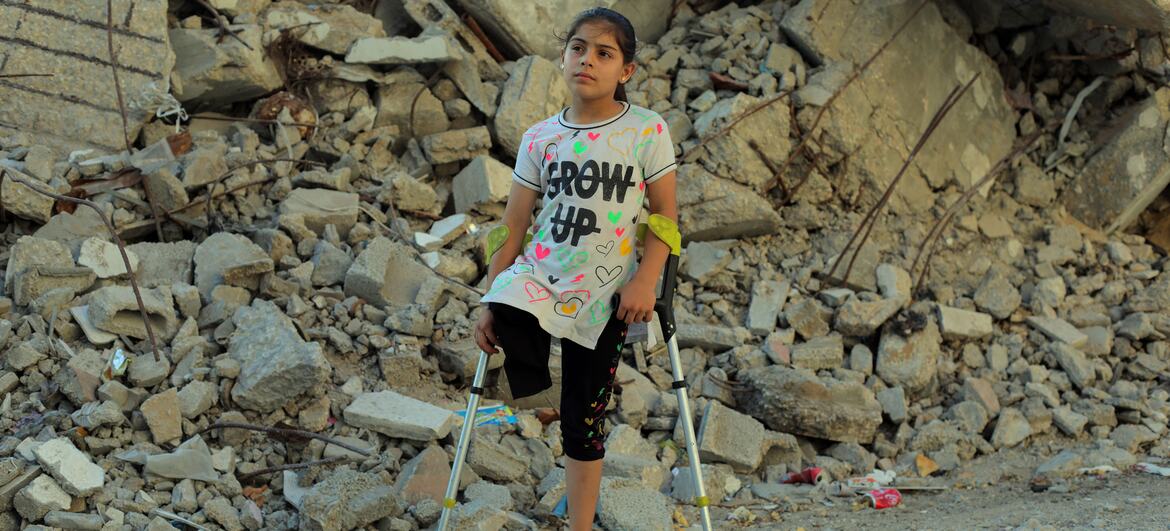
He emphasizes that Palestinian children were experiencing substantial psychological trauma decades before the current war.
Checking his research claims
The original research broadly supports his argument, and I found a particularly useful source.
A Gaza Community Mental Health Programme study, reported in UNRWA’s 2003 Annual Health Report, documented the following distribution of post-traumatic stress symptoms among children aged 10–19.
Severity of post-traumatic stress symptoms in the reported Gaza study
Acute: 32.7%
Moderate: 49.2%
Low: 15.6%
No symptoms: 2.5%
Source: UNRWA Health Annual Report 2003, citing the Gaza Community Mental Health Programme. This is a historical study population, not a current population-wide prevalence estimate. Original UNRWA report
The percentages total 97.5% reporting some level of symptoms. This is consistent with Maté’s statement that more than 90% experienced traumatic symptomatology, but having symptoms is not the same as receiving a diagnosis of PTSD.
Other peer-reviewed studies also documented serious problems before 2023. For example, research published in 1999 found that 72.8% of 239 children studied experienced post-traumatic stress reactions of at least mild intensity.
The biological consequences of trauma
Maté also refers to Syrian research suggesting that trauma can influence biology across generations.
A study published in Scientific Reports in 2025 examined 131 people from 48 Syrian families across three generations and found associations between exposure to violence and changes in DNA methylation.
This is genuine research, not an invented claim. PubMed Central (PMC)
However, the findings require careful interpretation. DNA methylation concerns the regulation of gene activity, not changes to the DNA sequence itself. The study does not establish that trauma-related disorders are inevitably inherited, and researchers have emphasized the need for replication. Nature
I agree with Maté’s larger point: the consequences of violence extend well beyond immediate deaths and injuries, affecting psychological functioning, family relationships, schooling, health, and potentially subsequent generations.
But this should not produce an assumption that traumatized children are permanently damaged or destined to repeat violence. Trauma recovery, resilience, and supportive social conditions also matter.
7. The denial of Palestinian suffering
Maté draws a distinction between the historical recognition of Jewish suffering and what he sees as the systematic denial or minimization of Palestinian suffering.
His argument is not simply about violence. It is also about what happens when people experience violence and their experiences are then disputed, rationalized, or erased.
Psychologically, this involves a second layer of harm: people must cope both with the original experience and with the refusal of others to acknowledge it.
I find this particularly relevant to Palestinian children, families who have lost relatives, displaced communities, and people who have repeatedly endured violence without obtaining meaningful accountability.
There are important qualifications, however. Holocaust denial and antisemitism still exist and remain consequential; Jewish trauma is not universally acknowledged. Likewise, Palestinians have received substantial international recognition and solidarity, even while many governments have continued to support Israeli policies.
The defensible point is not that one history is universally recognized while the other is universally denied. It is that recognition is uneven, and political power strongly influences whose suffering receives protection, accountability, and consequences.
That is a compelling criticism of international political institutions.
8. The United States, Israel, and the politics of empire
This is the section I would examine most closely in a follow-up investigation.
Maté argues that Israel’s position has depended on successive imperial patrons: initially Britain, subsequently the United States.
His historical interpretation has substantial support, although it oversimplifies some aspects of both British Mandate policy and the US–Israeli relationship.
Britain and the origins of Israel
Britain’s 1917 Balfour Declaration supported the establishment of a Jewish national home in Palestine. British administration under the Mandate subsequently played an important role in creating conditions under which Zionist institutions expanded.
Maté also refers to Britain’s suppression of the Palestinian revolt of 1936–1939.
Your correction in the transcript concerning troop numbers is warranted. Historical accounts indicate that Britain deployed roughly 20,000 or more troops, not the 100,000 Maté tentatively suggests. Origins
Britain did not uniformly support every Zionist objective throughout the Mandate, and its immigration and partition policies changed. Nevertheless, Maté’s argument that imperial patronage helped shape the political outcome is historically well grounded.
Why does the United States support Israel?
Maté considers three explanations, rejects two, and endorses the third.
| Explanation | My assessment |
|---|---|
| The US supports Israel out of affection for Jewish people. | Inadequate as an explanation of state policy. |
| Jewish Americans control the US government. | False as a collective claim and reliant on an antisemitic trope. Specific lobbying organizations and wealthy donors can exert influence, but that is not collective control. |
| Supporting Israel serves US strategic interests. | An important explanation, but not a complete one. (MAA: The support of evangelical Christian Zionists, including those currently in positions of power, is an important contributing factor.) |
I think Maté identifies a central element of US foreign policy but makes his interpretation too narrow by reducing the relationship primarily to imperial interests.
The US–Israeli relationship reflects several interacting forces: strategic cooperation, domestic electoral politics, lobbying organizations, defense-industrial relationships, religious and ideological commitments, institutional inertia, and changing regional priorities.
These explanations are not mutually exclusive.
Importantly, domestic political influence and geopolitical interests can reinforce one another.
For example, an elected official may support Israel because of strategic views, party positions, constituency preferences, campaign financing, or a combination of these factors.
Such influence should be examined through documented organizations, contributions, lobbying expenditures, and legislative behavior—not generalized claims about Jewish Americans.
The financial dimension
US military assistance framework, FY2019–FY2028
$38B
Ten-year memorandum of understanding
$3.8B
Annual baseline, subject to appropriation
$3.3B in foreign military financing (86.8%)
$500M in joint missile defense (13.2%)
Figures exclude supplemental assistance and other cooperative programs. Source: Congressional Research Service.
These figures demonstrate the institutional scale of American military support.
They do not, by themselves, establish that Israel has no independent military capability or that the US determines every Israeli decision. They do, however, support Maté’s argument that external assistance is central to the relationship.
9. Is American decline likely to produce a crisis for Israel?
Maté predicts that American power will decline and that Israel could face a major crisis if its principal external protector becomes unwilling or unable to support it.
I consider this one of his more speculative arguments.
American relative economic dominance has changed as other powers have grown, but relative decline is not the same as an imminent loss of military, economic, or diplomatic capacity.
Similarly, Israel has substantial indigenous military capabilities, a technologically sophisticated economy, and relationships beyond the United States.
A reduction in US support could nonetheless have important consequences, especially for access to particular weapons systems, diplomatic protection, and Israel’s regional strategic position.
Rather than assuming one inevitable outcome, I would consider several possibilities:
- Continued strong US–Israeli cooperation despite shifts in global economic power.
- Reduced US support accompanied by greater Israeli strategic autonomy.
- Growing international diplomatic and economic pressure that encourages political concessions.
- Regional security arrangements that reduce dependence on military confrontation.
- Escalating instability if protection declines without a viable political settlement.
Maté’s warning is worth taking seriously. His forecast of eventual disaster is a prediction, not an established historical inevitability.
10. The role of Western media
Maté argues that mainstream Western media have frequently inverted the relationship between perpetrators and victims.
There is a serious question here concerning how conflict is framed: whose deaths receive attention, whose voices are treated as authoritative, which events are assigned historical context, and whether passive language obscures responsibility.
However, a claim about mainstream media as a whole requires systematic evidence.
A rigorous investigation would compare coverage across outlets, countries, time periods, and types of events, examining headlines, sourcing, terminology, images, and corrections.
It is also important to distinguish editorial bias from deliberate coordination. Similar framing across organizations may result from shared assumptions, reliance on official sources, institutional pressures, or other factors without proving an organized propaganda campaign.
Maté is persuasive in identifying an issue deserving investigation. He does not provide sufficient evidence in this interview to establish its full scope.
11. Where Maté is strongest—and where I would challenge him
| Argument | Assessment |
|---|---|
| Historical suffering can contribute to moral exceptionalism. | Strong psychological interpretation, though not universal. |
| Victimhood can be politically instrumentalized. | Compelling and widely applicable. |
| Earlier Jewish thinkers warned about the treatment of Palestinians. | Historically well supported. |
| Palestinian childhood trauma predates October 2023. | Strong empirical support. |
| Violence may have intergenerational biological effects. | Promising but still developing science. |
| External protection contributes to Israeli impunity. | Strong structural argument requiring policy-level evidence. |
| Israeli society functions as a psychopath. | Powerful metaphor, not a valid clinical diagnosis. |
| Holocaust commemoration is fundamentally propaganda. | Overgeneralized; requires institutional distinctions. |
| US strategic interests explain all American support. | Important but incomplete. |
| Israel faces inevitable disaster when American power declines. | Speculative prediction. |
12. What I think is missing from the interview
Four issues would strengthen Maté’s interpretation considerably.
First, the institutional mechanisms connecting trauma to policy. Maté explains how people may rationalize violence, but he says comparatively little about the specific institutions that convert those attitudes into military orders, government policies, laws, and public messaging. Psychological explanations should supplement—not substitute for—political accountability.
Second, the relationship between ideology and material interests. Land, settlement expansion, political careers, military industries, strategic alliances, and economic incentives can motivate actions independently of collective trauma. A government might pursue a policy because it benefits particular constituencies or institutions, even when trauma is used to justify it publicly.
Third, differences within Israeli society. Maté mentions dissenting Jewish and Israeli voices, but his sweeping characterizations risk obscuring real differences among political, religious, ethnic, and ideological communities. Those differences matter when assessing the possibility of change.
Fourth, the requirements of a just future. Maté provides a forceful diagnosis but relatively little detail about the political arrangements that might end domination and provide meaningful security, freedom, equality, and accountability for Palestinians and Israelis.
Diagnosis is not a substitute for a political program.
13. The deeper significance: Trauma, power, and impunity
There is an aspect of this interview that I think deserves more attention than the provocative descriptions of Israel.
Maté is identifying a possible interaction between psychological identity and structures of political power.
A population may inherit a traumatic historical narrative. Political leaders can transform that narrative into an ideology of existential insecurity. Institutions then use that ideology to legitimize extraordinary policies. Foreign governments supply military and diplomatic backing. Public scrutiny may fail to produce effective accountability.
At that point, the problem is no longer simply psychological.
It becomes structural.
This matters because even if individual attitudes change, the institutions sustaining harmful policies may remain intact.
Conversely, institutional reforms can constrain harmful conduct even when deep social divisions and historical trauma persist.
That is why I consider his phrase infrastructure of impunity more useful than his characterization of Israel as a psychopath.
The former can be investigated through documents, decisions, money, weapons transfers, diplomatic records, legal findings, and measurable consequences.
It can also be challenged through political and legal mechanisms.
14. My concluding assessment
I think Maté has made an important contribution to understanding how the memory of genuine historical suffering can become entangled with nationalism, political identity, and the justification of violence.
His greatest insight is that victimhood is not necessarily accompanied by moral innocence, and possessing a history of persecution does not exempt any society or government from accountability.
I also think he convincingly links psychological narratives with the political structures that allow violence to persist.
Where he is less persuasive is in making broad characterizations of Israeli society, portraying Holocaust remembrance too uniformly, and suggesting that geopolitical developments will produce a single inevitable outcome.
The interview’s most useful lesson is not limited to Zionism or Israel. It concerns the danger of any political system that treats historical suffering, national identity, religious conviction, or perceived existential threat as sufficient grounds for suspending ordinary moral rules.
And there is one question I would add to Maté’s analysis:
What happens when a government no longer needs to persuade its population that its actions are morally justified because its military, diplomatic, economic, and political institutions can sustain those actions regardless of public objections?
That moves the investigation from collective psychology to the concentration and exercise of power.
It is also where Maté’s analysis becomes relevant to a broader examination of how governments, powerful institutions, and allied interests maintain policies despite substantial human consequences.
Selected sources for further investigation
- Stanford Encyclopedia of Philosophy — Yeshayahu Leibowitz
- Ahad Ha’am’s 1891 essay — English translation
- 2004 study of Palestinian children’s PTSD and depression
- 2025 study of intergenerational epigenetic effects among Syrian families
- UN Commission of Inquiry — September 2025 findings
- Congressional Research Service — US Foreign Aid to Israel
My suggested next step: Examine Maté’s infrastructure of impunity thesis as a source-documented investigation of US military financing, weapons transfers, diplomatic protection, lobbying influence, institutional accountability, and the gap between public opposition and government policy. This would turn his psychological and political interpretation into an evidence-based examination of how power actually operates.
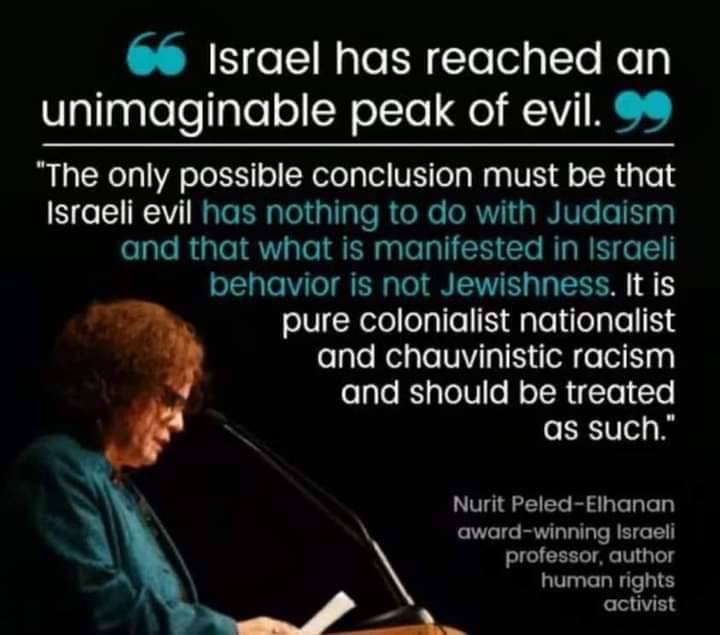
Bonus: A Katie Halper interview with Nurit Peled-Elhanan, who said this about Israel in 2013 (!).