This is a repost of a 19 November 2025 Out Loud Substack essay by Ahmed Eldin.
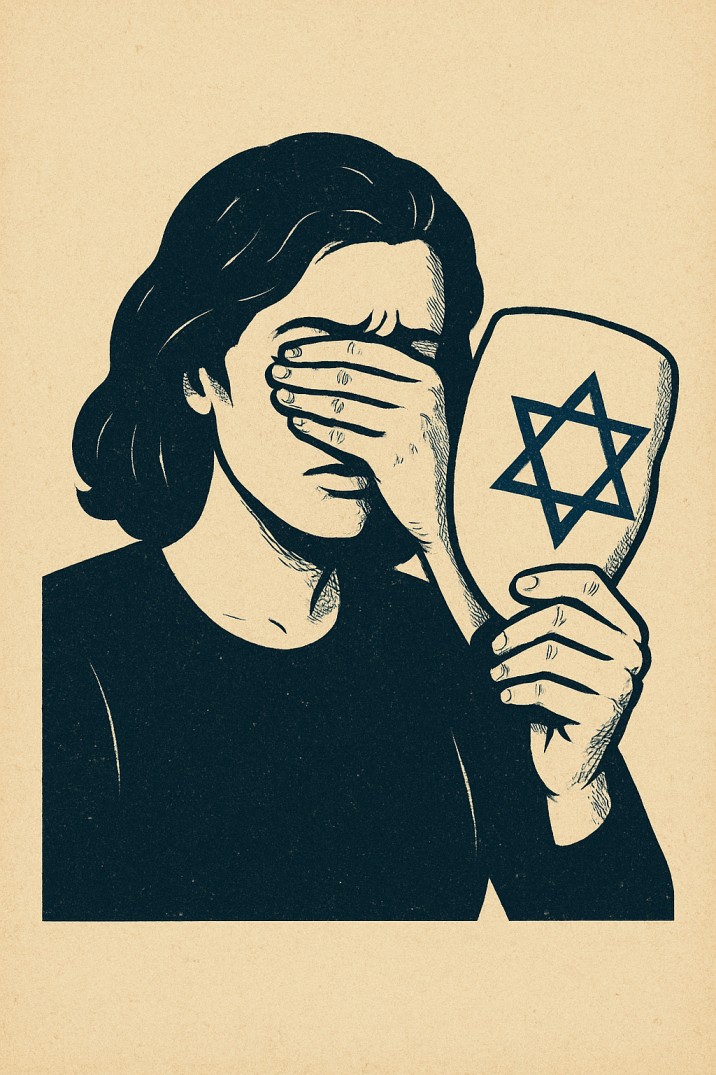
Sarah Hurwitz didn’t slip up—she said the quiet part out loud and exposed the Zionist project for exactly what it is.
For decades, Zionism thrived in the shadows—on curated images, sanitized history, and a billion-dollar perception-management machine designed to obscure the violence built into its foundations. But something ruptured over the last two years. It is not just Israel’s military onslaught in Gaza that has been exposed to the world; it is the ideology underlying it. The more Israel livestreams its own belligerence and brutality, the more frantic its defenders become, and the more unfiltered and unmasked their justifications grow.
Perhaps no moment captures this panic more clearly than former Obama speechwriter Sarah Hurwitz’s baffling breakdown at the Jewish Federations of North America General Assembly.
Speaking to an audience eager to be reassured, Hurwitz did not offer analysis so much as a confession. She complained that young people are no longer persuadable by pro-Israel arguments because they are seeing, in real time, the “carnage in Gaza,” and that social media is “smashing their brains” with imagery while she tries to provide them with “data” and “facts.”
She even admitted that, amidst the carnage, she sounds “obscene.” That admission, said almost accidentally, is the closest thing to honesty her worldview will allow: The problem is not the violence of Zionism itself, but the visibility of it. Zionism, as she inadvertently revealed, depends not on morality but on opacity. The ideology requires not less brutality, but simply fewer witnesses.
The clip that is going viral is damning enough. But then if you watch the full clip, it is shocking to see just how far her mask slips, when she blames not Israeli policy, not the relentless bombardment, not decades of occupation, but Holocaust education.
According to Hurwitz, Holocaust curricula have “backfired” because they taught young people that “you fight the big powerful people hurting the weak people.” In her telling, this universal ethical principle—this most basic moral intuition—is the problem.
The implication is staggering: the “correct” lesson of the Holocaust, she seems to believe, is not “never again for anyone,” but “never question Israel.” What outrages her is not the suffering of Palestinians but the possibility that young people are recognizing it as suffering.
This is not a fringe outburst; it is the mainstream Zionist ideology speaking plainly. What makes her remarks all the more disturbing is not their extremity but how ordinary they are within Zionist thinking and communities. These are the arguments usually whispered in greenrooms, at donor dinners, in the private corners of AIPAC strategy sessions. But now, as Israel’s propaganda machinery loses its grip, its defenders are saying the quiet parts out loud, unable to contain their panic as the narrative unravels in real time.
This same hysteria can be found in the growing outbursts of pundits like Mark Levin, Ben Shapiro, and Bari Weiss; you even hear it from Rahm Emanuel—one of the most powerful political figures in the United States—telling the Jewish Federations at the same event that “the Jewish people of America have never had a better country—outside of Israel,” as if total assimilation into elite power structures somehow still counts as marginalization.

We see it in billionaires like Bill Ackman and Larry Ellison who repeatedly position themselves as fragile victims, reenacting Auschwitz from their private islands, wielding “persecution” as a shield against accountability. It is the ideology itself that produces this behavior: Zionism requires eternal victimhood, even for the most powerful; it collapses under equality; and as is made clearer with each passing day, it cannot survive scrutiny.
This is why, for the first time in the digital age, Zionists like Sarah are finding that they are unable to outrun the camera. Hurwitz’s panic is the same panic animating Israel’s defenders everywhere: if people won’t buy the story anymore, then the only remaining strategy is to destroy their ability to see.
This logic explains the coordinated attacks on social media platforms, the lobbying for sweeping censorship laws, the smear campaigns against journalists, the blacklist culture, the obsession with “misinformation” conveniently defined as anything contradicting official Israeli narratives.
Everywhere you look, the mask keeps slipping. It slips when an Israeli hate-monitoring tool disables Hebrew-to-English translation on X because the volume of racist posts is too overwhelming to hide. It slips when journalists like Olivia Reingold are applauded for suggesting that children starved by Israel had “pre-existing conditions,” as though malnutrition becomes acceptable with the right medical footnote.

It slips when politicians demand that critics be fired, banned, deported, or silenced in the name of “safety.” These are not missteps or rhetorical lapses. They are structural truths, revealed when a system built on erasure loses control of the erasure.
Hurwitz’s comments expose something deeper still: Zionism cannot survive a world in which Palestinians are simply seen. Not theoretically, but literally. Not metaphorically, but visually. The occupation cannot withstand unfiltered video of its own behavior. It cannot survive a generation raised on raw footage instead of curated talking points.
The digital age has done what decades of diplomacy, journalism, and human rights reporting could not—collapse the distance between Israeli violence and global perception. Hurwitz’s language gives this away. She repeatedly refers to a “wall of carnage,” not to condemn the carnage but to describe the threat it poses to her arguments. The problem is not the brutality; it is what she makes visible, what she unintentionally is acknowledging.
If Zionism had a kryptonite, it would be documentation. Not radical theory. Not political critique. Simply information. Simply evidence. Hurwitz acknowledges this without meaning to when she says she sounds “obscene” trying to justify the images young people are seeing.
There is no hasbara clever enough to explain away what those images reveal. No amount of “context” makes a dead child in rubble look defensible. No argument can transform starvation into “security.” No narrative can spin massacre after massacre into “self-defense.”
This is why the propaganda machine is sputtering: the story no longer aligns with the visual reality. And reality is winning. The collapse of Zionist narrative power is not a mystery. It is the natural consequence of watching, in high resolution, a policy of domination unfold. You cannot bomb refugee camps in full view of the world and expect applause.
You cannot starve a population while simultaneously demanding empathy. You cannot present yourself as morally superior while razing entire neighborhoods. You cannot insist on your innocence when the evidence circulates globally, minute by minute. Young people are not rejecting Israel because they are ignorant; they are rejecting it because they are informed. They are not refusing “facts”; they are refusing propaganda. They have seen what Palestinians have been describing for generations—the destruction, the dispossession, the dehumanization—and they recognize it for what it is. With that recognition, the spell of Zionism’s propaganda breaks.
This is the true crisis for Zionism: not antisemitism, not campus protests, not “foreign influence,” but a world that is witnessing and seeing Palestinians as human is a world in which Zionism cannot function. A world that sees the violence cannot romanticize the ideology producing it. Once people witness the truth, the mythology cannot be resuscitated and the propaganda cannot be rehabilitated. Israel may be able to flatten Gaza’s buildings, but it cannot rebuild the ignorance it once relied upon. The truth is already out, the narrative collapse well underway, the mask irretrievably gone
 An International Educator in Vietnam
Zionism as cult: https://www.psychologytoday.com/us/blog/freedom-of-mind/202501/9-things-you-need-to-know-about-destructive-cults
If Israel Gets To Undermine Our Rights, Then We Get To Undermine Israel (21.12.25) https://www.caitlinjohnst.one/p/if-israel-gets-to-undermine-our-rights
Most in surveyed nations have negative views of Israel (2.6.25) https://www.pewresearch.org/short-reads/2025/06/03/most-people-across-24-surveyed-countries-have-negative-views-of-israel-and-netanyahu/sr_25-06-03_views-of-israel_1/