Here’s a guest post by Miral Askar, whose LinkedIn description reads as follows: Building Products by Day, Advocating for Justice by Passion Product Owner | Human Rights Advocate | Bridging Tech & Advocacy for a Just World. The Hebrew language source is Walla News. The article is entitled Daniel could not stand the sights of the war – and ended his life: “Mom, I can’t stop smelling the bodies.” The post below is essentially an English translation of a Dutch Instagram post linked in the first photo.
The reality is that most human beings, even those indoctrinated to hate “the other” in school, at home, and/or military training, have a conscience, however atrophied or suppressed. Most pay the price sooner or later for their bloodstained actions. This sums it up aptly: Edri didn’t die a hero. He didn’t die a victim. He died the way so many soldiers do after becoming tools of state-sponsored terror: consumed from the inside by the weight of their own complicity.
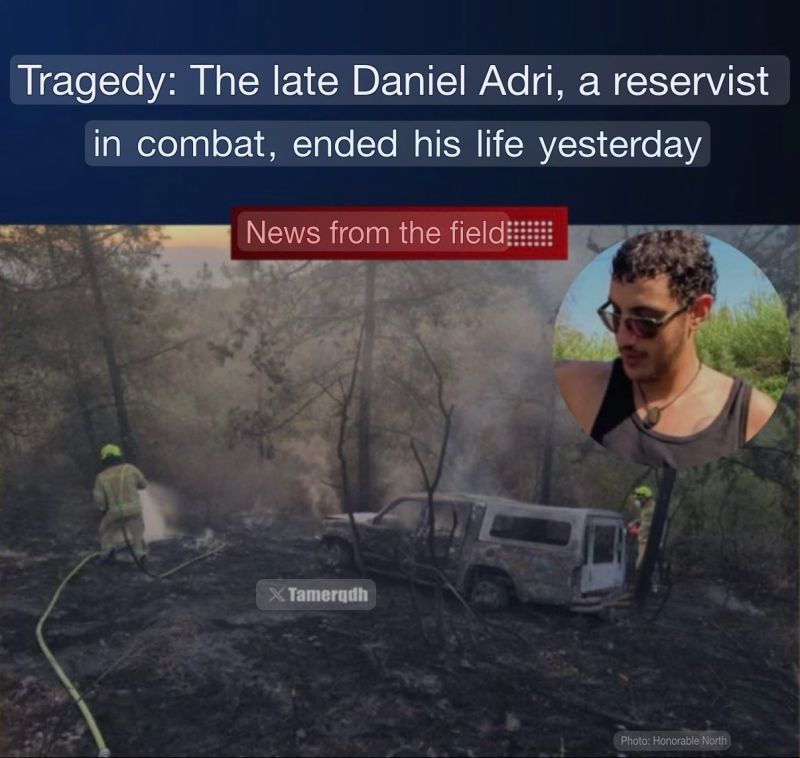
Israeli soldier Daniel Edri set himself on fire.
In a forest near the occupied city of Safed, Edri climbed into his vehicle, lit it ablaze, and left behind a note that read:
“I smell so many corpses I can’t stand it anymore.”
He had served in Gaza. He had served in Lebanon. And in the end, he was so haunted by the smell of the dead—the corpses he had helped create—that he chose death by fire over continuing to live with what he had done.
Edri didn’t die a hero. He didn’t die a victim. He died the way so many soldiers do after becoming tools of state-sponsored terror: consumed from the inside by the weight of their own complicity.
This is what happens when states deploy their youth to carry out collective punishment against entire populations. When the mission is not defense, but domination. Not protection, but extermination. It breaks the soul.
Israel calls it war. The world increasingly recognizes it as genocide. And Edri’s final act confirms something we don’t talk about enough: the psychological ruin that comes when a human being is ordered to kill innocents for no reason at all.
This isn’t new. We’ve seen it before.
In 2012, the U.S. Department of Veterans Affairs released data showing that more American veterans of the Iraq and Afghanistan wars had died by suicide than were killed in combat. By that year, over 6,500 veterans had taken their own lives—surpassing the number of U.S. military deaths in both wars combined.
A study published in JAMA Psychiatry (Maguen et al., 2010) found that soldiers who had killed in combat were twice as likely to suffer from PTSD compared to those who hadn’t. And a landmark RAND Corporation report (2008) revealed that roughly 20% of Iraq and Afghanistan veterans experienced major depression or PTSD, with many not receiving adequate care.
But the most haunting term that emerged was “moral injury” — the spiritual and psychological damage that occurs when someone participates in or witnesses actions that violate their deeply held moral beliefs. It is not about fear. It’s about guilt, shame, and spiritual collapse.
Burning down homes, bombing hospitals, watching children pulled lifeless from rubble—these are not things a conscience forgets. You can silence a population. You can censor the press. But you cannot silence the human mind screaming from within.
Daniel Edri did not break because he lost a war. He broke because he knew what he had done, and he knew he had no justification.
His death is not martyrdom. It is evidence.
Evidence that you can train a soldier to kill, but you cannot train a soul to accept mass murder.
This is the psychological blowback of genocide. Not only on the murdered, but on the murderers.
And it will not stop with him.
Every empire that trains its young to kill for supremacy will one day find them weeping, burning, or buried under the weight of what they became.
Israeli soldier sets himself on fire after participating in Gaza genocide and war on Lebanon.
—
Hebrew media sources report that Israeli genocider Daniel Edri committed suicide yesterday after returning from the Gaza Strip, suffering from severe psychological trauma. Edri also served in Lebanon.
He set himself on fire inside his vehicle in the woods near the occupied Palestinian city of Safad in the Upper Galilee.

 An International Educator in Vietnam