I urge you to take some time to listen to this February 2026 podcast interview with Ms. Shams Mazen Rajab hosted by the Tortoise Shack, “a hub for some of Ireland’s most creative and curious minds. The podcast world is overflowing with reams of content and but most of it is of little interest at all. The Tortoise Shack is all about putting loads of interesting stuff in one place for your perusal and listening enjoyment.” Note: The original Arabic title is Surrender Was Never An Option.
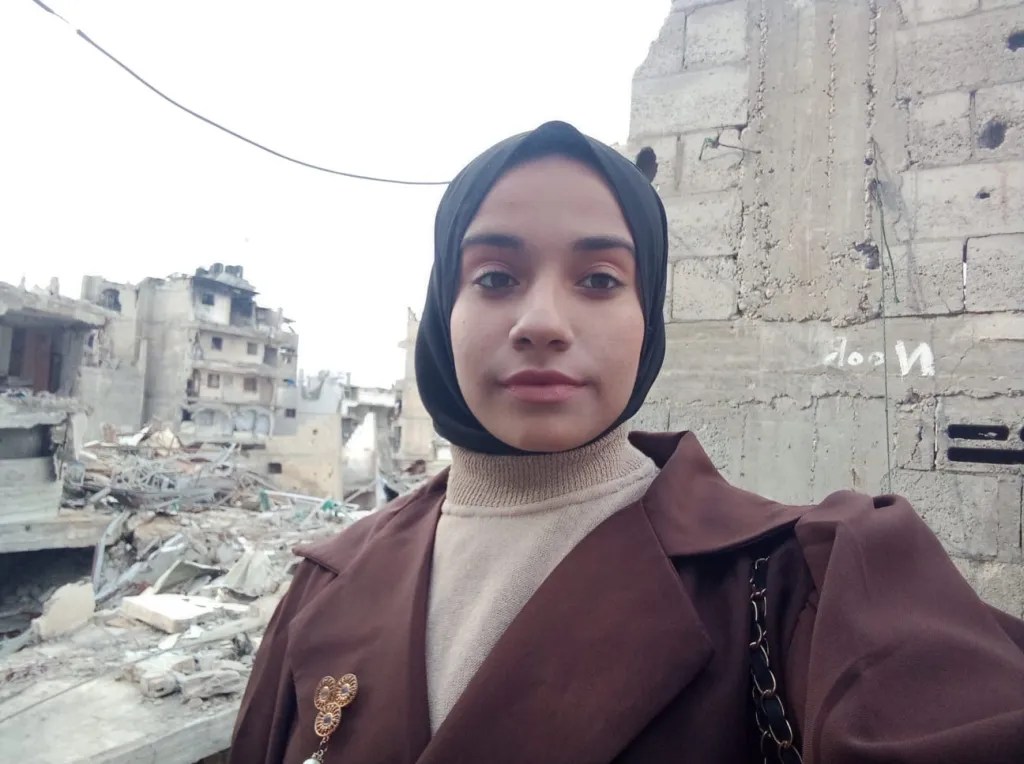
Shams is a Palestinian graduate in English Language and Teaching Methods from Al-Aqsa University in Gaza. She is a writer and translator whose work conveys the resilience, struggles, and hopes of her community. Her articles and poems have been published in international platforms such as We Are Not Numbers, the collective blog Through Our Eyes, and the academic journal Brief Encounters. She joined the podcast from her displacement tent in Deir al-Balah. Here are some of Shams’ poems that I set to music in descending chronological order.
A Spring in Autumn (12.8.25)
Stolen Beauty (5.8.25)
Sun of Hope (1.7.25) (Shams means sun in English.)
I edited out the introduction. I’ve added some links to provide additional information and context.
It’s a very important tradition for the Palestinian people, and we allow Palestinians to share their agony, aspirations, hopes, losses. Focusing on the Gaza genocide, today is February 17, Tuesday, and it’s 4 p.m. local time here in Sakarya. We’re very grateful for our co-sponsors, the Hashem Study Center for Palestinian Studies, Just Word Educational, and the Tortoise Shack Media for being with us throughout this time to make this project possible.
But today we’re very thankful for Shams Mazen Rajab for joining us from Gaza. Thank you very much for joining us today, Shams. Okay, so Shams is a Palestinian graduate of English language and teaching methods from Al-Aqsa University in Gaza.
She’s a writer, translator, whose work conveys the resilience, struggles, and hopes of her community. Her articles and poems have been published on international platforms such as We Are Not Numbers, the collective blog Through Our Eyes, and the academic journal Brief Encounters. Again, we’re very thankful for having you today.
Thank you for joining us from Deir el-Balah in Gaza. And thank you for everyone who can make efforts for us to let our voices be heard. Thank you, thank you.
Host: So you’re joining us from a tent, as you said. How does it feel to live in a tent?
Shams: Okay, yes, you know, you are in the forest and you didn’t have a place to live, okay? And we are here like this, just in the fabric, hot all of the day, all of the day in the summer. It’s very hot in the winter.
It’s very cold. And also in the day like this and in the night also cold. So live in this circumstance is very difficult for us.
And for me also, or for all Gazan people here, it’s very difficult. Also, there is no privacy because, you know, the tent is beside each other. So you can’t hear your neighbors or the state.
And there’s no privacy in the tent and no safety also.
So how many people live in the tent with you? And for how long have you been living in the tent?
Shams: Yeah, we are 11 members. We are seven girls.
Two boys with my father and mother. We displaced four times. And finally, we find some stability in Jere El Balah.
So we are now more than one year in Deir al-Balah.
Host: So where do you come from before October 7? Where did you live?
Shams: Yes. I live in Shujaiya area.
And you know that Shujaiya now is very dangerous and we can’t reach it because if someone just try to be there, they will shoot them. And can you imagine that my house is destroyed and I can’t.
Just see the rubble in my house. This is more than one year. And what should we do? What should we do?
Host: You left immediately after Israel asked Palestinians to evacuate to the south in October 2023. Is this correct?
Shams: Yes.
Host: And how was the journey to the south?
Shams: Yes. It’s very difficult just to put your memories or your stuff in one bag and just go.
Host: And you didn’t go.
Shams: You didn’t know where should you go. Just walk.
And you know, we came in Deir al-Balah after Israeli occupation forced us to leave as a wider area. And we just cry and in that time running just to find a safe area. And we find it in Jere El Balah.
After two days, we are in Deir al-Balah in the street. We didn’t have any shelter or any tent at the moment. But after two days, we have this.
And then we adapt to this area because you know that I have lived in Shijia more than 20 years. And I’m here in Deir al-Balah just two days.
Host: What happened to your neighborhood and your community in Shijia, your neighbors? Did you meet any of them? Did you hear anything about what happened to them?
Shams: Yeah, yes.
Unfortunately, in that time, when they announced that there is an armistice or truce, just when I leave the home, I go to my home. Then they told us you should to leave Shijia. We leave it.
And some of my neighbors don’t did that. So the Israeli occupation bombed the house on them. So my street is Baghdad Street.
You know, all of my neighbors is displaced. And some of them is under the rub until this moment. You mentioned your neighbors who were bombed as they were inspecting their home during the ceasefire.
Could you please tell us more about your neighbors, their names and how many of them and if they’re still under the rubble of their home?
Shams: Yes, and not also my neighbors, also my cousins in the same house, Rajab family and Abu Amsha family, you know. I think until now, there are more than 20 persons under the rubble in Baghdad Street, Shijia. And we can’t see the rubble, we can’t see them.
We can’t also give them their rights to build for them a grave, you know. And that’s so hard. Also, the grave, the occupation has destroyed it.
Host: So this is what happened in the last year.
Shams: Yes, in the last year, on April. Those many, many graves.
Host: You mentioned like living in Shijia for 20 years and now you had to leave. Your education continued somehow. You mentioned that you graduated from Al-Aqsa University. How was the process of graduation and studying during the genocide?
Shams: Yes, you know, after my university announced there is an educational, an education, online education. Without any thinking, I just tried to continue my degree, my BA degree. So directly, I continue.
And you know, this is my final semester. I will graduate in this month, in February. And it’s combined with the challenges and passion, you know.
Because I write a lot of written writings and I translate some things as a volunteer and ELT for Palestine and the Ramzan languages. And you know, I continue my education without interfering. I also submit my assignments and do my exams in the street, under bombing, just to have hope to live in this life.
Because, you know, just live without any, do nothing and just thinking, it’s very hard. So directly, when my university announced there is an online education, I agree with them and continue my education.
Host: Shams, can I just say, before Yusuf says anything, that you’re clearly remarkable to be able to continue your education and continue to have a hope for the future, for you and your community, given all of the things that have happened over the last nearly two and a half years, but particularly life in a tent, as you say.
So I just, I’m actually, you’re doing extraordinary stuff that people should really, I hope people listen to your story and understand how many challenges you’ve already overcome. So I just want to say, this is why we do this podcast, to hear people like you talk about their experiences of the genocide in Gaza and how you haven’t given up and it’s just, it’s remarkable. Thank you for sharing that.
Shams: Yes, to complete the education is very important for us and imagine that Israeli occupation need us just to be ignorant. So if I didn’t learn, or my siblings, or my friends, or all of us, we can’t, we stopped our education. So we are not here, we are not in this place.
My writings is improved and published to the world that we are here, we are not numbers, like just breaking news, Israeli occupation shooting three person on the beach. We are not numbers, we are human, we have rights. And we hope that one day we can achieve our rights as international human rights, not like in Gaza, we are just killed by occupation and in the news that the news is people in Gaza is killed, starving, things like that.
Host: Yeah, so you mentioned Shujaiya neighborhood and I wonder what Shujaiya means to you as a place that, you know, you grew up, we hear about Shujaiya in the news. Shujaiya is also the home of a Palestinian intellectual, Dr. Refaat Alareer. How was life in Shujaiya before October 7 and like growing up there and all the memories you had there?
Shams: Yes, you know, to grow up in the place of Shujaiya, not because it’s my area or it’s my childhood, but it’s like a life itself.
When I displaced in another area, also, even if I’m in Jerusalem, I show some safety, but when they announced that you can come back to Shujaiya without anything, I will be there because it’s a life itself. Working up, go to university and they see the children playing and your siblings go to university and share memories and walking, especially in the streets like Omar Al-Mukhtar Street, mosques like Al-Omari Mosque. So it’s full of places, beautiful places, and it’s full of beautiful memories for me and for everyone in Shujaiya.
So I feel like it’s a life. So even if our home is bombing, but we can rebuild it, but give us the allowed to be in Shujaiya area, especially in Baghdad Street. You know, I don’t know Dr. Rifat Al-Arir, but I know that Al-Arir family is in Shujaiya and I know some people, you know.
Shams: I see. So how do you see your career now? You’re almost done with the school. You’re graduating this month.
Host: What is your next plan career-wise? What do you want to do? Yes. To be honest, I don’t know if there’s a real job in Gaza. You know, there is no schools, you know, and just a tent.
Shams: When I volunteer, I volunteer to learn students in the tent or online. But to have a real job, I don’t know, because they can’t give you, for example, your salary. You should do volunteer and someone like me, I don’t know if when I graduated, I can find a job.
But I can be a volunteer even if there is no job and to give the salary to support my family. But also I can learn other students how to be better and not to let their minds limited to queues for water or for food. So that’s a lifeline for me and for them to complete their education.
And for jobs, I don’t know if I can have one or not.
Host: Just on the experience of going back over, you know, displacement, you might share with us just maybe a memory that you have over the last couple of years, whether it could be a good memory or a bad memory. And I don’t mean to drag you into anything, but something that you want to share with our listeners so we can remember that story, if possible, please, Shams.
It should be the story of joy or sorrow. Your choice. You’re absolutely whatever you prepare.
Shams: Yes, you know, because I live on the beach. So I show my, especially in the summer, my siblings and some young people in our camp now playing football after after al-Asr or just playing with their kites. When the queues of when the water or water tanker or charity kitchen came, they talk with each other.
Host: Oh, who told them to come?
Shams: We didn’t need food. We wanted to play. And they know if they didn’t get food from charity kitchen or water from water tanker.
Host: Hey, Tony. I think we’ve lost Shams. Yeah.
And yeah, we may have to leave it there, Yusuf, if that’s the situation. And I understand there’s a lot going on. And I know it’s the beginning of Ramadan and I know there’s a lot going on.
But I’m just, you know, she’s a remarkable young woman who hopefully we can speak to again at another time. Yeah, absolutely. We thank her very much for joining us from Al-Asr today, sharing her family’s story of displacement and her story of continuing her education during the genocide.
It takes so much strength to be able to do all of that and having to live in a tent. Your life is defined by a tent now. Summer is very hot and the winter is very cold.
And but you still find hope. Despite, you know, having lost her cousins and neighbors and the house was bombed on them and her own house was bombed. Baghdad street was completely destroyed.
Her neighborhood is gone. Yeah, not just now, but also in 2014. Yeah, yeah.
Badly damaged then. So this is the story of Shuja’iya, another story. Thank you, Shams, for joining us today.
And again, thank you to our co-sponsors, the Hashem Sani Center, Just Wear Educational, and the Tortoise Shack Media. Thank you, Tony. And I’ll talk to you next week.
(Transcribed by TurboScribe.ai. Go Unlimited to remove this message.)
 An International Educator in Vietnam