I’m pleased to repost and amplify this 10.2.26 Facebook post by Michael Jochum. It’s a brilliant analysis and prescription for much of what ails the US.

I keep coming back to the same exhausted, nauseating question: where do we go from here? Because whatever this is, this country, this moment, this grotesque parody of governance, it no longer resembles anything I was raised to recognize. The flags are the same. The slogans are louder. But the soul? That’s either been pawned off for campaign cash or beaten into submission by men who confuse cruelty with strength.
We are told, endlessly, to trust the process. March. Chant. Vote. Hold signs. Be patient. Be polite. Be reasonable. And for decades, many of us did exactly that. We showed up peacefully, believing, foolishly, perhaps, that moral clarity still mattered, that exposure would lead to accountability, that truth would eventually exert gravity. But what happens when peaceful protest is met children are detained, journalists are arrested, dissent is criminalized, and the Constitution is treated like a quaint suggestion instead of the law of the land?
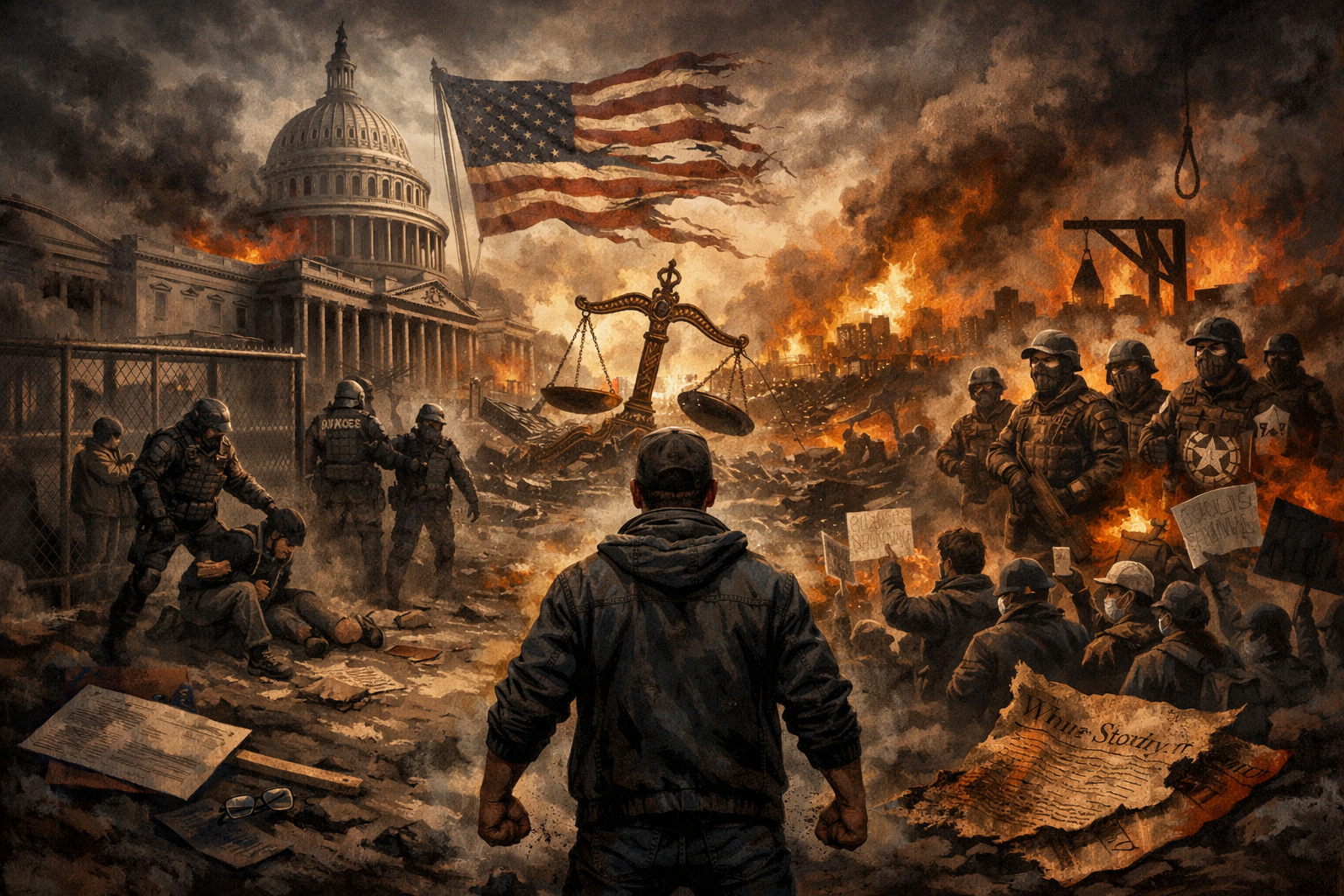
Here’s the part no one wants to say out loud: people don’t ask about insurrection because they’re bloodthirsty, they ask because they’re desperate. When every institutional guardrail fails, when courts are ignored, when elections are undermined, when laws are selectively enforced like a mob protection racket, the human mind starts running out of options. History isn’t subtle about this. It doesn’t whisper. It screams. And it always begins the same way: with people being told to calm down while the house is actively burning.
But this is where the real terror lies, not in whether violence is coming, but in what it costs. Because once a society crosses that line, it doesn’t come back cleaner. It comes back scarred, traumatized, and often indistinguishable from the monsters it rose up against. Revolutions don’t just devour their enemies; they devour their children, their ideals, their innocence. Anyone selling violence as a neat solution is either lying or historically illiterate.
So how do we stop monsters without becoming monsters ourselves?
By refusing the lie that brutality is strength. By rejecting the authoritarian fantasy that force is the only language power understands. By building resistance that is relentless, strategic, coordinated, and morally unassailable. Not passive. Not meek. But disciplined. Organized. Documented. Unignorable. The kind of resistance that gums up the machinery instead of feeding it martyrs. The kind that exposes fascism not as a fearsome inevitability, but as what it really is: cowardice in a uniform.
Authoritarian regimes don’t fall because people lose their tempers, they fall because they lose legitimacy. They rot from exposure. They collapse under the weight of their own lies when enough people refuse to normalize them. That takes time. It takes stamina. It takes a level of moral endurance that doesn’t trend well on social media and doesn’t feel satisfying in the moment. But it’s the only thing that doesn’t leave us standing in the rubble asking how we became the very thing we swore we were fighting.
Will anything stop the neocons? Will anything stop this fascist drift toward permanent minority rule and constitutional contempt? That depends on whether enough people decide that democracy isn’t a vibe or a hashtag, but a practice, one that requires sacrifice, vigilance, and yes, courage that doesn’t come with applause.
The monsters are counting on exhaustion. On nihilism. On the idea that once you’re angry enough, you’ll burn it all down for them and save them the trouble. I refuse to give them that satisfaction. Rage is justified, but it must be aimed. Otherwise it becomes just another accelerant in a fire they started and are happy to watch spread.
So where do we go from here?
We go forward with eyes open. Teeth clenched. Memory intact. We resist without surrendering our humanity. We tell the truth until it’s boring. We show up until it’s inconvenient. We protect the vulnerable because that’s the whole goddamn point. And we remember, stubbornly, defiantly, that democracy doesn’t die in a single dramatic moment. It dies when enough people decide it’s already gone and stop acting like it’s worth saving.
I’m not ready to give it that luxury.
—Michael Jochum, Not Just a Drummer: Reflections on Art, Politics, Dogs, and the Human Condition
Two comments:
Jeff Ribman
What hit me hardest in this essay is the way it captures the psychological terrain we’re all walking: the exhaustion of watching institutions fail in slow motion while being told to behave as if nothing is wrong, the creeping sense of illegitimacy that grows when courts are ignored and power is exercised without restraint, and the dangerous temptation to believe that only fury can break the cycle. What stays with me is Michael Jochum’s refusal to romanticize collapse; he names the cost of crossing that line and insists that real resistance is disciplined, strategic, and morally anchored rather than cathartic. That’s the kind of clarity that forces a choice about whether we’re going to let exhaustion write the ending or commit to the long, unglamorous work of keeping democracy alive.
Brent Hurlburt
As a stage 4 cancer patient, seeing the end of Trump is one of my main motivations to keep fighting cancer.
 An International Educator in Vietnam