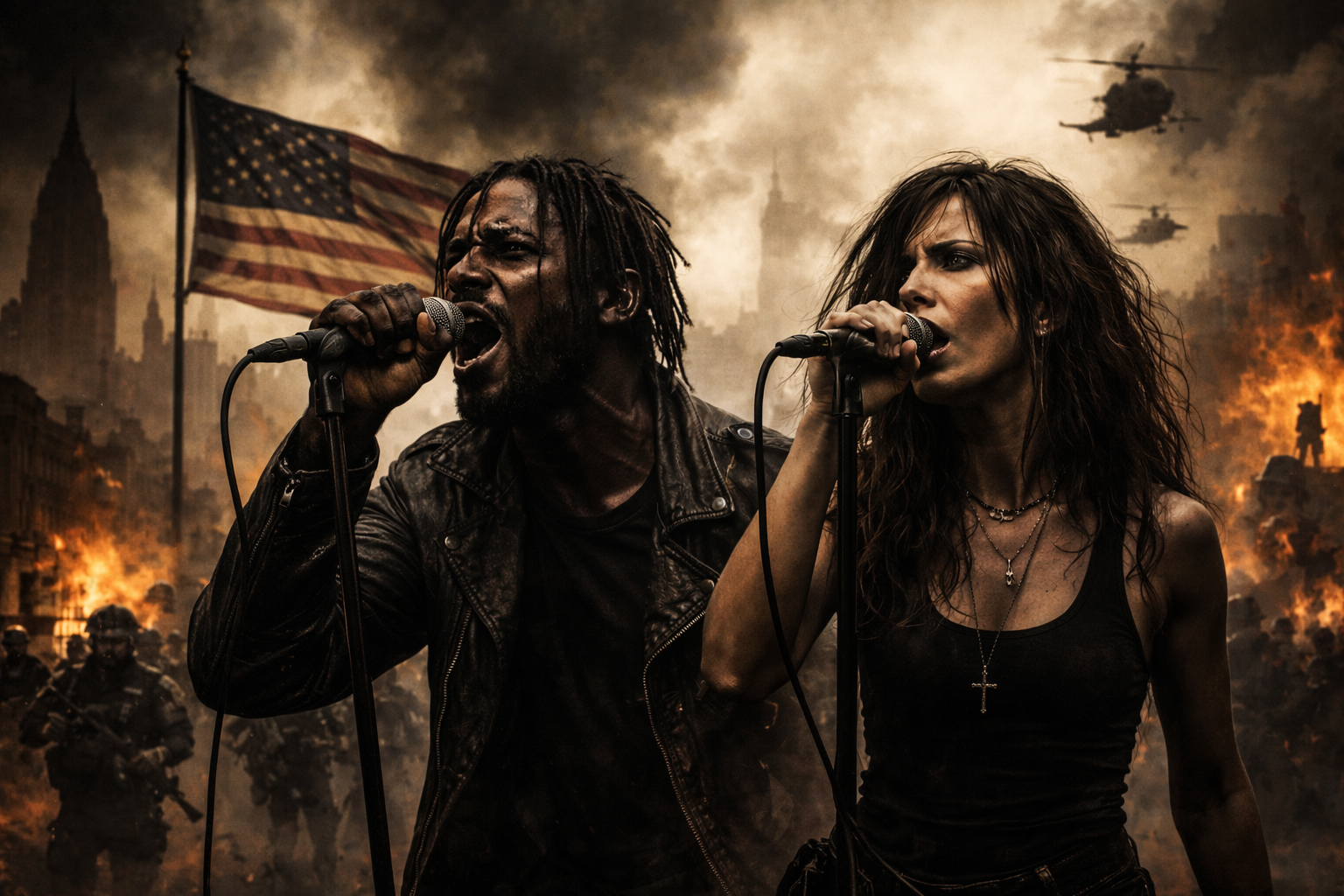
Nations that stomp around the globe like King Kong infect themselves with a fatal virus.
This is a song I created that was inspired by Chris Hedges’ latest essay America is a Gangster State. Here are some other articles with the same theme in descending chronological order. I saved the best for last. I bet the author of this Foreign Affairs essay never imagined that his description would apply to the US. Exhibit A: In mafia states, government officials and criminals often work together through legal business conglomerates with close ties to top leaders and their families and friends.
The Trump doctrine exposes the US as a mafia state (7.1.126)
Donald Trump’s America Is Acting Like a Mafia State (5.1.26)
Donald Trump is turning America into a mafia state (7.3.25)
Trump’s America is a gangster’s paradise (29.1.25)
Mafia States (25.4.12) An important obstacle to combating the spread of mafia states is a basic lack of awareness among ordinary citizens and policymakers about the extent of the phenomenon. “
Turn it up and resist!
(Verse 1)
We walk the streets of fractured laws,
Where empire’s shadow grins and claws,
The suits are slick, the coffers fed,
While justice sleeps, cold and dead.
Diplomats reduced to errand boys,
Gunboats roll, the blocks destroy,
Soft power’s gone, it’s muscle now—
The mob in charge, they show us how.
(Pre-Chorus)
They talk of freedom with a loaded gun,
Preach peace while war is never done,
Rule of law but not for all—
Just for those who ride and brawl.
(Chorus)
We’re singing the Gangster State Blues,
A nation built on empire’s ruse,
Gold-lined pockets, iron fists,
We lost the dream in the mist.
No more laws, just crooked crews,
Welcome to the Gangster State Blues.
(Verse 2)
The halls of Congress hollowed clean,
Bought and sold behind the screen,
Courts that bend, police that crush,
Dissenters silenced, voices hushed.
Wall Street kings with golden chains,
They write the rules, they break the reins,
Prosperity for just a few—
For the rest, it’s déjà vu.
(Bridge)
Here in this land, so fierce, so proud,
We shout our love, but silence loud,
The truths we fear, the wars we make,
The cost of all the hearts they break.
History’s eye won’t look away,
Empires die when debts are paid,
The people rise, the tyrants fall—
Justice echoes through us all.
(Final Chorus)
We’re singing the Gangster State Blues,
No more myths, no more excuses,
Broken laws and stolen dues,
We fight to shed the Gangster State Blues.
Justice rising, voices fuse,
Break the chains, refuse to lose—
Singing the Gangster State Blues.
Version 1
Version 2
 An International Educator in Vietnam
ICE vs. People of Minnesota: Community Resists Trump’s Militarized Crackdown – Special Report (21.1.26) https://www.youtube.com/watch?v=8g1tu-XgdhE
Trump’s ‘Board of Peace’ Erases Gaza—and Replaces the UN – How Gaza became the test case for dismantling international law
Ahmed Eldin
Jan 21
Christian Adams for The Telegraph
The charter announcing Donald Trump’s so-called “Board of Peace” — released by Israeli media as the framework for governing Gaza after the ceasefire — opens with a striking omission. Gaza does not appear.
Not as territory. Not as a people. Not as a place that exists despite sustaining one of the most destructive military campaigns in the world.
A body presented as the mechanism for peace in Israel and Palestine begins by removing from its founding document the place where the genocidal war has been targeted. Tens of thousands killed. Entire neighborhoods erased. A population subjected to siege, bombardment, and forced displacement. None of this is named.
What is offered instead is a language of administration using terms like reconstruction, stabilization, and governance designed to flatten the obscene violence into a managerial problem and turn any accountability into a real inconvenience.
The structure of the Board is not a multilateral body accountable to international law, but a three-tier hierarchy crowned by one maniacal man. Donald Trump sits at the apex as chairman, holding veto power over all decisions. He selects the members, appoints the executive leadership, defines the agenda, controls funding, and even claims authority over the Board’s seal. Membership itself is conditional: permanent seats reportedly require billion-dollar contributions.
Palestinians are nowhere near this apex. They do not sit on the Board. They do not shape its agenda. They do not vote. At best, they are assigned to a subordinate administrative committee tasked with municipal services like electricity, sanitation, and paperwork, under the supervision of a foreign-appointed “High Representative,” ultimately answerable to Trump’s board. For Trump, Palestinians may manage daily life under ruins, but may not decide their political future.
Within this architecture, the presence of Benjamin Netanyahu is a confirmation. A sitting prime minister indicted by the International Criminal Court for war crimes is welcomed as a participant in so-called peace deliberations. The legal process underway in The Hague is simply set aside.
The man who presided over the bombardment of Gaza is invited to help oversee what exactly?
The United States and France anchor this project. Washington, which supplied the weapons, vetoed accountability at the United Nations, and shielded Israel diplomatically, now presents itself as guarantor of reconstruction. France, which invokes international law with urgency in Europe and restraint when it collapses in Palestine, is positioned as an arbiter of the post-war order.
Upgrade To Paid Subscription
The contrast was on full display in Davos, where President Emmanuel Macron took the stage to lecture the world about the sanctity of international law, doing so in designer sunglasses, projecting authority while presiding over a policy that has treated that same law as optional when it comes to Gaza.
The image was unintentionally revealing: performance where substance is absent, posture where principle should be. International law, it turns out, is invoked when it flatters power and accessorized when it does not.
The board’s membership reflects this logic: Billionaires whose interest in reconstruction aligns with capital flows not political rights. Financiers and World Bank officials whose development language has historically imposed donor priorities on devastated societies. Political figures whose records include illegal wars, repression, mass incarceration, and open hostility to Palestinian self-determination.
Tony Blair, a war criminal who exploited Iraq and a failed Middle East envoy, reappears somehow as a statesman.
Jared Kushner, who once described Gaza as “valuable waterfront property” and believes Palestinians’ lack the capacity for self-rule returns alongside Marco Rubio, who has argued that critics of Israel should be denied visas and has championed the criminalization of Palestine solidarity.
This is not a gathering of peacemakers.
As Muhammed Shehadeh has warned, Gaza is not the end goal. It is the pilot project.Muhammad Shehada@muhammadshehad2 Trump’s “Board of Peace” isn’t just about Gaza; it’s about replacing the UN & multilateral system with unaccountable billionaires, businessmen, politicians… The Board’s founding charter calls for “a more nimble & effective international peace-building body,” & “the courage to3:16 PM · Jan 17, 2026 · 164K Views70 Replies · 937 Reposts · 1.66K Likes
The Board’s founding charter explicitly calls for “a more nimble and effective international peace-building body” and urges “the courage to depart from institutions that have too often failed” — a direct reference to the United Nations and the post-World War II multilateral system.”The ambition is not merely to manage Gaza, but to replace the architecture of international law with ad hoc councils of unaccountable power. If this model succeeds here, it will not stop. Venezuela. Ukraine. Greenland. Panama. One board after another, each bypassing international law in the name of efficiency.”
On Wednesday, China made this plain by expressing reservations about joining the Board unless it operates under the auspices of the United Nations, reaffirming its stated commitment to an international system with the UN at its core. Whatever one thinks of Beijing’s intentions, the objection matters because it exposes what this Board is designed to avoid: shared rules, legal restraint, and accountability beyond the discretion of a single emperor.
Any world power that chooses to join this body does so with eyes open. Participation is an endorsement of a structure that sidelines the occupied, rehabilitates the accused, and substitutes power for law. It is legitimacy laundering.
Meanwhile, the ceasefire the Board claims to celebrate never existed, as it continued to be repeatedly violated. Israeli attacks have continued. Palestinians continue to be killed and injured. Aid remains restricted. Humanitarian organizations face shutdowns and obstruction. These facts do not interrupt the process; they are absorbed into it. Violence becomes background noise to diplomacy.
This is how the contemporary international order increasingly operates. War is reframed as stabilization. Destruction is followed by conditional generosity. And accountability is deferred indefinitely in the name of pragmatism.
The so-called Board of Peace is a mechanism through which those responsible for devastation oversee reconstruction. And any state that chooses to sit at this table must confront what it is agreeing to legitimize, which is not the end of violence, but the managed continuation of it under a more respectable sounding name.
The US-Israel Hybrid War Against Iran
Jeffrey D. Sachs & Sybil Fares | January 19, 2026 | Common Dreams
The question is not if the US and Israel will attack Iran, but when. In the nuclear age, the US refrains from all-out war, since it can easily lead to nuclear escalation. Instead, the US and Israel are waging war against Iran through a combination of crushing economic sanctions, targeted military strikes, cyberwarfare, stoking unrest, and unrelenting misinformation campaigns. This combination strategy is called “hybrid warfare.”
Both the American and Israeli deep states are addicted to hybrid warfare. Acting together, the CIA, Mossad, allied military contractors and security agencies have fomented chaos across Africa and the Middle East, in a swath of hybrid wars including Libya, Somalia, Sudan, Palestine, Lebanon, Syria, Iraq, Iran, and Yemen.
The shocking fact is that for more than a quarter century, the US and Israeli militaries and intelligence agencies have laid waste to a region of hundreds of millions of people, blocked economic development, created terror and mass refugee movements, and have nothing to show for it beyond the chaos itself. There is no security, no peace, no stable pro-US or pro-Israel alliance, only suffering. In the process, the US is also going out of its way to undermine the UN Charter, which the US itself had brought to life in the aftermath of World War II. The UN Charter makes clear that hybrid war violates the very basis of international law, which calls on countries to refrain from the use of force against other countries.
There is one beneficiary of hybrid war, and that is the military-industrial-digital complex of the US and Israel, with firms like Palantir and others profiting from their AI-supported assassination algorithms. President Dwight Eisenhower warned us in his 1961 farewell address of the profound danger of the military-industrial complex to our society. His warning has come to pass even more than he imagined, as it is now powered by AI, mass propaganda, and a reckless US foreign policy.
We are witnessing two simultaneous hybrid wars in recent weeks, in Venezuela and Iran. Both are long-term CIA projects that have recently escalated. Both will lead to further chaos.
The United States has long had two goals vis-à-vis Venezuela: to gain control over Venezuela’s vast oil reserves in the Orinoco Belt, and to overthrow Venezuela’s leftist government, in power since 1999. America’s hybrid war against Venezuela dates to 2002, when the CIA helped to support a coup attempt against President Hugo Chávez. When that failed, the US ramped up other hybrid measures, including economic sanctions, the confiscation of Venezuela’s dollar reserves, and measures to cripple Venezuela’s oil production, which in fact has collapsed. Yet despite the chaos sown by the US, the hybrid war did not bring down the government.
Trump has now escalated to bombing Caracas, kidnapping President Nicolas Maduro, stealing Venezuelan oil shipments, and imposing an ongoing naval blockade, which of course is a continuing act of war. It also seems likely that Trump is thereby enriching powerful pro-Zionist campaign funders who have their eyes on seizing Venezuelan oil assets. Zionist interests also have their eye on toppling the Venezuelan government, since it has long supported the Palestinian cause and maintained close relations with Iran. Netanyahu has cheered on America’s attack on Venezuela, calling it the “perfect operation.”
The United States and Israel are simultaneously escalating their ongoing hybrid war against Iran. We can expect ongoing US and Israeli subversion, air strikes, and targeted assassinations. The difference with Venezuela is that the hybrid war on Iran can easily escalate into a devastating regional war, even a global war. In fact, even US allies in the region, especially Gulf countries, have been engaged in intensive diplomatic efforts to persuade Trump to back down and avoid military action.
The war on Iran has a history even longer than the war on Venezuela. The US started to make deep trouble for Iran back in 1953, when democratically elected Prime Minister Mossadegh nationalized Iran’s oil in defiance of then-called Anglo-Iranian Oil Company (today’s BP). The CIA and MI6 orchestrated Operation Ajax to depose Mossadegh through a mix of propaganda, street violence, and political interference. The CIA installed the Shah and backed him until 1979.
During the Shah’s rule, the CIA helped to create notorious secret police, SAVAK, that crushed dissent through surveillance, censorship, imprisonment, and torture. Eventually, this repression led to a revolution that swept Ayatollah Khomeini to power. Amid the revolution, students seized US hostages in Teheran when the US admitted the Shah for medical treatment, leading to fear that the US would try to reinstall him in power. The hostage crisis further poisoned the relations of the US and Iran. From 1981 onward, the US has plotted to torment Iran, and if possible, to overthrow the government. Among the countless hybrid actions the US has undertaken, the US funded Iraq in the 1980s to wage war on Iran, leading to hundreds of thousands of deaths, but failing to topple the government.
The US-Israeli objective vis-à-vis Iran is the opposite of a negotiated settlement that would normalize Iran’s position in the international system while constraining its nuclear program. The real objective is to keep Iran economically broken, diplomatically cornered, and internally pressured. Trump has repeatedly undercut negotiations that could have led to peace, starting with his withdrawal from the 2016 Joint Comprehensive Plan of Action (JCPOA) that would have monitored Iran’s nuclear energy activities while removing US economic sanctions.
Understanding the hybrid war tactics helps to explain why Trump’s rhetoric oscillates so abruptly between threats of war and phony offers of peace. Hybrid warfare thrives on contradictions, ambiguities, and outright deceit in US intentions. Last summer, the US was supposed to have a round of negotiations with Iran on June 15, 2025, but then supported Israel’s bombing of Iran on June 13, two days before the negotiations were to take place. For this reason, signs of de-escalation in recent days should not be taken at face value. They can all too readily be followed by a direct military attack in the coming days.
The world’s best hope is that the other 191 countries of the UN aside from the US and Israel finally say no to America’s addiction to hybrid war: no to regime-change operations, no to unilateral sanctions, no to the weaponization of the dollar, and no to the repudiation of the UN Charter. The American people do not support the lawlessness of their own government, but they have a very hard time making their opposition heard. They and almost all the rest of the world want the US deep state brutality to end before it’s too late.
https://www.commondreams.org/opinion/us-israel-iran-venezuela
https://www.other-news.info/the-us-israel-hybrid-war-against-iran/
Donald Trump’s most revealing moments at Davos didn’t come from behind the lectern. They came later, at the reception, after the formal address, after the polite but cautious applause, when the setting shifted from staged authority to donor lounge candor and the mask slipped almost immediately.
Standing before a room packed with executives, financiers, and political insiders, Trump dropped any remaining pretense that this was about policy or dialogue. Instead, he offered something closer to a victory toast. “I go around and I say meet the biggest people, biggest businesspeople,” he told the crowd. “I say congratulations. They say, ‘What?’ I say, ‘You’ve doubled your net worth since I’ve been president, right?’ And they say, ‘Yeah, more than that.’”
This Trump considers proof of success.
“We’ve given you a platform where you can really put your genius to work,” Trump continued, casting his presidency as an accelerator for elite wealth. Regulation, oversight, and restraint were treated as obstacles already cleared. The room was not being asked to debate values; it was being congratulated for winning.
Then came the line that clarified everything. “I’m a dictator,” Trump said, pausing just long enough for the laugh. “But sometimes you need a dictator.”
No one seemed especially alarmed, and no one left. The reception speech was riddled with moments like this, offhand confessions passed off as humor, grievances rewarded with laughter, power framed as something personal and transactional. Trump openly acknowledged that some people in the room he “couldn’t stand” had become very rich anyway. “I would screw them if I could,” he said, pausing as the room laughed, “but I can’t do it.” The barrier wasn’t principle, at least not his, It was process.
He praised the deployment of troops into American cities as a model of governance, bragging that Washington, D.C. had been made “safe” in weeks through force. If he were a mayor, Trump said, he’d call the president and ask him to “send about a thousand troops in here and we do it fast.” Law enforcement, civil authority, and consent were afterthoughts. What mattered was speed, spectacle, and control.
Immigration rhetoric at the reception was stripped of even the thinnest euphemisms. Trump described migrants as criminals “dumped” into the United States from foreign prisons and mental institutions, insisting that if they were “bad someplace else, they’re going to be bad here.” Individualized justice disappeared entirely, replaced by collective suspicion and mass removal framed as necessity.
By the time Trump wrapped up, the meaning of the earlier, more formal Davos speech had been clarified.
In that first speech, Trump had performed a familiar routine of inflated claims and historical grievance. He declared that the United States was enjoying “the fastest and most dramatic economic turnaround in our country’s history,” boasting that inflation had been “defeated,” the border rendered “virtually impenetrable,” and growth unleashed at levels “no country has ever seen before.” He cited “$18 trillion. maybe closer to $20 trillion” in investment commitments, a figure so large it floated free of verifiable reality.
America, he said, was the engine of the world. “When America booms, the entire world booms,” Trump told the assembled leaders. “When it goes bad, you all follow us down.” Allies were warned, implicitly and explicitly, that their prosperity depended on American indulgence.
Europe, in Trump’s telling, was in visible decline, its cities “not recognizable anymore,” its energy policies a “Green New Scam,” its leaders too weak to stop the damage. Windmills were mocked as economic poison. Germany and the UK were held up as cautionary tales. Energy independence was recast as cultural purity.
Then came the line that echoed louder the second time around: “Without us right now, you’d all be speaking German and a little Japanese perhaps.” Trump delivered it in Switzerland, a country where German is the most widely spoken language, while arguing that Denmark should hand over Greenland as a matter of overdue gratitude for World War II.
Greenland, in fact, loomed large in the speech, described as “a big beautiful piece of ice” of existential strategic importance. Trump complained that the United States had foolishly returned it to Denmark after World War II. “How stupid were we to do that?” he asked, casting himself as the lone realist brave enough to correct the historical record before an audience of Europeans who actually live with that history. The implication was that postwar norms, sovereignty, and alliance-building were naïve errors rather than deliberate choices made to prevent another catastrophe. Denmark, he said, was now “ungrateful.” The logic was unmistakable: restraint was a mistake, power should never be relinquished, and history creates permanent debts to be collected indefinitely by the strongest party in the room.
What made the moment especially jarring was Trump’s confidence that he was educating Europe about its own past. The speech treated World War II not as a shared trauma that produced institutions like NATO and the postwar order, but as a transactional event, an invoice that never expires. There was no recognition of why territories were returned, why alliances were structured as they were, or why American power was deliberately constrained by law and norms after 1945. History, in Trump’s telling, is not something to be learned from; it is a myth to be massaged, simplified, and weaponized.
Throughout the address, Trump flirted openly with force. NATO was accused of exploiting the United States. Allies were portrayed as freeloaders living off American generosity. If they didn’t comply, Trump suggested, America could always remind them who was really in charge. “We probably won’t get anything unless I decide to use excessive strength and force,” he said, before assuring the room he wouldn’t, at least for now. The reassurance landed hollow, the threat had already done its work.
Physically, the performance told its own story. Trump appeared slumped and weary, leaning into the microphone, his expression heavy and fixed. The delivery wandered, looping through tariffs, windmills, nuclear power, Greenland, NATO, Ukraine, grievances recycled rather than arguments built. Against the crisp, hyper-controlled World Economic Forum backdrop, the contrast was stark. Instead of vitality, it was inertia.
Here is the important background we need to pay attention to. While Trump was projecting limitless authority in Switzerland, the legal reality he avoided mentioning was moving sharply in the opposite direction.
The D.C. Circuit Court of Appeals just issued a unanimous ruling rejecting Trump’s claim of presidential immunity for his January 6 conduct. In an opinion joined by judges across the ideological spectrum, including a Trump appointee, the court drew a clear, objective line: acting as a political candidate or party leader is not the same as acting as president. Campaign rallies, pressure on officials, and efforts to cling to power are not official acts, and they are not immune. Damn straight they are not immune!
The decision directly undercuts Trump’s central defense in the federal January 6 criminal case and signals that the sweeping immunity he assumes, on stage and off, does not exist in law. While procedural battles remain and the Supreme Court always lurks as a wildcard, the trajectory is unmistakable. Accountability is moving closer, not farther away.
Other unresolved issues Trump breezed past in Davos, including the legal vulnerability of his tariff regime, also hang in the background. Courts, unlike applause lines, demand evidence.
Taken together, Trump’s Davos appearances amount to something more revealing than either speech alone. The reception showed the intent. The podium speech supplied the doctrine. Power was framed as personal, wealth as validation, force as a shortcut, and law as an inconvenience that would eventually yield.
follow me on Substack at marygeddry.com and @magixarc.bsky.social
#USPolitics#Davos2026#kakistocracy#Authoritarianism
Michael Jochum
What I’m watching unfold right now feels less like politics and more like a slow-motion moral collapse, the kind you read about later and wonder how anyone pretended not to see it while it was happening. The Hennepin County Medical Examiner ruling the killing of Alex Pretti a homicide,” multiple gunshot wounds,” flat, clinical, almost antiseptic language should have been a line in the sand. The murders of Alex Pretti and Renée Nicole Good should have stopped everything. Full stop. Instead, they barely registered as a national reckoning, just more names folded into the ever-expanding ledger of state violence. That, more than anything, is what terrifies me: not just the brutality, but how quickly it’s normalized.
We are living under an administration that treats the Constitution like an inconvenience and power like a birthright. A Republican Party and a Congress that once pretended to care about law, restraint, and accountability now function as a silent accomplice, unwilling to act against Donald Trump for anything, ever. And while the headlines churn through distractions, Venezuela, Greenland, Iran, EPSTEIN, the next shiny outrage, the real story is happening in plain sight: deportations without due process, mass detention, the rounding up of the disenfranchised, the unwanted, the politically inconvenient. If you’re disabled, poor, undocumented, outspoken, elderly, or simply in the wrong place at the wrong time, congratulations, you’ve made the list.
We are told, often with a shrug, that tens of thousands of people are now being held in detention. We are told new facilities are being built, quietly, efficiently, in small towns across the country. We are told this is about “law and order.” But anyone with a functioning conscience understands what this really is: infrastructure. Capacity. Preparation. Prisons don’t appear overnight unless someone plans to fill them. And when citizens start protesting, real American patriots, not flag-waving authoritarians, they’re dismissed, mocked, surveilled, or threatened. That alone should tell you where this is headed.
Authoritarians are painfully predictable. Narcissistic psychopaths obsessed with power don’t see people; they see obstacles. Humanity is collateral damage. Snatching a five-year-old into custody by masked agents isn’t an aberration, it’s a signal. It tells you how far they’re willing to go, and how little resistance they expect. We’ve already seen the language: veiled racism wrapped in superlatives, open dehumanization, flirtations with fascist symbolism that are no longer even subtle. This isn’t theoretical. It’s happening. It keeps happening.
And like every authoritarian movement before it, this one has its propaganda machine. A network that reaches millions, floods the zone with lies, and reframes cruelty as patriotism. Kristi Noem, Pete Hegseth, and the rest of the loyalists perform their roles dutifully, while Congress acts as a rubber-stamp Reichstag, applauding or looking away as the Department of Justice is hollowed out and repurposed into a political weapon. Career public servants, journalists, minorities, the LGBTQ community, anyone committed to actual truth, all labeled enemies of the state. That is not hyperbole. That is the playbook.
It is not a giant leap from where we are now to ghettos, to trains, to destinations “unknown for security reasons.” The only thing that ever slows that descent is public resistance and a refusal to pretend this is normal. What’s most chilling is that the missing piece, the logistical framework, is actively being assembled while we argue online about decorum and tone. At the same time, religion has been hijacked and twisted into a cudgel. The message of a poor carpenter who preached compassion and humility has been reshaped to serve greed, cruelty, and blind obedience. Prosperity preachers rake in money while blessing policies that would have horrified the figure they claim to worship. Their congregations, misinformed and inflamed, become an unofficial army, loyal not to conscience, not to truth, but to a false prophet who demands everything and gives nothing back.
History tells us that systems like this don’t collapse because someone makes a well-reasoned argument on cable news. They end because people finally refuse to comply. Because fear stops working. Because the cost of silence becomes higher than the cost of resistance. That is where we are drifting, whether we like it or not.
I’m not a religious man, but even I find myself reaching for words that sound like prayer. Dear God, or whatever still listens, save us from this gathering storm of demagoguery, cruelty, and moral rot. Save us from confusing power with virtue, obedience with patriotism, and silence with safety. And if salvation isn’t coming, then at least grant us the clarity and courage to see this moment for what it is, and the spine to act before it’s too late.
—Michael Jochum
Not Just a Drummer: Reflections on Art, Politics, Dogs, and the Human Condition
Federal Agents Left Behind “Death Cards” After Capturing Immigrants (3.2.26) https://theintercept.com/2026/02/03/ice-death-cards-ace-of-spades-colorado/
A Running Count of How Many People ICE Has Killed and Injured (2.2.26) – ICE doesn’t share its violent incidents with the public. So here’s our list. https://prospect.org/2026/01/29/ice-trump-killed-injured-list-dhs-cbp-border-patrol-renee-good-alex-pretti/
ICE Is Expanding Across the US at Breakneck Speed. Here’s Where It’s Going Next (10.2.26) https://www.wired.com/story/ice-expansion-across-us-at-heres-where-its-going-next/
What Authoritarian Regimes Do (29.10.25) https://blog.ucs.org/jennifer-jones/what-authoritarian-regimes-do/