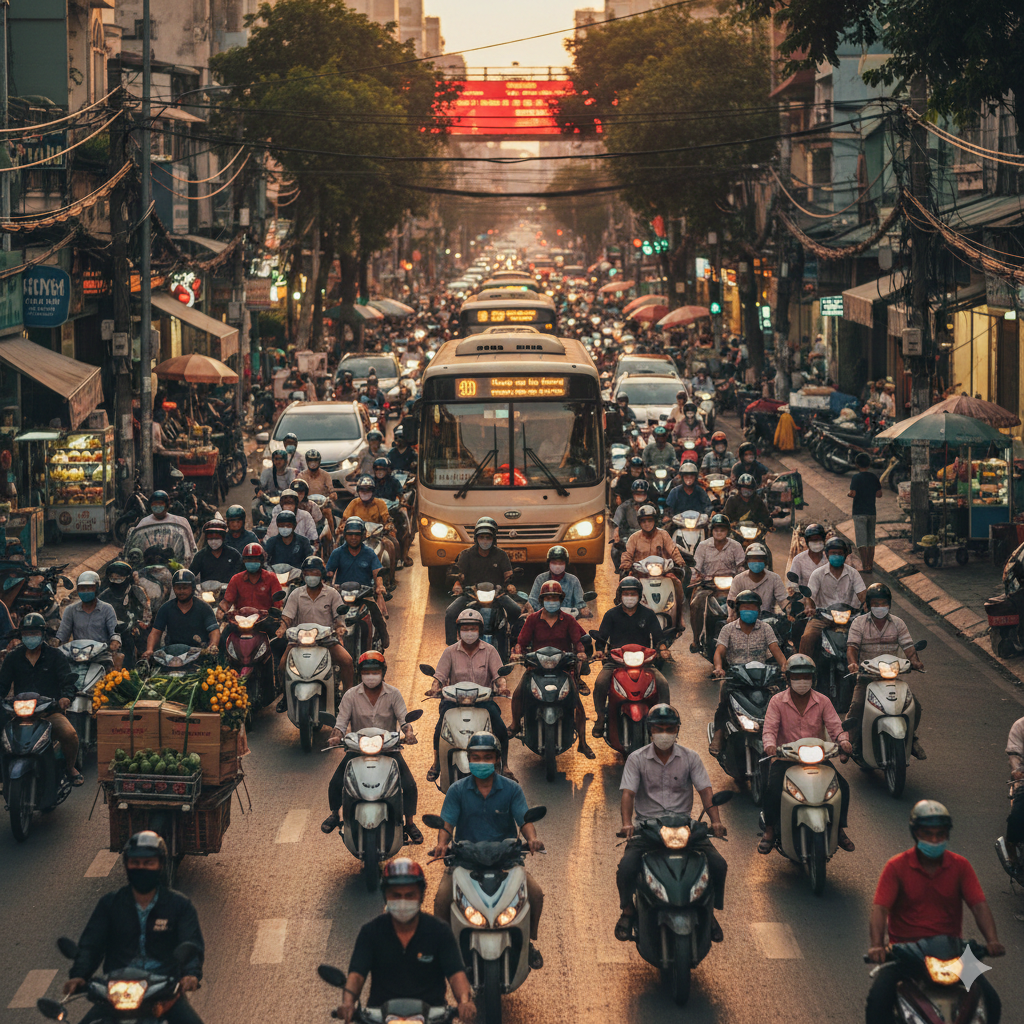
This is a repost of a LinkedIn post by Stephane Masse about traffic in Vietnam, something I am intimately familiar with, having lived here for over 20 years. While some foreigners new to Vietnam invariably ask me if I have a motorbike, the car has always been my mode of transportation. Most of my driving experience has been in Hanoi and rural northern Vietnam.
I think the analysis is superb. It should be required reading for anyone traveling to Vietnam or interested in learning more about the country. I would add that there are regional differences. Based on my 20+ years of experience, Hanoi drivers are the most aggressive in the country. They have a take-no-prisoners mentality on the road, pardon the wartime expression.
This is one reason why I welcome the now ubiquitous AI cameras that record traffic violations up to 700 meters. According to an AI overview, AI cameras can detect a wide range of traffic violations, with advanced systems capable of automatically identifying 20 to 28 different types of offenses. The specific number and types of violations recorded depend on the system’s location, technology, and local laws. Common violations detected by AI cameras include: running red lights, speeding, failing to wear a seatbelt, using a mobile phone while driving, not wearing helmets (for motorcyclists), failing to comply with road markings or lane usage regulations, stopping or parking in prohibited areas, driving against the flow of traffic, carrying more passengers than permitted Illegally modified, obscuring or covering license plates, etc. Thanks to AI cameras, driving will ultimately be more orderly and less stressful. As in China, they’ll also virtually eliminate petty corruption among traffic police.
Here’s my two cents about driving in Vietnam based on two decades of experience. It’s less “scientific” and less charitable than Stephane Masse’s analysis.
Driven to praise, driving me nuts: a US-Vietnam traffic comparison (12-22)
Lái xe ở Việt Nam (11-22) Vietnamese version of the above article. It’s interesting and not surprising that most Vietnamese recognize and support what I wrote, while there was more criticism from foreigners. The former clearly know Vietnam better than the latter. 😉
Another Day on the Mean Streets of Hanoi (1-25)
When in Vietnam, drive as the Vietnamese do (10-18)
Let me know what you think, especially Vietnamese and longtime expats who know Vietnam.
January 2, 2026
The streets of Vietnam’s major metropolises do not merely facilitate transport; they serve as a living laboratory of the nation’s sociological and economic DNA. To the uninitiated observer, the swarm of motorbikes in Hanoi or Ho Chi Minh City appears as a chaotic, lawless tangle. However, beneath the surface of this “organized chaos” lies a sophisticated system of fluidity, pragmatism, and collective intuition. This paper argues that the Vietnamese way of driving is a perfect microcosm of the country’s broader cultural and professional landscape. Just as a driver navigates a busy intersection through constant micro-adjustments and a relentless forward momentum, so too does the Vietnamese worker navigate a rapidly developing economy. By examining the parallels between the “flow” of the street and the “flow” of daily life, we can uncover the core values resilience, agility, and high-context coordination that drive one of Asia’s most dynamic nations.
Social Architecture (Hierarchy and Proximity)
The physical layout of Vietnamese traffic acts as a real-time map of the country’s social structure. Unlike the individualistic “metal boxes” of Western car culture, which emphasize isolation and personal space, the Vietnamese commute is a deeply communal experience. This density reflects two core pillars of Vietnamese society: the shrinking of personal bubbles and a deeply ingrained respect for hierarchy.
The Proximity of Community In the West, “road rage” is often triggered by an intrusion into one’s personal space. In Vietnam, personal space is a luxury that the road and the culture cannot afford. Motorbikes ride so closely that riders’ knees may touch, yet there is a profound lack of aggression. This mirrors the “high-context” nature of Vietnamese living, where multi-generational households and packed communal spaces are the norm. The comfort with physical and social proximity allows for a level of collective tolerance that is essential for a country with such high population density. On the road, as in the family, the individual is always part of a larger, moving collective.
The Unspoken Hierarchy of the Road While the traffic may seem egalitarian, it is governed by an unspoken “Law of the Large.” Trucks and buses command the center of the road, followed by cars, then motorbikes, and finally pedestrians. This is not merely a matter of physics; it is a reflection of the Confucian respect for seniority and status. In a Vietnamese office, the “big truck” (the Director or Elder) sets the course, and the “motorbikes” (the staff) are expected to navigate around them. One does not expect the truck to stop for the bike; rather, the bike finds the safest, most efficient path around the truck. This acceptance of hierarchy ensures that despite the apparent chaos, there is a clear, understood order that prevents total gridlock.
Economic Agility (Pragmatism and Resourcefulness)
If the Vietnamese road is a river, then the motorbike is its most versatile vessel. In Western contexts, a vehicle is often a static tool with a singular purpose commuting. In Vietnam, however, the motorbike is a “living” capital asset, mirroring the country’s high-speed entrepreneurial spirit. This section explores how the pragmatic “workarounds” seen on the road are direct reflections of the Chớp thời cơ (seizing the opportunity) mindset that defines the Vietnamese economy.
The “Shortcut” as Strategic Innovation On the streets of Saigon, a driver facing a blocked intersection will not hesitate to mount the sidewalk or navigate a narrow alleyway (the hẻm) to reach their destination. To a Western observer, this may look like a disregard for the law; to a Vietnamese local, it is a display of resourcefulness. This mirrors the business landscape, where formal bureaucracy can often be slow or rigid. Vietnamese entrepreneurs are masters of the “workaround” finding lateral solutions to move projects forward when the “main road” is blocked. This agility allows small and medium enterprises (SMEs) to pivot with a speed that larger, more structured global corporations often struggle to match.
The Multi-Tool Mentality The physical adaptability of the vehicle itself is perhaps the most striking comparison. It is common to see a single 125cc scooter transporting an entire family of four, or a delivery driver balancing a stack of crates three meters high. This is the “can-do” spirit in its most literal form. It reflects a culture where people are not confined by the “official” description of their tools or their job titles. A teacher might run an online shop from their phone during breaks; a security guard might manage a small real estate portfolio on the side. Just as the motorbike is modified to fit the needs of the moment, the Vietnamese worker is inherently “multi-stack,” wearing several hats to maximize economic security for their family.
Micro-Negotiations and Fluid Momentum Economic transactions in Vietnam, much like driving, often rely on constant, real-time negotiation rather than fixed, long-term contracts. On the road, drivers negotiate space through eye contact, subtle leans, and the rhythmic use of the horn. In commerce, this translates to a preference for “high-context” business where relationships (Quan hệ) and immediate verbal agreements are often more vital than the fine print of a document. This allows the economy to move at a breakneck pace because it doesn’t wait for the “green light” of perfect conditions; it moves when the immediate gap opens up.
Ultimately, the driving style in Vietnam is not an absence of logic, but the presence of a different logic: Pragmatic Efficiency. Success on the road, and in the market, is reserved for those who can see the opening first and have the courage to flow into it without hesitation.
Psychological Resilience (Persistence and the “Now”)
To drive in Vietnam is to engage in a constant exercise of mindfulness and resilience. The psychological state required to navigate a busy intersection in Hanoi is remarkably similar to the state of mind that has allowed the Vietnamese people to survive and thrive through centuries of external and internal challenges.
Constant Forward Motion The most important rule for a pedestrian or a rider in Vietnam is to never stop unexpectedly. Safety is found in predictable, steady movement. If a driver hesitates or stops mid-stream, the entire system behind them falters. This “Steady Forward” mindset is the pulse of the Vietnamese economy. Having transitioned from a war-torn nation to a global manufacturing powerhouse in just a few decades, there is a cultural consensus that “stopping is failing.” This manifests as a relentless work ethic and a focus on incremental progress. Even when the “traffic” of global markets becomes difficult, the Vietnamese approach is to keep the wheels turning, trusting that the flow will eventually carry them through.
The Resilience of the “Bumper-Tap” Minor collisions are a daily occurrence on Vietnamese roads. In many other cultures, a minor scrape results in an immediate halt, an exchange of insurance, and perhaps a heated argument. In Vietnam, a common response is a quick nod of acknowledgement and an immediate return to the flow. There is an inherent understanding that time is the most valuable resource and that dwelling on minor setbacks is counterproductive. This psychological resilience the ability to “get back up” and continue after a minor hit is a hallmark of the Vietnamese character. Whether facing a business failure or a personal hurdle, the cultural default is not to litigate the past, but to focus on the immediate two meters of road ahead.
The Wisdom of the Flow
In conclusion, what appears to the casual observer to be a dangerous lack of structure is, in fact, a highly evolved system of adaptive coordination. The Vietnamese way of driving is a physical manifestation of a culture that values flexibility over rigidity and collective momentum over individual ego. By observing the streets, we see a nation that does not wait for the perfect conditions to move but instead creates its own path through the gaps. As Vietnam continues its rapid ascent on the global stage, its ability to navigate “organized chaos” will remain its greatest competitive advantage showing the world that sometimes, the most efficient way to move forward is not to follow a straight line, but to join the flow.
Observations
1. “Fluidity over Formality” (The Water Metaphor)
- Driving: Traffic in Vietnam moves like a river. If there is a gap, a motorbike will fill it. Drivers don’t wait for “their turn” in a lane; they flow toward the open space.
- Life/Work: This reflects a “water-like” adaptability in business. Vietnamese entrepreneurs are famous for their ability to pivot. If a business model isn’t working or a new opportunity appears, they “flow” into that new space immediately rather than sticking to a rigid, pre-set 5-year plan.
2. The Unspoken Hierarchy
- Driving: There is a clear, unwritten hierarchy: Trucks > Buses > Cars > Motorbikes > Pedestrians. The bigger vehicle rarely stops for the smaller one; it is the smaller one’s job to get out of the way.
- Life/Work: This mirrors the deep-rooted Confucian respect for hierarchy and seniority in the workplace. Decisions usually flow from the top down, and junior employees (like motorbikes) are expected to navigate around the needs and directions of their superiors (the “big trucks”).
3. “Organized Chaos” and Collective Coordination
- Driving: To an outsider, it looks like a mess. To a local, it’s a dance. Everyone is constantly making micro-adjustments based on the person next to them.
- Life/Work: In Vietnamese companies, work often happens through “informal coordination.” While there may be a lack of formal SOPs (Standard Operating Procedures) compared to the West, teams have a high level of intuitive synchronization, knowing how to “vibe” with colleagues to get the job done under pressure.
4. High Proximity and Low Personal Space
- Driving: Motorbikes ride inches away from each other, often touching elbows at stoplights without any sense of “road rage” or intrusion.
- Life/Work: Vietnam is a “high proximity” culture. People live in multi-generational homes and work in bustling, open offices. The concept of a “personal bubble” is much smaller than in Western cultures; people are comfortable being physically and socially close to one another.
5. Pragmatic Problem Solving (The Shortcut Mentality)
- Driving: If going the “wrong way” for 50 meters saves a 2-kilometer U-turn, a driver will take the sidewalk or the wrong side of the road.
- Life/Work: This “Chớp thời cơ” (seizing the moment) mentality is a hallmark of Vietnamese business. It’s about efficiency and results.7 If a “workaround” exists that bypasses bureaucracy to reach the goal faster, it is often viewed as clever and resourceful rather than “breaking the rules.”
6. The “Constant Forward Motion” Principle
- Driving: The golden rule of crossing the street in Vietnam is: Keep moving at a steady pace. If you stop or hesitate, the flow breaks and accidents happen.
- Life/Work: This reflects the country’s “Đổi Mới” (Innovation/Renovation) spirit. Since the 1980s, the country has been in a state of relentless forward motion. There is a cultural sense that if you stop moving, improving, or earning, you will be “hit” by the competition or left behind by the fast-paced economy.
7. Communication through “Nudges” (The Horn)
- Driving: The horn in Vietnam isn’t an “I’m angry” signal; it’s a “Hello, I am here” signal. It’s a constant, low-level notification to others.
- Life/Work: Vietnamese communication is often indirect but frequent. In the workplace, people use many non-verbal cues, “nudges,” and “reminders” to keep projects moving, rather than one big, confrontational meeting.
8. Resilience and “Getting Back Up”
- Driving: Minor bumps or “fender benders” between motorbikes are usually resolved with a quick nod and both parties are driving away. There’s no time for a 20-minute argument; life is too fast.
- Life/Work: This mirrors the incredible resilience of the people. Having faced decades of war and hardship, the Vietnamese spirit is one of “falling down and getting right back up.” They don’t dwell on minor setbacks; they fix the problem and keep going.
9. Entrepreneurial Agility (The Motorbike as an Office)
- Driving: A single motorbike can be a family van, a delivery truck carrying 200 eggs, or a mobile florist shop.
- Life/Work: This represents the “can-do” entrepreneurial spirit. Most Vietnamese have a “side hustle” or a family business. Just as the motorbike is a multi-tool for survival, the Vietnamese worker is often a “multi-tool” individual, wearing many hats to support their family.
10. Living in the “Now” (Immediate Horizon)
- Driving: Drivers focus almost exclusively on the 2-3 meters immediately in front of them. They don’t worry about what’s happening 100 meters ahead because that situation will have changed by the time they get there.
- Life/Work: This reflects a focus on short-term agility. Because the Vietnamese economy is developing so rapidly, the “far future” is unpredictable. Success is found by being the best at navigating the immediate environment and reacting to the present moment.
 An International Educator in Vietnam