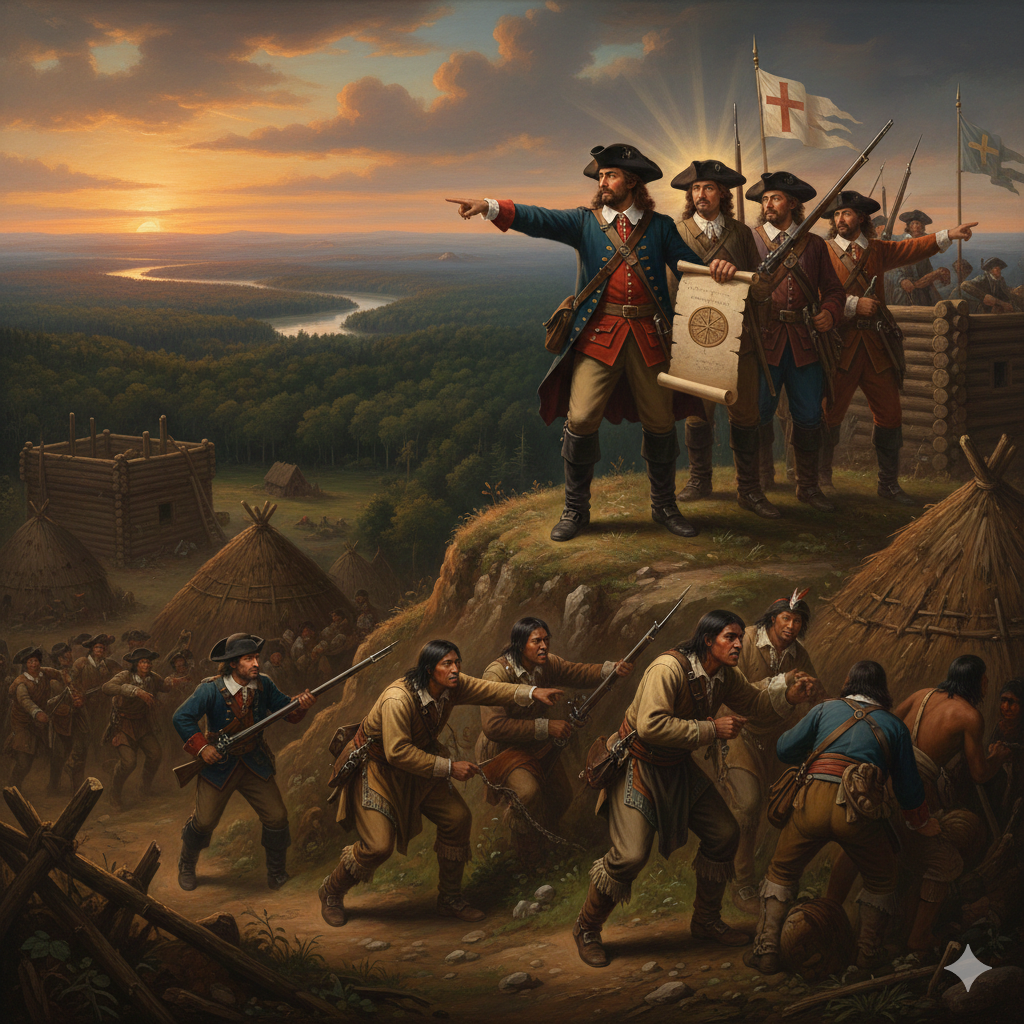
Every empire, however, tells itself and the world that it is unlike all other empires, that its mission is not to plunder and control but to educate and liberate.
–Edward W. Said
I come from a long line of settler-colonizer ancestors who have much in common with the Zionists in Israel and their brutality, sense of impunity, view of themselves as “God’s chosen people,” and the ongoing regional land grab known as the Greater Israel project, in which the means always justify the ends.
In British Colonial America, it wasn’t a biblical mandate that underpins the ultranationalist Zionist concept that is the Greater Israel project, AKA regional land grab, but the foundation was religious. The Doctrine of Discovery derives from a series of Papal Bulls in the 15th century that were used as legal and moral justification for colonial dispossession of sovereign Indigenous land.

Specifically, the Papal Bull of 1493 stated that any land not inhabited by Christians was available to be “discovered,” claimed, and exploited by Christian rulers and declared that “the Catholic faith and the Christian religion be exalted and be everywhere increased and spread, that the health of souls be cared for and that barbarous nations be overthrown and brought to the faith itself.”
I know that many of my ancestors killed, enslaved, and displaced Native Americans and owned African slaves, but this is the first documented example I’ve found of a New England ancestor owning another human being. Below is the will of Constant Southworth‘s (1614-1679), a paternal 10th great-grandfather. His parents were members of the Puritan separatist community living in Leiden, Holland, with the “Pilgrims” who sailed on the Mayflower in 1620 to their New World in what became Plymouth. (I’m a direct descendant of six “Pilgrims” and a collateral descendant, e.g., cousin or nephew, of 12 others, ample evidence of my settler colonial bona fides. Here’s a related article published four years ago: From New England to Vietnam: Settler Colonialism in Cross-Cultural Perspective.)
Constant Southworth died at Duxbury 11 March 1678/79. In his 27 Feb 1678/79 will, he names his wife Elizabeth; sons Edward, Nathaniel and William; daughters Mercy Freeman, Alice Church, Mary Alden, Elizabeth Southworth (who was to receive a bequest as long as she didn’t marry William Fobes), Priscilla Southworth; grandson Constant Freeman; cousin Elizabeth Howland; brother Thomas. In the 15 March 1678/79 inventory, his estate was valued at 360 pounds and disturbingly included an Indian boy worth 10 pounds. It also lists real estate, without valuation including about 25 acres in Duxbury where his house, barn and grist mill were located, parcel of land at North Field, several parcels of meadow, totaling about 12 acres, in Duxbury and Marshfield, one share of land called “Freeman’s Land” near Taunton, land and meadow at Paomett in Eastham. (My bold)
I think about that boy and what became of him. According to the Bank of England’s inflation calculator, his monetary value in November 2025 would have been 1,795.08 pounds, or $2,427.29 USD. In 1679, he comprised 2.77% of Constant Southworth’s estate.
I’m a direct descendant of Southworth’s daughter Mary (1654-1719) and her husband David Alden (1642-1719), a son of John Alden, a Mayflower passenger and paternal 10th great-grandfather. Mary’s sister, Alice (1648-1718) married Benjamin Church (1639-1717), whose grandfather is Richard Warren (1583-1628), a paternal 11th great-grandfather. Church is “best known for his role in innovative military tactics, notably developing unconventional warfare.” He was involved in the Great Swamp Fight in 1675, during which “forces of the colonies of Massachusetts, Plymouth, and Connecticut killed an estimated 300 Narragansett warriors and an unknown number of women and children of the Narragansett Tribe. The surviving Narragansetts fled and remained in hiding for the remainder of the war.”
Related to the Great Swamp Fight of 1675, Joshua Tefft (1646-1676), who was married to a Native American woman and accused of having fought on the side of the Narragansett, has the distinction and misfortune of being the only colonist who was hanged, drawn, and quartered. He’s also a paternal 6th cousin 10 times removed. We’re both direct descendants of English aristocrats. Joshua Tefft is an ancestor I admire for the position he took and for which he ultimately gave his life.
One of my most infamous ancestors in colonial America is Robert “King” Carter (1664-1732), a distant paternal cousin. (His first wife, Judith Armistead, is a paternal 6th cousin nine times removed, and his second wife, Elizabeth Landon, is a paternal 6th cousin seven times removed.) When Carter died, he left his family 300,000 acres (1,200 km2) of land, 3,000 slaves, counted as personal property, and £10,000 in cash, worth $2,883,431 in October 2025, making him the wealthiest man in the colony of Virginia. In case you’re counting, his real estate holdings comprise 1.08% of the current state of Virginia.
This is why I often remark that my family history parallels the good, the bad, and the ugly of colonial and US history – with a disproportionate share of the latter two.
Postscript: I drafted this post before the US bombing and invasion of Venezuela, and the kidnapping of its president. Edward Said’s quote is spot-on. The spirit of settler colonialism and neoimperialism is alive and well in the US, Israel, and elsewhere, supported by more military power than ever in the spirit of might makes right.
 An International Educator in Vietnam
Majorities of Americans say it’s important to talk about the country’s historical successes and failures (26.1.26) https://www.pewresearch.org/short-reads/2026/01/26/majorities-of-americans-say-its-important-to-talk-about-the-countrys-historical-successes-and-failures