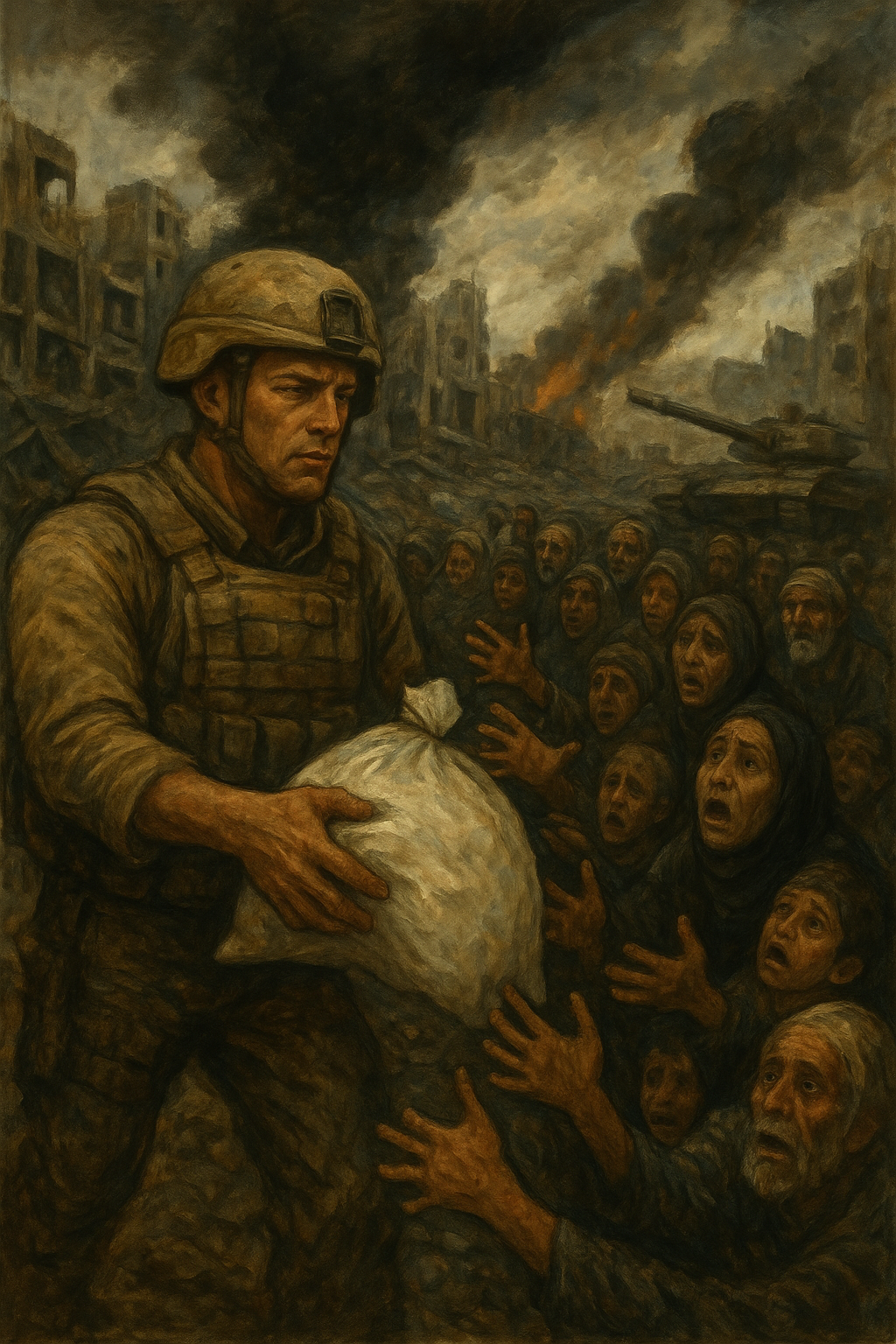
This is a 1 October 2025 Al Jazeera interview with former U.S. soldier Anthony Aguilar, who spent several months in Gaza during the genocide. He thought he was going to help deliver aid to Palestinians being starved by Israel, but as he tells Dena Takruri, what he saw was a scheme to force Palestinians out of their land. Below is a transcript I created with TurboScribe. I lightly edited it and added some links.
Thank God for people like Anthony Aguilar, who are not afraid to speak the truth about the war crimes and crimes against humanity that Israel is committing in Gaza with US support.
The simple response to Anthony Aguilar’s assertion that “I didn’t think anybody could be that evil” is that there is a mountain of evidence, text, public quotes, images, and videos, that both Israel and the US are that evil.
If you have the means, I urge you to donate to the Gaza Soup Kitchen and the UNRWA USA, which are doing heroic and lifesaving work in Gaza.
Postscript: Here’s a 22.8.25 post about the murder of a child that Anthony Aguilar witnessed after the boy thanked him for giving him some food: Amir’s Final Walk. It includes two versions of a song I created to honor the memory of Amir, a Palestinian boy who walked 12 km (7.5 miles) to collect food at a “Gaza Humanitarian Foundation” aid distribution point, only to be gunned down by the IOF.
Never in my life did I think that an army could be so evil as to use food to lure a starving population through a battlefield, killing women and children and elderly and just human beings on purpose. You might recognize Anthony Aguilar, the retired U.S. Special Forces officer who blew the whistle on the Gaza Humanitarian Foundation or GHF. Retired U.S. Special Forces officer Anthony Aguilar.
Anthony Aguilar. A retired lieutenant colonel.
A security contractor for the U.S. and Israel-backed firm, the so-called Gaza Humanitarian Foundation. I wanted to hear more about how he went from believing he was going to Gaza to help feed Palestinians to realizing the United States was complicit in Israel’s genocide, particularly as a 25-year veteran of the U.S. Army. I didn’t fill out an application.
I didn’t apply online. They called me because they were specifically looking for recently retired or recently out of the service special forces, special operations background individuals. And they explained to me that they had been selected to provide the subcontract for security in Gaza to deliver and then secure distribution of aids.
The interview was three questions. Do you have a valid passport? Is it valid for 90 days? And can you leave in three days? Those were the questions. Never verified or validated who I was, what experiences I had, what I’d done or not done, who I was, my background, nothing.
They just said, come on. So what did you understand to be the mandate of your mission? What exactly were you going to be doing on the ground there? What we were told in kind of a general overview briefing before we got on the plane out of Dallas is that the United States stepped forward to take over the United Nations mission because Israel would no longer allow the United Nations in, and that Israel will allow the United States to work with them to do it. And that we were going in to take over that mission to deliver food.
I envisioned that we would be going in, occupying and securing or securing at least 400 distribution sites and securing, you know, 500 to 550 trucks a day going in because that’s what the U.N. did. That was my my mindset going in that that’s what we were stepping into. And I believed that until the very first day I got there.
And I realized that was not the case. Describe to me what you first saw and felt when you arrived to the Gaza Strip. What I witnessed in that first look as we came in was the most devastating, destructive, beyond war annihilation, apocalyptic thing I’d ever seen in my life.
Something that I would couldn’t even imagine in a nightmare. Rubble, dogs eating remains of bodies, smoke in the horizon from bombs being dropped, not a building left in sight and everything leveled. It was a landscape of destruction and horror to which I’ve never witnessed before.
And honestly, it made me feel sick. I felt like this this this sickness that this pit of my stomach like this isn’t right. Like this is I feel bad even being a being a witness to this.
The Israeli defense forces that were leading us and they gave us this briefing. They pulled out a giant map that showed operations that were going on. First of all, I didn’t see 400 distribution sites.
I saw four. All of them, all of them were in the the the south away from the areas that people needed the food. And no one north of the Netzerim corridor from Gaza could reach these sites.
That started to paint a picture to me that this is this is either horribly planned or there’s something else going on here. Then when I looked at the sites and I saw the operational graphics on their map, this is an Israeli map that showed that offensive combat operations going on around these sites. These sites were were behind the forward line of contact, the front line, if you will, which means the civilians have to cross have to travel through the fighting to get there.
It’s a violation of the Geneva Convention. Why do you think it was designed that way? In the moment, I didn’t think it was designed that way. It became clear to me that it was designed that way when we got to site one and I walked up to the berm to stand up on top of the berm to look.
And there’s there’s Merkava battle tanks driving through and firing at positions. There’s battle going on. There’s mortar rounds, there’s artillery rounds, there’s people, thousands of Palestinians lined up along the coastal corridor, the coastal road, because either they have nowhere else to go.
They live on the beach. They live there in shanty tarp shacks because there’s nowhere else to live because their homes have been destroyed. And there’s this battle going on.
And I look at my map and I look at that and I go back and I talk to the IDF and to the guy in charge of the the GHF guy in charge. And I said, you know, we can’t distribute aid from these sites. We’re going to get a lot of people killed and it violates Geneva Conventions.
We cannot do this. That was wholly ignored in terms of we’re going to do it anyway. We’re doing it doesn’t matter.
We’re fighting Hamas. Geneva Convention doesn’t apply, which is absolutely wrong. Absolutely wrong.
Couldn’t be further from the truth. But then when I saw all the sites, how all the sites were designed this way, it became very clear to me then from seeing the way the sites were designed and how they functioned that this is forced displacement. The Israeli government, through the Israeli defense forces in Gaza, are using food to bait Palestinians to forcefully displace them to the in mass.
And I don’t mean just a couple of hundred. I mean everybody, the entire population. You have to make a decision as a Palestinian.
Do I starve to death or do I go get food? Did it strike you as wrong that the same people that were deliberately starving Palestinians, the Israelis, are now tasked with feeding them? Morally, ethically, legally, humanitarianly, wrong, wrong, wrong. Yes, it was shockingly wrong to me, which is why in the beginning I thought that do these people just not know what they’re doing? Or this can’t be intentional. But what came to my realization and it came to me very hard is that this is intentional.
Why did you initially think it’s not intentional? Because I didn’t think anybody could be that evil. So in your interactions with personnel from the IDF, how did they describe what they were doing? Or how did they talk about the Palestinians that they were purportedly feeding? The Israelis did not want to feed the Palestinians. They, from the very bottom level, soldiers, IDF soldiers in Gaza that I talked to that are, you know, in Gaza, in the war, they asked me flat out one day, clearly, why are you feeding our enemy? And I was like, well, we’re feeding the civilians.
No, they’re all our enemy. You are feeding our enemy. It was like women, children, old men and women.
Yeah, they’re all the enemy. Every Palestinian is our enemy. OK, so that’s how they saw it.
But they also referred to them as animals. They called them zombies. They referred to the groups of the Palestinians where they’d come to the sites as the zombie horde, dehumanizing them, not providing them water, shooting at them to get them to move a certain way like they’re like they’re animals in a cage.
It’s horrible. And was this perspective of dehumanization also evident in the GHF, like members that you were working with as well, your colleagues? Absolutely. Now, not all.
I’m not going to say this is in the sense of of every single person, but in many of them, yes. And and here’s why I believe that to be the case, is that the American contractor in charge of all of the security, the American contractor who’s in charge of the entire security plan for armed Americans being in Gaza is the national president of the Infidels Motorcycle Club, a U.S.-based veterans motorcycle club. Their charter of their organization is to fight jihad and the elimination of all Muslims from the earth.
This is the guy in charge of the armed security for delivering food into Gaza to a predominantly Arab Muslim population. The majority of the contractors, my fellow contractors that were hired, were recruited and hired through the Infidels Motorcycle Club. They’re very large.
So they recruited hundreds to come and work on this contract. Other than these sort of like ideological motivations for going to Gaza, were contractors with GHF well compensated? Were you all compensated? Well, this type of work is very lucrative. So for all of us and what we were getting paid, $1,320 a day.
A day. So if you’re there making that much money and that was just the the the run of the mill person, if you’re in a leadership position, site leader, mobile leader, you’re making $1,600 a day. So that’s a lot of money to where you can just look the other way, say this isn’t my problem.
No one’s going to know. And to be brutally honest, they’re right. These guys are going to go there and they’re going to get rich and they’re going to come home with three hundred thousand dollars after four months of three months or four and a half, five months of work.
Can you imagine only having to work five months out of the year and being rich doing it? It’s a lot of money. It’s a lot of money, not to mention the people under the contract, the people that run the contract, they’re making millions, millions. This future Gaza Riviera resort plan is going to make people billions.
This is about money, which is really the sickening, sickening part of this. This isn’t about Hamas. This isn’t about religion.
This isn’t about who owns the land. This is about money. And it’s disgusting.
I did want to ask you, what is your reaction to the leaked Trump Gaza Riviera plan, which calls for the reconstruction of Gaza as an investment and manufacturing hub? And Boston Consulting Group, which also worked on the plan for deploying GHF, is involved. Do you think GHF should be involved in this plan to turn Gaza into a U.S. territory? So in the main control center where the where the operations are on the wall in that main control center, a large poster, 24 by 30 or 36 by 24, like a poster you would have on your wall in your bedroom, is that Boston Consulting Group rendering of the future industrial complex resort. That rendering is on the wall in the control center at Kareem Shalom for the GHF.
The GHF are a part of it. The GHF is not a humanitarian organization. The GHF doesn’t have the ability to do any humanitarian admission and they don’t care.
They are there to stake claim. They are there to stake property. First come, first serve.
Remember, we’re not providing the Palestinians with meals. We’re not providing them with readily perishable, nonperishable foods. We’re not providing them with propane or fuel or baby formula or medicine or sanitary products or any of those things.
All we’re providing them with is dried parcel goods, rice, beans, lentils, pasta, dried, all dried. What about water and no water and no water? And that was something I was like, why are we not providing them water at all? And it’s like the people come to the sites and they’re begging for water. They’re begging for water.
We’re not giving them water. Why aren’t we giving them water? It’s not in the contract. We’re not contractually obligated to give them water.
Well, who owns the contract? The Israeli government. At what point did you decide that you could no longer have any part to do with it? On the 8th of June, I was in the control center outside of Kareem Shalom and we were distributing at site number two. And I’m in the control room watching it on this screen.
The crowd was very, very packed in there, very packed. And people were being crushed up against the, there was these kind of these concrete walls inside of the sites that were lined with barbed wire, this razor wire. And people were getting crushed up against it.
So this, there was a Palestinian man in the crowd who lifted these children up because these children were getting tramping and crushed. They were small. So we picked up these children and put them on top of this barrier wall so that they weren’t getting crushed.
And the Israeli Defense Force liaison officer, a senior ranking officer in the Israeli Defense Force who is in our operations center, looks at the screen and he says, get them off of there right now. And so I’m looking at the same thing he’s looking at. And I’m like, well, the security on the ground, they’re addressing it.
They’re dealing with it. But I mean, these are their children. Like, calm down.
These are children. Get them off of there. That’s not secure.
Get them off. I was like, they’re children. They have no shoes on.
They don’t have any weapons. There’s nothing in their hands at all. One of the children doesn’t even have a shirt.
They’re taking care of it. Calm down. He walks back to his desk, gets on the radio with the IDF, his forces.
And then he comes back over to where I’m standing. There was an American in our operations center that understood and could speak Hebrew a little bit, but understood it enough. And he says to me, he just said on the radio to for his snipers to shoot them down.
So when this officer came back up all upset, you know, he’s, you know, sitting like this. And I was like, did you just order your snipers at site number two to shoot these kids? He said, well, if you’re not going to take care of it, I will. I was like, we’re not shooting children.
As we’re having this dialogue, the children had run off to the edge of this wall and they jumped down so they could run away. They were scared. They didn’t want to be there.
Thank God we didn’t have to see what would have come. But in that moment, the the safe reach solutions contract lead, the boss, if you will, who was in the operations center, he called me over and he said, Tony, never say no to the client. And I said, what do you what do you mean to don’t say no to the client? He said, the the IDF are our client.
We work for them. They’re in charge. And I was like, even when they say to kill children.
He said, if they’re going to, you know, what decisions they make and how they want to fight this war, whether you know who they decide to kill or not is not our decision. This is a contract. This is business.
Don’t say no to our client. And did you step down at that point? I told him at that point, I said, I’m I’m I’m I’m done. How many people do you understand to have been killed at these GHF sites up until now? From the beginning of operations, 26 May until today, thousands, thousands, not only the hundreds and hundreds into the magnitude of thousands that have been reported by the U.N. and Medicines Sans Frontieres and others at the Nassar Hospital and the Conunis Hospital and hospitals directly near these sites about receiving MCI or mass casualty incidents on the days that correlate to the same times and dates of distribution.
There are hundreds of bodies buried outside of these sites that have just been buried in the rubble, bulldozed and buried in the ground. So what do you want Americans to know as one of the few Americans who has been to Gaza during this genocide? The United States is hand in glove with the Israeli government in committing a genocide. What is happening in Gaza is not a misfortune of war.
It is designed – the displacement, the removal, the destruction, the ethnic cleansing, the genocide. It is by design. Wake up, America.
If we stand by and we allow it to happen there, it’s going to happen here. And when it does, don’t say you couldn’t you didn’t see it coming.
Recommended Reading
Security contractor says he witnessed ‘barbaric’ and un-American tactics at Gaza aid sites (1.8.25)
Ex-US contractor says he saw IDF commit war crimes at aid sites; GHF rejects ‘false claims’ (26.7.25)
 An International Educator in Vietnam
Anthony Aguilar should learn more about US and world history. Israel has mastered the art and science of evil is exporting it to other countries that want control their populations and destroy their enemies. Israel learned from the best – England, the US, Nazi Germany, etc., ad nauseam.