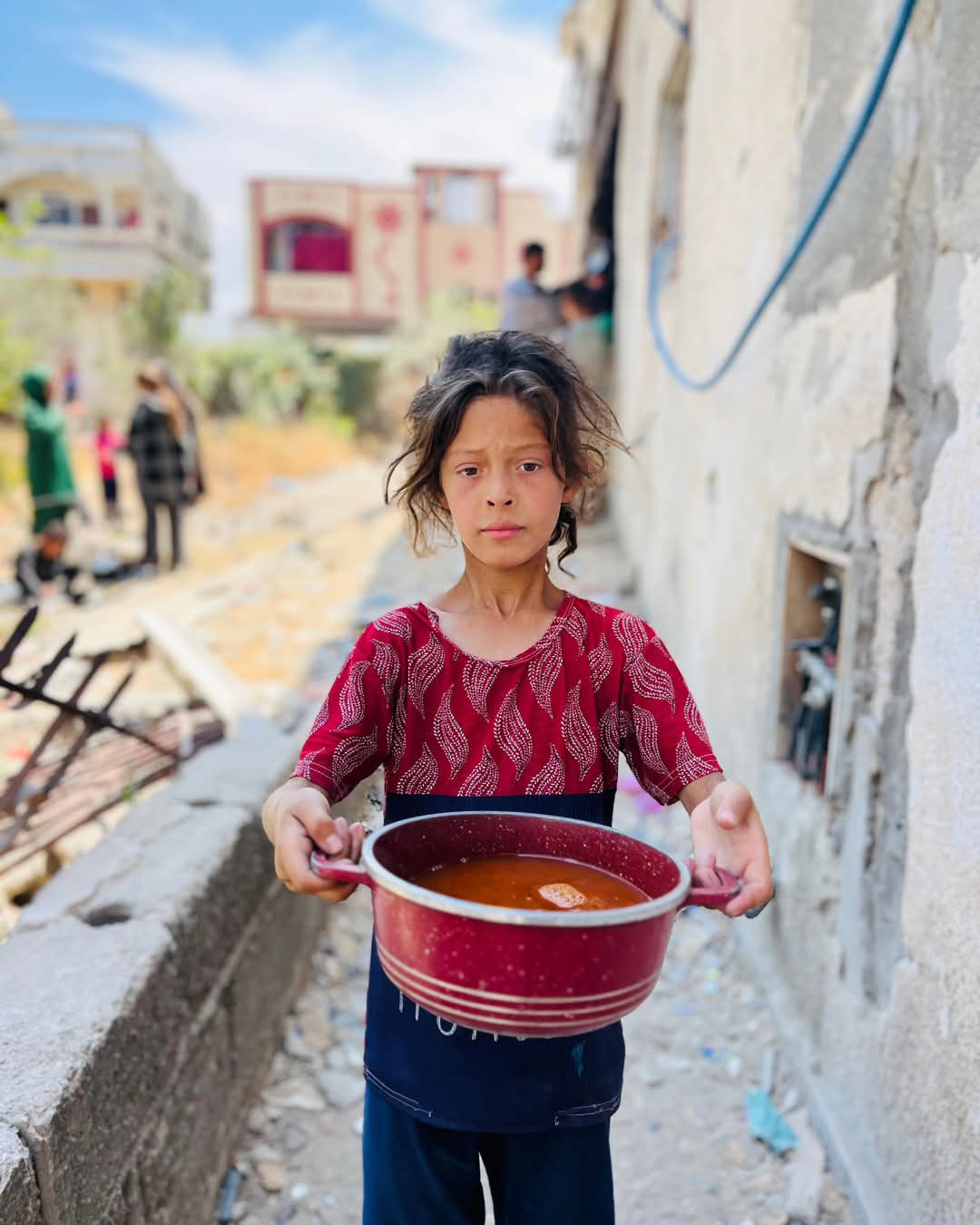
This is Gaza.
A child arrives, silently asking for food. Her neck and shoulders reveal the unmistakable signs of severe malnutrition — prominent bones, depleted fat and muscle.
She holds a pot of stew like it’s life itself.
And in many ways, it is.
Let the food in, world.
If you feel powerless, make sure the politicians in your country never stop hearing about Gaza.
Tell them. Remind them. Shame them.
Source: Hani Almadhoun (Hani is the senior director of philanthropy at UNRWA USA, a nonprofit whose slogan is Showing Palestine refugees that Americans care. I urge you to support the good work he and his colleagues are doing in Gaza by donating to the UNRWA.)
Photo by @aboodmadhoun1
This is Gaza Revisited

“This is a photo of a young girl in Gaza holding a mobile phone displaying a picture of herself two years ago. The child’s name is Rahaf Ayad. This photo is credited to the Palestinian photographer/ journalist @khames.alrefi (Instagram) who works with Reuters, Aljazeera, NBC News, and others. Another Palestinian journalist, Hani Aburezeq, also has a story about her. And she appears via other sources.
The child Rahaf Ayad: A body wasting away under siege and starvation (4.5.25)
“My name is Rahaf… I’m 12 years old. I used to love wearing pretty dresses and playing with my friends. We used to laugh, draw, and dream. But the war took everything from me… even food. I’m always hungry, my stomach hurts, and I get tired from the smallest movement. I just want to go back to how I used to be… to eat, laugh, run, and go to school. I want to live like other children.”
With these simple words, Rahaf Ayad from Gaza sums up the pain of Palestinian childhood under siege. Two photos of Rahaf are circulating on social media: in the first, a lively girl wearing a flowery dress and smiles innocently; in the second, a frail body with eyes drowning in sorrow and malnutrition. The difference between the two pictures isn’t time — it’s war.
Today, Rahaf suffers from severe malnutrition due to the suffocating blockade and the lack of food and medicine — a condition affecting more than a million children in the Gaza Strip, according to relief organizations.
These children have been deprived of life’s basic necessities — their rights to safe food, healthcare, and education.
Rahaf’s mother, holding back tears, says: “My daughter was always laughing. She loved to dance in front of the mirror and sing. Now she just lies down. She doesn’t even have the energy to speak. I pray to Allah she can go back to how she was.”
The ongoing war and blockade over the past years have devastated Gaza’s infrastructure, collapsed its healthcare system, and driven poverty rates above 80%. Hospitals are nearly out of medicine, food supplies are running out, and thousands of children suffer from moderate to severe malnutrition with no effective intervention.
Rahaf is not just one case; she is a symbol of a childhood being silently assassinated every day. Doctors in Gaza have warned that her health could deteriorate rapidly without urgent treatment, yet they also admit they lack the resources to help because of the blockade and dwindling aid.
In the face of this tragic reality, the question arises: how long will children remain victims of a conflict they had no part in creating?
Rahaf, like thousands of other children, is not asking for the impossible. She simply wants to eat, play, and return to school.
Her message to the world needs no translation: “Help me live … it’s not my time to die.”
The story of Rahaf Ayad should sound the alarm and awaken consciences. Voices must rise, and wills must act to end the blockade and save what’s left of childhood in Gaza.
 An International Educator in Vietnam